Custom supply chain software in 2026 is a multi-year platform decision, not a one-shot build. The work spans lead-to-invoice scope (CRM, quoting, payments, documents, BI), typically integrates four to ten external systems, and pays off when your operating model is too specific for off-the-shelf platforms to handle without expensive workaround.
This guide walks through what a real custom supply-chain build looks like in 2026 using three production systems our team has shipped: the Cloud Van Lines SaaS that anchors most of this article, the MiniMoves orders platform that shows a tighter scope done well, and Bitergo’s Warehouse Star, a modular suite that scales from start-ups to 4PL operators. By the end, you should be able to size your own build, name the integrations that will trip you up, and decide where custom belongs in your stack.
Table of contents
- The state of custom supply chain software in 2026
- What lead-to-invoice really means: inside the Cloud Van Lines build
- When a focused custom build beats a platform: MiniMoves
- Modular SaaS that scales from start-up to 4PL: Bitergo’s Warehouse Star
- The build-vs-buy decision in 2026
- Architecture choices that hold up in production
- What a custom supply-chain build costs in 2026
- Frequently asked questions
- Where to take this next
The state of custom supply chain software in 2026
Supply chain software spend keeps climbing. Gartner forecasts the market will grow at a 16.3% compound annual rate, from $29 billion in 2023 to $62 billion in 2028. The agentic-AI slice of that market, which barely existed in 2025 at under $2 billion, is projected to reach $53 billion by 2030, with 60% of enterprises running AI agents inside their SCM stack by then (Gartner, April 2026).
That growth tells half the story. The other half is that money invested keeps failing to land. PwC’s 2025 Digital Trends in Operations Survey of 610 operations leaders found 92% cited at least one reason their technology investments hadn’t fully delivered, and 83% cited two or more. Integration complexity led the list at 47%, followed by data quality issues at 44% (PwC, 2025).
So the operational picture is paradoxical: enterprises are spending more on supply chain software than ever, AI is moving from pilot to production, and most leaders still feel undersourced on the actual integration and data work that decides whether a system performs. McKinsey’s research backs this up. Only about a quarter of supply-chain professionals believe their company has finished its digital transformation, even as early adopters of AI-enabled SCM report 15% reductions in logistics costs, 35% reductions in inventory levels, and 65% improvements in service quality (McKinsey, 2025).
For most operators, the question in 2026 isn’t whether to invest in supply chain technology. It’s whether to keep accreting features onto a generic platform or commission a custom build that fits the operating model. The rest of this guide is about how that second path actually plays out.
What lead-to-invoice really means: inside the Cloud Van Lines build
The phrase “lead-to-invoice SaaS” gets used loosely. Our Cloud Van Lines build is the clearest reference point we have for what the full scope looks like in practice.
Cloud Van Lines licenses a SaaS platform to brokers and van lines in the U.S. moving industry. The system covers everything from the first inbound web form to a paid invoice, plus the affiliate accounting and BI reporting that sit around it. We built it on a Java, PHP, and .NET back-end with React on the front-end and Azure underneath. The technology stack is not the headline. The headline is the scope: one system that replaces what most moving brokers run on five or six disconnected tools.
Lead capture and the integrated CRM
The platform captures leads from web forms and inbound calls, scores them, routes them to the right rep, and stores every interaction against the customer record. The CRM was built into the same data model as the job-order system, so conversation history, signed documents, collected payments, and truck assignments all live behind one customer ID. That is the unglamorous part of custom that off-the-shelf can fake but rarely deliver: one record, four roles (customer, mover, affiliate, company staff), and no double-entry.
Job orders, quoting, and e-signed documents
Sitting alongside the CRM is a job-order engine. When a lead converts, the system spins up an order, attaches an inventory sheet, generates a quote against the broker’s pricing rules, builds the right service agreement for the move type (local, long-distance, packing, storage), and routes the agreement for signature. The signature flow uses a customized e-signature implementation built directly into the document module, not a third-party widget bolted on top. Brokers can edit their pricing rules without touching code, and quotes regenerate automatically when inputs change.
Payments through four gateways and Twilio call-center integration
Once an agreement is signed, the system bills. The reason most off-the-shelf platforms struggle here is that moving brokers don’t standardize on one payment processor. They use whichever combination of Authorize.Net, PayPal, USAePay, and BluePay best serves their customer mix and merchant agreements. The Cloud Van Lines platform integrates all four behind a single billing interface, so an agent doesn’t need to know which gateway is processing a transaction. Payment events feed back into the order record automatically.
The call-center integration uses Twilio for inbound and outbound voice, with quote follow-up workflows triggered by call outcomes. An agent can pick up a missed quote, pull the call context, see the previous interaction trail, and send a follow-up document, all without switching tools.
Affiliate management, automated emails, and BI reporting
The affiliate module handles partner accounting: which mover referred which job, what commission applies, when it pays, and how disputes are tracked. Automated email sequences run off the same workflow engine that drives quotes and call follow-ups, so a marketing campaign and an operational reminder don’t end up in conflicting systems. The BI layer rolls everything up: leads per source, conversion by rep, revenue per affiliate, gateway-level chargeback rates.
Although they continue to make changes, the system meets all initial project requirements and feedback from outside experts has been very positive. While unicrew’s leadership stands out as very ethical and skilled, their team manages expectations well through consistent communication.
Jeff Chizmas, CEO, Cloud Van Lines LLC (Clutch review)
What we want operators to take away from Cloud Van Lines is the scope, not the brand. A lead-to-invoice supply-chain SaaS in 2026 is at minimum twelve to fifteen distinct modules glued together by a shared data model and a common workflow engine. If your evaluation of a build is missing any of those modules, you have a feature gap, not an MVP.
When a focused custom build beats a platform: MiniMoves
Cloud Van Lines is a broad system. Sometimes the right call is the opposite: a narrowly scoped custom application that does one job exceptionally well and integrates upstream and downstream with whatever already runs the business.
The MiniMoves Orders Management Platform is that pattern. MiniMoves is a U.S. national moving company specializing in small shipments. Their operating model is lean: a small sales team, high order volume, and a customer who wants to self-quote without picking up a phone. They asked us to design and build the order experience, not a full ERP.
We delivered a React-based front-end with a .NET back-end. The core of the application is a guided quote wizard: the customer selects items by room, the system prices the move in real time, the customer books, the order syncs to internal tools, and customers can come back later through a secure link to edit details. Status tracking, callback scheduling, and dynamic updates are all part of the order surface.
The point of the example is the discipline. MiniMoves did not need lead routing, affiliate accounting, or call-center voice. They needed an order experience that would reduce manual sales work and feel modern. Building only that and integrating it cleanly with the rest of their stack is the move.
Internal stakeholders are impressed by unicrew’s client-oriented work ethic. Despite being remote, they foster a seamless collaboration by communicating frequently and providing a reliable lead developer to act as a liaison. The team deploys the Agile methodology and stays within cost estimates.
Jeff Sides, VP of IT, MiniMoves (Clutch review)
When you are scoping a 2026 build, ask whether the project belongs as a Cloud Van Lines (full lead-to-invoice platform) or a MiniMoves (one excellent module that integrates with what you already run). Most operators will fall closer to MiniMoves than they think.
Modular SaaS that scales from start-up to 4PL: Bitergo’s Warehouse Star
The third pattern is modular SaaS designed to scale across customer segments. Bitergo’s Warehouse Star is a collection of more than fifteen warehouse-management apps delivered as a business app store. A start-up warehouse operator can subscribe to two or three modules. A 4PL running national networks can subscribe to the full catalog and integrate its own customer systems on top.
Our team worked on the front-end, upgrading the entire app catalog to the latest Angular and building a library of reusable components with Storybook so future apps could be assembled faster. The back-end is exposed through REST. Because the apps share a component library and a common API contract, Bitergo can ship a new module without re-engineering the platform.
This is the architecture pattern we recommend most often for SaaS vendors in the supply-chain space. A monolithic warehouse management system is hard to sell across the start-up-to-4PL spectrum because the price-to-feature ratio is wrong at both ends. A modular catalog with a strong component foundation lets the same codebase serve a five-person 3PL and a thousand-person operator.
After the site launch, there was a rapid increase in test accounts ordered by potential customers. With unicrew’s support, the website provided a steady source of sales leads.
Andreas Trautmann, Managing Director, Bitergo (Clutch review)
The build-vs-buy decision in 2026
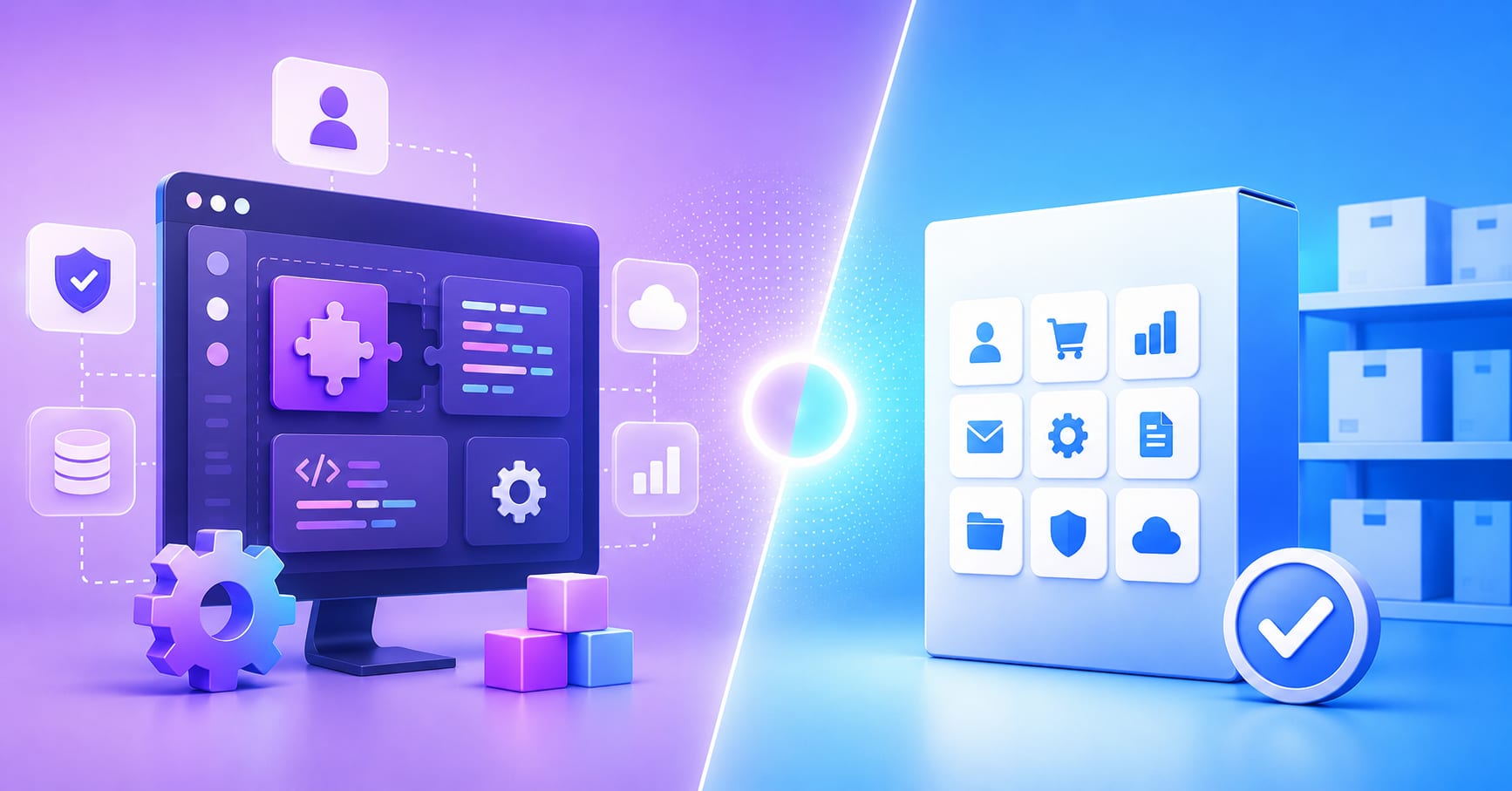
Most build-vs-buy posts on the internet treat this as a feature checklist. It isn’t. The decision is about process specificity. Buy when your processes are common enough that the off-the-shelf platform’s defaults are close to your operating model, and customization stays in configuration. Build when your competitive advantage is the process itself and the platform’s defaults force you to operate worse than you would on paper.
A few signals that tip the answer toward custom:
You operate four or more external integrations that a platform doesn’t natively support, and your back-office spends real time keeping them in sync. Cloud Van Lines, with four payment gateways and Twilio voice, sits squarely here.
Your pricing logic is too specific for the platform’s quoting engine, and you are subsidizing the gap with manual quote work. The MiniMoves quote wizard exists because the lean sales model could not afford manual quoting at the volume they needed.
You sell to multiple customer segments at different price points, and a single feature set can’t serve all of them without confusing the buyer. Warehouse Star’s modular catalog is the answer to that problem at the SaaS-vendor level.
You expect to be on this system for five to seven years, and you would rather own the roadmap than negotiate it.
Note what is not on that list: company size, urgency, or “we want flexibility.” Those are reasons people give for custom that don’t survive a serious build. Process specificity is the only one that does.
Architecture choices that hold up in production
Once a custom build is decided, three architecture choices matter more than the rest.
The first is modular versus monolithic. In our experience shipping supply-chain platforms, modular wins every time the build is meant to live more than three years. Warehouse Star is the proof point at the product level: a shared component library with a common API contract lets new apps slot into the catalog without re-engineering the platform. The cost of modular is real upfront, perhaps 15 to 20% higher first-version cost. The payoff is that you ship features into one module without re-testing the world.
The second is integration architecture. PwC’s 2025 survey identified integration complexity as the leading reason supply-chain tech investments fall short (PwC, 2025). The fix is not more integrations; it is fewer integration patterns. Use a single API gateway, a single message bus for asynchronous work, and a single schema-versioning policy. Vendors that introduce new connector types into the project every quarter are the ones that end up with brittle systems.
The third is the AI layer. Gartner expects 60% of enterprises on SCM software to be running agentic AI by 2030 (Gartner, 2026), which means any 2026 build needs to leave a clean seam for AI agents to sit beside the workflow engine, not bolted onto the UI. Practically: expose your business actions as APIs an agent can call, log every action with enough metadata to train against, and treat the AI layer as an interchangeable provider rather than a hard dependency on any one model vendor.
What a custom supply-chain build costs in 2026
Cost ranges for custom SCM software vary so widely that most published numbers are useless. A meaningful estimate requires three inputs: the scope (single module vs. lead-to-invoice platform), the integration count (each external system adds two to six weeks of engineering), and the operating model fit (the more bespoke your process, the more discovery time the build needs).
A focused single-module build like the MiniMoves quote experience is achievable in three to five months with a team of four to six engineers. A multi-module SaaS like Cloud Van Lines, with twelve to fifteen modules and four external payment gateways, runs twelve to eighteen months for the first production release and continues to evolve for years after. A modular product catalog like Warehouse Star, with reusable component foundations, lives somewhere in the middle and accelerates as the component library matures.
What we tell operators planning a 2026 build is to budget against the longer time horizon. The five-to-seven year platform decision is the real cost. The first version is the down payment.
Frequently asked questions
What is custom supply chain software development?
Custom supply chain software development is the practice of building tailored applications that manage the flow of goods, information, and money across an operating model that off-the-shelf platforms can’t fit without significant workaround. Scope ranges from a single focused module, like an order or quoting tool, to a full lead-to-invoice SaaS covering CRM, payments, documents, and BI.
When should you build custom supply chain software instead of buying off-the-shelf?
Build custom when your process is the competitive advantage and platform defaults force you to operate worse than you would on paper. Buy when your processes are close to the platform’s defaults and customization stays in configuration. Signals that tip toward custom include four or more unsupported integrations, pricing logic that doesn’t fit the platform’s quote engine, and a five-to-seven-year horizon on the system.
How long does it take to build a custom supply chain platform?
A focused single-module build, like an order or quoting experience, typically takes three to five months with a small engineering team. A multi-module lead-to-invoice SaaS with four to ten integrations takes twelve to eighteen months for the first production release. Both continue to evolve through ongoing release cycles for the life of the product.
How much does custom supply chain software cost in 2026?
Published cost ranges run from $15,000 for a small utility to $500,000 or more for a multi-module platform, but meaningful estimates require three inputs: scope, integration count, and process specificity. The bigger budgeting mistake operators make is comparing build cost to the first year of a SaaS subscription. The correct comparison is the five-to-seven-year platform total cost of ownership.
What technology stack is best for custom supply chain software?
There is no single best stack. Our team has shipped supply-chain platforms on Java, .NET, PHP, and Node.js back-ends with React or Angular front-ends, deployed on Azure and AWS. The right stack depends on team expertise, integration targets, and the operating profile of the existing systems you have to work with. The architecture choices (modular versus monolithic, API gateway versus point-to-point integrations) matter far more than the language.
Where to take this next
If you’re sizing a custom supply chain build, the most useful first step is a scope conversation that translates your operating model into modules and integrations, then maps those onto a realistic timeline and budget. That’s the discovery work our Custom Software Development service is designed to handle, and it’s how the Cloud Van Lines, MiniMoves, and Warehouse Star builds all started.
The pattern we keep seeing is that operators underestimate the breadth of a real lead-to-invoice build (Cloud Van Lines is the right yardstick) and overestimate how much custom they actually need at the start (MiniMoves is the right yardstick for that). Either is a defensible answer. The wrong answer is to spend twelve months wedging your process into a platform that was never going to fit.