
 58 reviews
How We Integrate AI into Your Existing Systems
Outcomes of AI Integration Services

Hello 👋 I’m Andriy, Senior Engineering Manager
Let me know if you have any questions about AI Integration Services.
How does AI Integration work?


Why clients choose us?
01
We ensure the ethical AI
02
We are the most reviewed company
03
We provide turnkey solution
Our Clients Say
We’re one of unicrew’s smaller clients, but they’re always incredibly quick to respond. When we have issues, they treat them as if they’re extremely important. We feel like we have a partner, and that’s been incredible. That’s why we’ll keep them on for as long as we can.
unicrew has met all project milestones on time and within budget. They have excellent communication skills and available resources as promised. We are impressed with the quality and reliability of the team’s developers.
unicrew’s testing had a very positive impact on the client’s processes, elevating their team’s morale and increasing their confidence in the quality of their work, ultimately improving their productivity. unicrew was proactive, communicative, and autonomous, and delivered items as expected.
Our Case Studies
Our Case Studies
 USA
USA 

 Ukraine
 About our AI Integration Services
Yes, integrating AI into legacy systems is one of our most common engagements. We start with a technical audit of the existing architecture to identify safe integration points, then implement incrementally using APIs, middleware, or microservice wrappers rather than rebuilding the system from scratch. This approach minimizes delivery risk and lets the existing system continue operating during the rollout.
- 1. Typical legacy AI integrations: document processing via OCR/NLP, predictive analytics layered onto existing data pipelines, LLM-powered search and recommendation modules.
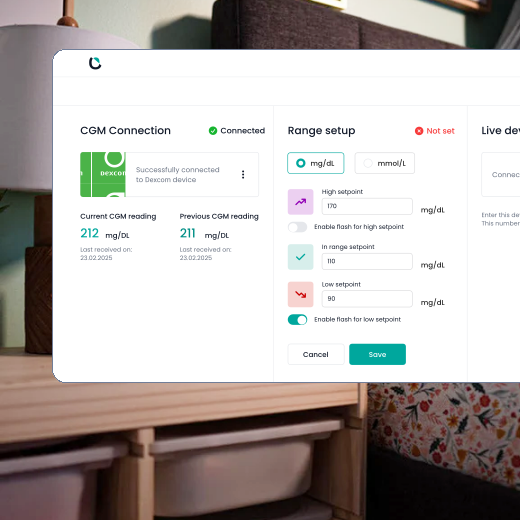
- 2. We have delivered legacy AI integrations for healthcare monitoring platforms, financial services tools, and knowledge management systems.
We integrate a broad range of AI technologies depending on the use case:
- 1. Large language models (LLMs): GPT-4, Claude, Llama, Mistral for document processing, chat interfaces, content generation, and knowledge retrieval.
- 2. AI APIs: OpenAI, Anthropic, Google Vertex AI, AWS Bedrock, Azure OpenAI.
- 3. NLP and text processing: entity extraction, sentiment analysis, classification, summarization.
- 4. Computer vision: image recognition, OCR for document digitization, visual inspection.
- 5. Retrieval-augmented generation (RAG): connecting LLMs to your proprietary data sources.
- 6. Predictive ML models: forecasting, anomaly detection, recommendation engines.
- 7. Generative AI: content generation, code assistance, data synthesis.
AI integration means connecting existing AI services, APIs, or pre-trained models into your product, typically faster and lower cost. Building a custom AI model means training a model on your proprietary data, which is appropriate when off-the-shelf models cannot meet your accuracy, latency, or data-privacy requirements.
Most business use cases are better served by integration. We will tell you which approach makes sense after reviewing your requirements.
Scope determines timeline. As a general guide:
- 1. Proof of concept (single feature, one AI API): 2-4 weeks.
- 2. Single module integration (e.g., document processing pipeline, LLM-powered search): 4-8 weeks.
- 3. Multi-module or system-wide AI integration: 8-16 weeks.
- 4. Legacy system AI integration with architectural changes: 12-20 weeks.
Our AI readiness assessment is a structured evaluation of whether your product and team are ready to benefit from AI integration. It covers:
- 1. Tech stack review: identifying integration points and blockers in the current architecture.
- 2. Data quality audit: assessing whether your data is structured, accessible, and sufficient for the intended AI use case.
- 3. Use case prioritisation: ranking integration opportunities by expected ROI and delivery complexity.
- 4. Risk and compliance mapping: flagging regulatory constraints (GDPR, HIPAA, PCI-DSS) that affect AI implementation.
- 5. Cost and timeline estimate: a realistic projection for your top-priority integration.
Many of our clients run products built on platforms like Salesforce, HubSpot, AWS, or Azure. We integrate AI at the application layer, building custom connectors, webhooks, or middleware that bridge your platform and the AI service without replacing the underlying infrastructure.
If the platform has its own AI marketplace or native AI features, we evaluate these first before building custom integrations.