
Senior engineers for US startups and scaleups when hiring cannot move fast enough.
unicrew is the engineering team a funded startup brings in when the roadmap is already committed and the next senior hire is months away. 100+ senior in-house engineers across six countries, building software since 2012.
This page is about the buying decision rather than the code: what starting looks like, what you are billed for, and where we are the wrong answer.
- 120+Projects delivered across 12 countries since 2012
- 100+Senior in-house engineers, six countries
- 2 to 4 weeksTypical time from signature to start
- ISTQBCertified QA inside every sprint
- ISO 27001Certified security practice, audited by Quay Audit UK
01Overview
Hiring is the constraint, and the roadmap does not wait
A startup engineering partner is an outside team of senior engineers who take ownership of part of your roadmap, so capacity arrives in weeks rather than through a hiring cycle. unicrew has worked that way since 2012, and several engagements on this page have run for years rather than months. The published work is in freight, B2B SaaS and consumer health. For the smallest possible first step, see MVP in 6 Weeks.
- Start in weeks, not hiring cyclesMost engagements start within two to four weeks of signature, with a team we have already picked rather than one we still have to find.
- Scale down as easily as upTeam extension is billed monthly per engineer, so seats come back off the way they went on, and nothing is charged for sourcing or placing anyone.
- One team, not a rotating benchClients here describe full-time people assigned to their product, and more than one of these engagements has been running for years.
- QA inside the sprintISTQB-certified QA sits in the team rather than arriving as a test pass before launch, which is when a startup can least afford the news.
02Options
Three ways to put engineers on the roadmap this quarter
Pick by what happens in month nine, not month one. A fourth answer the table leaves out is a recruiter placing a permanent hire, which is the right call for a role you will still need in three years. Three briefs we turn down: engineers sitting in your office, a build where the product decisions have not been made yet, and equity in place of an invoice.
| A standing team from unicrewunicrew | Hiring the engineers yourselfIn-house | Contractors, booked per roleContract |
|---|---|---|
| What it takes to startA scoping call, an NDA and a signature. Most engagements start within two to four weeks. | What it takes to startA search, an offer, a notice period and an onboarding, before the first commit lands. | What it takes to startQuick the first time, and repeated in full every time somebody finishes or leaves. |
| When the plan changesTeam extension is billed monthly per engineer, so seats come back off the same way. No recruitment or placement fee. | When the plan changesA salary carried through a quiet quarter, and a decision nobody wants to make if the quarter stays quiet. | When the plan changesAvailability disappears mid-build, usually belonging to whoever understood the difficult part. |
| Who knows the code next yearThe people already on it. One client below dates the start of our work to 2009, and it is still running. | Who knows the code next yearYour own engineers, which is the strongest answer on this table, for as long as they stay. | Who knows the code next yearNobody. The context leaves with the contract and the next contractor starts from the README. |
03Situations
Where a funded team runs out of engineering first
Six situations we get called into, split by whether the product has proved itself yet. The right first move is different in each, and it is not always a bigger team.
You have made the product decisions and you have access to users. What is missing is a working first version on a date you can plan around, which is a fixed-scope six-week engagement agreed before we start.
- First move
- MVP in 6 Weeks, fixed scope
The owner of EZ-SQR, a security startup in Boca Raton, came to us with a description of an idea and nothing else. On Clutch he says we "delivered an extremely high-functioning product that's great even as a demo".
- First move
- Nail the features, then build
A previous vendor, a freelancer, or a technical co-founder who left. We read what exists and say plainly what is salvageable before anybody quotes you a rewrite.
- First move
- An audit, then a written plan
Real users arrive and the architecture that got you here starts to argue back. The answer is usually a dedicated team that owns delivery end to end, not a longer queue of tickets.
- First move
- A dedicated team on your product
A US B2B SaaS founder brought us in as his programming team, and his AWS costs came down by 30% or more. That happened inside the ordinary engagement rather than as a separate audit, and his case study is below.
- First move
- Find the spend, then fix it
Once real users are on it, a broken release costs more than a late feature. ISTQB-certified QA sits inside the sprint on every engagement rather than arriving as a test pass at the end.
- First move
- QA in the sprint, not after it
AI advice from a team that runs its own AI products
unicrew builds and operates Snaplore and Talkmetry, both owned, revenue-generating products with active users. So when we say which AI feature will move a metric and which is demo-day decoration, that comes from running our own on our own bill.
Hire in-house for the part of the product that only you can get right, and buy the rest. Founders usually get this backwards: they keep the plumbing because it feels core and hand out the thing their whole idea depends on. We would rather argue about that split on the first call than inherit it later.
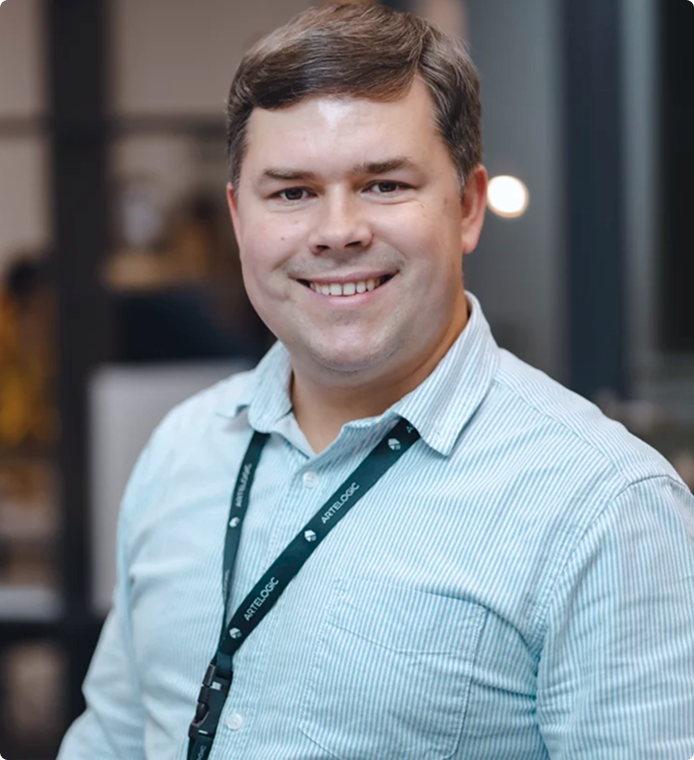 Oleksandr TrofimovCTO & Co-Founder, unicrew
04Proof
Proof, with the dates left on it
Four things clients said in their own verified Clutch reviews, each with the year they said it. The strongest of them is old and it is one client. US relevance here is proven by named US clients, not by an office address.
- A founder who raised money after we shippedBoruch Akbosh, founder of Mover Technologies in Florida, in his updated Clutch review: "After Artelogic developed our BuildMyMove project, we raised $1.5 million in investor capital." That funding, he writes, "grew our business from three to 70 people within an eight-month period". He dates the start of the work to 2009, under our former Artelogic brand, and the freight platform is still being built.$1.5 millionraised in investor capital after the first build, in the founder's words, 2018
- A platform that kept growing for yearsCraig Elsdon-Dew, CEO of WaiverKing, on Clutch: "They've been helping us grow our platform together since the beginning, from a couple hundred companies to around 2,000." On how the work was staffed he adds that "Artelogic has assigned full-time team members to work on our mission". The WaiverKing build began under our former Artelogic brand.Around 2,000companies on the platform, up from a couple hundred, in the CEO's words, 2022
- Faster turned out to be cheaperPatrick W., founder and president of a New York B2B SaaS company that Clutch anonymises, was straight about the rate on Clutch: "When I first spoke to the team, the pricing was higher than I had hoped, but it turned out that Artelogic could work much faster than our previous service provider. Ultimately, the team wound up costing us less or at least the same." His AWS bill came down in the same engagement.30% or morelower AWS costs, in the founder's words, 2024
- Recent, and one of the smallest clients hereKevin Terry, founder of a health management company in Charlotte, North Carolina, on Clutch: "We're one of unicrew's smaller clients, but they're always incredibly quick to respond. When we have issues, they treat them as if they're extremely important. We feel like we have a partner, and that's been incredible." We stabilized and now run the platform he arrived with.2025the year this review was published; the engagement began in June 2024
05Delivery
From a first call to a team inside your standup
Four stages, and the first two exist to make the third cheap. Nothing here asks you to commit a full team before you have watched us ship something. Most engagements start within two to four weeks of signature.
- A call about the gap, not the pitchWhat is on the roadmap, what your own team should keep, and what is genuinely better bought. If the honest answer is that you should hire for this role rather than partner, you hear it on this call.You getAn opinion on scope and team shape, in writing
- Scope the first sliceThe smallest piece worth shipping, with the stack, the team shape and the reasoning written down so you can argue with it before a line of code exists. Fixed scope wherever the work allows it.You getA scoped first slice and an engagement model
- Ship it in front of real usersWorking software early and often, with ISTQB-certified QA inside the sprint. A startup cannot afford a big reveal that lands wrong, so nothing waits for a launch date to be seen.You getSoftware you can put in front of users
- Grow the team, or stand it downWhen the product earns it, the engagement grows into a dedicated team that owns delivery end to end. When a quarter is quiet, team extension is billed monthly per engineer and the seats come back off.You getA team that scales in both directions
06Terms
Money, people and paperwork, before you ask
Six things a founder usually has to dig for. Three about how you are billed, three about who turns up and how they work inside your systems.
Three ways to be billed
Time and materials, billed hourly and quoted per project. Fixed price, quoted per project against an agreed outcome. Team extension, billed monthly per team member.
- In practice
- Recommended after scoping, not before
No recruitment or placement fee
On a dedicated team or team extension nothing separate is charged for sourcing, vetting or placing an engineer. The engagement is priced monthly, per team or per engineer.
- In practice
- Nothing charged for finding people
A warranty on fixed-scope work
Fixed-scope work carries a post-launch warranty period as standard, with the length agreed in the contract rather than assumed on either side.
- In practice
- Agreed per contract, in writing
Certified security and quality
ISO 27001:2022 for information security and ISO 9001:2015 for quality management, both renewed through a multi-stage audit with Quay Audit UK.
- In practice
- The controls a security review asks for
ISTQB-certified QA in the sprint
Certified QA engineers sit inside the team on every engagement, rather than a test pass bolted onto the week before a release.
- In practice
- Defects found before your users do
Least-privilege access to a live product
On a build engagement we work from access agreed with your technical contact, read-only wherever the work allows, and with no write access to production during discovery.
- In practice
- Agreed with your technical contact
07Client voices
What founders say when Clutch asks them
Up until a year and a half ago, I handled all the development and support of our application myself and I needed help. I brought in Artelogic, and it was one of the best business decisions I’ve ever made.
They delivered an extremely high-functioning product that’s great even as a demo. We’re really excited to see the results once it’s finalized and connected to a database. Nothing got lost in translation and we managed the time difference well. Artelogic has been professional, personable, and flexible, especially when it comes to our budget after the pandemic.
They’re a highly ethical and well-managed organization. I was amazed by the CEO’s skill level and business acumen.
We had to stop the application development for business reasons unrelated to unicrew, so it didn’t go into production. However, the development was successful, and the software was functional. unicrew met deadlines and stayed on budget. It was more of a full-service provision than expected, so I was delighted.
We’ve seen enhanced customer satisfaction thanks to unicrew’s work. Our customers love the UI and speed of the application. We’ve received positive feedback, and there are no errors in the system. We only fix minor UI bugs, which aren’t worth mentioning. unicrew meets their deadlines and stays on budget.
08Case studies
Startup builds you can read end to end
Three engagements with published write-ups: a freight platform for a Florida founder, a decade-old B2B SaaS platform taken over and made cheaper to run, and a waiver platform grown over years.
See all case studies- LogisticsA freight-management platform and mobile apps for a US logistics startup (Mover Technologies)
- SaaSAWS costs down 30%+ for a US B2B SaaS platformunicrew became the programming team for a B2B SaaS platform that had run for over a decade, streamlined how it used AWS and Heroku, and sped up rollouts.30%+Lower AWS costs
 SaaSWaiverKing: Software Development for Waiver Form CreatorWaiverKing is a document management business serving primarily the health and fitness industries. The platform is partnered with MindBody Online, one of the largest business-systems providers for gyms and yoga studios.Weeks to hoursTime for an update to reach live

09Questions
What founders ask before they commit budget
Because they answer different questions. A permanent hire is right for a role you will still need in three years, and we will say so on the call. An outside team is right when the roadmap is already committed and the capacity has to exist this quarter: most engagements start within two to four weeks of signature, and team extension is billed monthly, so the seats come back off when a quarter goes quiet.
Our engineers work from Europe, so the overlap window is something we agree at scoping rather than promise on a landing page. What clients describe is a live daily meeting. Stephanie Allemann, president of Crik-IT in Maine, put it this way on Clutch: "We have a daily status meeting over Google Meet. They're ahead of me, so we meet in their evening time in Ukraine. The accommodations they've made for US time have been great."
unicrew publishes no project price band, because an honest figure depends on team shape, stack and scope. What is settled before you commit is how you are billed: time and materials, quoted per project and billed hourly; fixed price, quoted per project against an agreed outcome; or team extension, billed monthly per team member. There is no recruitment or placement fee on a dedicated team or team extension.
Growing an existing engagement is faster than starting one, because the team already knows the product. The CTO of a German science tech company describes it on Clutch: "They return with two or three high-quality developers when we need another resource. We've had difficulty choosing between them because they're all so good." We will not promise engineers tomorrow, because staffing senior people responsibly takes longer than that.
Yes, and it is a common way engagements here begin. We read what exists and say plainly what is salvageable before anybody quotes a rewrite. One US consumer health platform arrived mid-crisis with recurring outages: we stabilized it, brought its cloud costs down, and are still the team on it. If a rewrite genuinely beats a rescue, you get that answer with the tradeoffs written down.
Yes, and it is a defined offer rather than an open-ended discovery phase. MVP in 6 Weeks takes a product idea to a working, usable first version in six weeks, on a fixed scope agreed before we start, so you learn what works before committing budget to a larger build. What you bring to it is the product decisions and access to real users.
When you need engineers sitting in your office, because ours work remotely. When the product decisions have not been made and you are hoping an outside team will make them. When you want a technical co-founder paid in equity rather than invoiced, which is not an arrangement we offer. And unicrew runs no investor or accelerator network, so nobody here is going to introduce you to a fund.
Send the roadmap and the gap in the team
A call with a senior engineer rather than a sales qualifier. Bring what you are building and what you cannot staff. If hiring is the better answer for this role, you will hear that.
What happens after you contact us
- We reply within one business dayA senior engineer reads what you sent, not an autoresponder.
- A call about the roadmap and the gapWhat your own team should keep, and what is genuinely better bought.
- Scope and engagement model, in writingThe first slice, and whether it is time and materials, fixed price or team extension.
- NDA, then a start dateMost engagements start within two to four weeks of signature.