
E-commerce development for catalogues, orders and the systems behind the shop.
We build product catalogue, order and fulfilment systems for retailers and manufacturers.
Our e-commerce development connects your ERP, payment provider and warehouse.
- 120+Projects delivered across 12 countries since 2012
- 100+Senior in-house engineers, six countries
- 2 to 4 weeksTypical time from signature to start
- ISTQBISTQB-certified QA engineers
- ISO 27001Certified security practice, audited by Quay Audit UK
01Overview
E-commerce systems from product data to fulfilment
Start with catalogue and ERP integration for product, stock and price data, or B2B order collection through electronic data interchange (EDI). We scope our e-commerce development services around that flow and the custom development and integration it needs. For shopper-facing pages and checkout, choose e-commerce website design.
- Capture ordersConnect sales channels and B2B order collection to the same order flow.
- Storefront and channels
- Basket and checkout
- B2B and EDI order capture
- Manage product dataDefine which system owns each product record, price and stock update.
- Product information
- Stock and pricing
- Catalogue at volume
- Fulfil and reconcileCarry orders into logistics and match payment and refund records back to them.
- Warehouse and 3PL
- Payments and refunds
- ERP and accounting
- Commerce across marketsFor one European manufacturer, we connected catalogue, order and logistics systems supporting sales in seven EU countries.
02Architecture
Choose the platform, headless or custom route
Commerce architecture starts with the catalogue and sales channels you need to support. These routes distinguish changes to the storefront, shared product data and the integrations around the platform.
| Commerce requirement | Engineering responsibility | Workstream |
|---|---|---|
| “One shop with a standard catalogue.” | Platform configuration and storefront changes | Keep the platform and configure its existing features. We design the storefront around its catalogue and checkout model.Storefront design on the platform you haveOr book a meeting |
| “One catalogue feeds a shop, an app and a marketplace.” | Shared catalogue and independent front ends | Use headless commerce when each channel needs its own front end. The commerce back end serves shared product and pricing data; each front end needs its own maintenance.Platform development and integrationOr book a meeting |
| “Pricing, bundles or a configurator need custom rules.” | Rules and extensions maintained with the platform | Use a standard extension where it supports the rule. For requirements beyond the platform model, we build a custom component alongside it or scope a replacement.How we build custom systemsOr book a meeting |
| “The storefront and ERP need consistent stock, prices and orders.” | Connector, data ownership and update rules | Keep the storefront and build middleware, the connector that exchanges product, order and logistics records with the ERP and warehouse.See the catalogue and ERP integrationOr book a meeting |
| “B2B orders arrive as files or through EDI.” | Order collection and ERP handoff | Connect the buyer's order format to the system of record. Electronic data interchange (EDI) is the structured exchange of business documents between systems.See the EDI order-collection projectOr book a meeting |
Headless is the right fit when one catalogue feeds several fronts, such as a shop and an app. It also suits catalogue logic a platform's data model cannot hold. For one shop with a standard catalogue, we design the storefront on the platform you have.
 Yaroslav HavrylivSenior Engineering Manager, unicrew
03Solutions
Commerce engineering workstreams
We develop the components that carry products from catalogue to order, payment and fulfilment. Each workstream can extend the platform you already use.
Catalogue and product information
We centralize product information management (PIM) and connect it to the channels that publish it, with the catalogue rules and market-specific data your products need.
- Right when
- New channels need the same product data
Order flow and fulfilment
We build the connector that collects orders from sales channels, passes them to the ERP and logistics systems, and returns fulfilment status.
- Right when
- Order volume and fulfilment routes grow
ERP and system-of-record integration
We build middleware around Microsoft Dynamics ERP and existing systems of record. The integration defines how products, stock, prices and orders move between the shop and back-office systems.
- Right when
- The store needs an ERP connection
Payments, refunds and reconciliation
We connect the payment provider to the order flow, including authentication, failed payments, refunds and settlement records. Provider requirements define the payment-data boundary.
- Right when
- Payment records need to match orders
B2B ordering, EDI and account pricing
We build EDI order collection for business customers. We establish account pricing and ordering rules with you before selecting platform features or custom components.
- Right when
- Business customers place structured orders
Running it after launch
We define monitoring, support and module-by-module changes as part of the agreed post-launch scope, planning releases around the trading calendar and peak-season demand.
- Right when
- The live commerce system needs ongoing care
04Stack
What we build commerce systems with
Your commerce platform, ERP and provider interfaces guide the technology choices. We scope the application stack and connectors around the systems you retain.
 Angular
 React
React Flutter
 Laravel
 PHP
PHP Yii2
Yii2 Node JS
 ASP.NET
 C#
C# MySQL
MySQL AWS
AWS Shopify
 WordPress
05Obligations
Requirements for commerce data, payments and orders
We establish commerce requirements against the markets you sell into, your payment provider and your data policies. The build translates those requirements into catalogue fields and order workflows.
Payment authentication and 3-D Secure
We agree the applicable authentication and 3-D Secure flows with your payment provider, including challenge outcomes and exemptions. PCI guidance keeps merchant oversight of service providers in scope.
- In a build
- Provider rules and challenge outcomes
VAT, OSS and selling across borders
We map the tax and reporting data your order flow needs with your tax advisers. Where you use the optional One Stop Shop, its requirements become inputs to the build.
- In a build
- Tax requirements agreed for each market
Consumer law, returns and cancellation
We define return and cancellation rules for the markets and products you sell, then connect the approved workflow to stock movements, refunds and settlement records.
- In a build
- Returns connected to stock and refunds
Product safety information on a listing
We establish which safety and responsible-person information your listings need, then model the applicable fields in the product catalogue.
- In a build
- Applicable information in the catalogue
Personal data under GDPR
We build personal-data handling around your purposes and retention policy. GDPR principles make data minimisation and storage limitation inputs to the order and customer-data model.
- In a build
- Data use and retention agreed first
One audit trail per order
We agree which price, discount, stock and status changes need a history, who can access it and how long the records remain available.
- In a build
- History matched to the agreed requirements
Security, quality and build access
unicrew holds ISO 27001:2022 and ISO 9001:2015, renewed through a multi-stage audit with Quay Audit UK. We have ISTQB-certified QA engineers. On build engagements, least-privilege access is agreed with your technical contact, read-only wherever the work allows, with no write access to production during discovery. We work inside your cloud where your customers or insurers require it.
06Proof
Commerce integration projects and client results
Our commerce work connects catalogue, ERP and EDI order collection. The recognition project applies automation to a software company's product-data entry.
- A catalogue and an ERP that had to agreeWe connected storefronts, product information and ERP workflows for JewelCandle. Their Head of IT writes in his 28 July 2020 Clutch review of work under our former Artelogic brand: "We also developed a component that connects products to the appropriate sales channels, takes orders from channels, connects them to the ERP, and manages logistics." The project includes BPMN models, test plans, and automation, load and stress testing.10,000-plusproducts, seven EU countries, one order flow
- EDI order collection for B2B commerceWe built the EDI tool that collects Bigfood Group's customer orders. In his 22 October 2018 Clutch review, their Senior Digital Manager writes: "The EDI tool generates significant daily revenue and helps us solve order collection issues." He dates the relationship in the same review: "We started working together in September 2016 and the partnership is ongoing." The review describes work under our former Artelogic brand.2016the year this client started with us
- Product-data recognition and operator reviewFor a software company we built a recognition tool in C# on AWS that reads product datasheets and lets an operator check the results. In its 15 April 2022 review, the client reports twice the data-entry throughput from a manual baseline of about 5,000 datasets a month.2xdata-entry throughput for a software company
07Client voices
What retail and B2B commerce clients say
Artelogic anticipates our needs and meets them before we even identify them. My team lead wants to keep both of Artelogic’s developers on the project until the product’s release. We have a backlog of 40 big projects, so I only see Artelogic’s involvement increasing.
Artelogic invested time to understand our needs and has subsequently proposed appropriate solutions. In the end, the team’s quality deliverables have created value for cost. The EDI tool generates significant daily revenue and helps us solve order collection issues.
08Case studies
Catalogues, orders and integrations we have built
These projects cover the systems that prepare product data and carry orders into the back office.
See all case studies eCommerceEcommerce software development for JewelCandleJewelCandle, a mid-size European manufacturer of scented products, sells across seven EU countries (B2B and B2C) via online shops.10,000-plusProducts manufactured
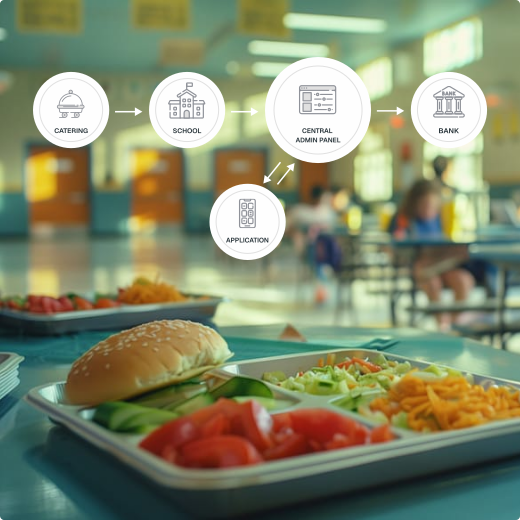 FoodtechDigital Transformation in the Food IndustryOur client is an innovation-oriented group of food companies based in Germany that produces and distributes a wide range of products for well-known retail businesses and food services.
- AutomationDoubling data-entry throughput with a custom recognition toolunicrew automated a manual data-entry bottleneck with a C# and AWS recognition tool, doubling the data sets the team processed each month.2xData sets processed per month

09Questions
E-commerce development: frequently asked questions
An e-commerce platform packages the storefront, catalogue, basket, checkout and administration into one product.
Keep or configure it when its catalogue and order model supports your plans. Extend it for a specific rule or integration. Consider headless or replatforming when several front ends need shared product data, or the platform model cannot support required catalogue logic.
Headless fits when several front ends need one commerce back end, or your catalogue logic needs a separate model.
A shop and app can share catalogue and pricing services while their interfaces change independently. For a single shop with a standard catalogue, we design on the existing platform. The choice also defines who maintains the front ends and their integrations.
Yes. We build the middleware that connects commerce channels to the ERP, logistics and payment systems behind them.
We scope product records, stock and prices separately from orders, fulfilment events and payment records. Bring the systems involved and the interfaces available; that establishes the connector work. See platform development and integration for the wider integration scope.
Yes. We build electronic data interchange (EDI) order collection for business customers, alongside B2C commerce integrations.
Account pricing and ordering rules are requirements to establish with your team. A commerce client's Senior Digital Manager described the EDI outcome in a 22 October 2018 review: "The EDI tool generates significant daily revenue and helps us solve order collection issues."
E-commerce development is quoted against the integration and build scope.
- Time and materials: billed hourly, quoted per project.
- Fixed price: an agreed outcome, quoted per project.
- Team extension: billed monthly per team member, with no recruitment or placement fee.
A single ERP integration and a full replatforming have different scopes. We agree the model around the work you want to commission.
Most engagements start within two to four weeks of signature; this is the start window, not the build duration.
The delivery plan scopes the catalogue, integrations and testing separately. For replatforming, we plan shop-by-shop or market-by-market migration, with the cutover sequence agreed against your trading calendar and the teams responsible for connected systems.
Post-launch support and handover are agreed in the engagement scope. Fixed-scope work includes a post-launch warranty, with its length agreed per contract.
For build engagements, access is agreed with your technical contact on a least-privilege basis, read-only wherever the work allows. Discovery uses no write access to production. We work in your own cloud where your customers or insurers require it.
Plan your commerce systems and integration project
Tell us which sales channels you plan to grow and which systems hold your products, orders and stock. We will discuss the architecture, first workstream and commercial model with you.
What happens after you contact us
- We reply within one business daySend your channels, catalogue and integration requirements.
- A call about the systemsYour platform, ERP and fulfilment partners, and the order flow between them.
- Route and engagement model, in writingKeep, integrate or build, priced as time and materials, fixed price, or team extension.
- NDA, then discoveryMost engagements start within two to four weeks of signature.