
Node.js development services with typed API contracts
We build Node.js backend APIs, real-time features and integration gateways for product teams. Our Node.js development services cover runtime selection, typed contracts and maintainable releases for new and inherited services.
01Capabilities
Backend services and real-time product features
We use Node.js to run server-side JavaScript, with TypeScript for shared API contracts. These services connect a product interface to its data, events and external systems.
- APIs
Product APIs and backends
We build REST and GraphQL APIs for product interfaces, including React frontends in a web build. Workload design distinguishes requests waiting on a database or third party from computation that needs separate execution.
- Realtime
Real-time and event-driven features
We develop WebSocket features for live dashboards, chat, presence and notifications, including price or status updates on fintech interfaces. We assess open connections and event-loop load against expected traffic.
- Integration
Integration and gateway layers
We connect payment providers, messengers, ERPs and the carrier or marketplace APIs behind logistics platforms. Our platform integration work defines how repeated requests are handled through idempotency, alongside retries, rate limits and reconciliation.
- Extraction
Services split out of a larger system
We extract a function that needs its own deployment, scaling or failure boundary and run it as a separate service. Interfaces let the surrounding application stay in its current stack.
02Case studies
Delivered systems with Node.js in the stack
We built commodities-trading software and a foodtech application that automates product workflows previously managed through email and spreadsheets. Node.js is part of each wider stack.
See all case studies TradingTrading software with smart contractsOur client, an experienced commodities trader, came to unicrew with a detailed PRD (Product Requirements Document) to develop the trading platform.
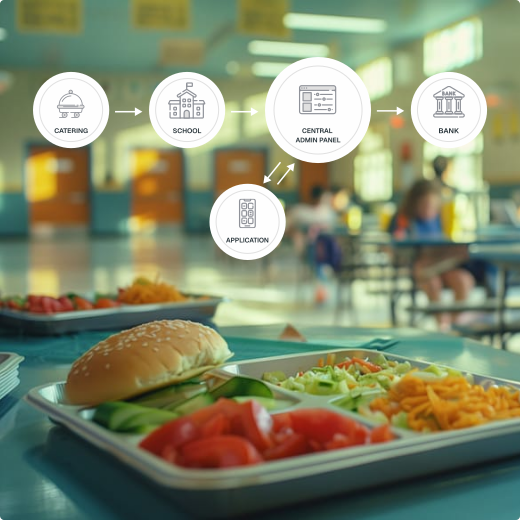 FoodtechDigital Transformation in the Food IndustryOur client is an innovation-oriented group of food companies based in Germany that produces and distributes a wide range of products for well-known retail businesses and food services.
03Fit
Which execution model fits your service?
Node.js fits requests and events that wait on databases or external services. We profile the workload before deciding how computation, connections and concurrency should be handled.
| Your situation | What we recommend |
|---|---|
| A product API with many short requests, mostly waiting on a database, a queue or a third party | Use Node.jsKeep request callbacks responsive and measure database, queue and remote-call latency. Set concurrency limits around the workloads and systems the API depends on. |
| Realtime work: live updates, chat, presence, many connections open but idle | Use Node.jsUse event-driven connection handling for WebSocket features. Set operating limits from tested message volume, payloads and processing per message. |
| Heavy computation in the request path: media processing, large exports, cryptography, big numeric work | Isolate CPU workRun CPU-intensive JavaScript in worker threads, or place computation in a separate service. Compare Go (Golang) or .NET when their libraries and execution model fit the requirement. |
| Network throughput and native-binary packaging are key operating requirements | Assess GoAssess Go (Golang) against the workload and deployment target. Check native dependencies, memory use and operating responsibilities before choosing the package. |
| The real product is a data pipeline or a machine-learning feature | Python for data workUse Python for analytics and machine-learning libraries, with a Node.js API or integration boundary around that component where required. |
| An internal tool that will be maintained by an existing application team | Your existing stackUse the team's established runtime and deployment pipeline where they fit the requirement. Define who maintains and operates the tool as part of the scope. |
Scope
Our Node.js engineers own the execution model, dependency choices and behaviour under load. unicrew has built software since 2012, with 100+ senior in-house engineers across six countries. Delivery follows ISO 27001:2022 certified information-security management and ISO 9001:2015 certified quality management.
04Delivery
Build runtime and release decisions into delivery
We define how the service behaves and changes in production before extending its features. The delivery plan covers an existing codebase as well as a new service.
- Profile waiting and computationWe measure time spent waiting on databases and external calls separately from CPU work. The results guide execution choices, including worker threads or a separate service for heavy calculations.
- Inventory and maintain dependenciesWe record the npm packages the service relies on and review their role. Audit and update checks run in the pipeline, with a supported Active LTS or Maintenance LTS Node.js release selected for production.
- Share types and API boundary contractsWe use TypeScript across the service and share one API-shape definition with the frontend. For inherited JavaScript, we add types at boundaries first and expand coverage as the code changes.
- Make it operable under loadWe add structured logging, tracing and health checks, with explicit concurrency and payload-size limits. Test automation follows our QA practice and verifies important service paths alongside load behaviour.
05Client voices
Client experience with unicrew
06Stack
The interface, contracts and data around Node.js
A Node.js backend connects to frontend frameworks and data stores through explicit contracts. Each choice follows the product's interface and data requirements.


07Questions
Questions about Node.js runtime and delivery decisions
Node.js delivery involves workload fit, dependencies and the team operating the service. These answers cover the practical choices before building or taking over a backend.
Yes. Our Node.js engineers take responsibility for the runtime decision, design and implementation.
An architect outside the delivery team reviews the design, and the work follows our QA practice. Managed teams include unicrew delivery coordination; custom software development provides ownership of an agreed outcome.
Node.js fits API and real-time workloads where JavaScript or TypeScript already supports the product. Compare Go (Golang) when network throughput and native-binary packaging are priorities.
We profile representative workloads and assess dependencies, memory use and team ownership. Go packaging still depends on the target and any native libraries.
Yes, for workloads dominated by database or network waiting, with performance verified against the target load.
We keep request handling responsive and place CPU-intensive JavaScript in worker threads or a separate service when needed. Concurrency limits, payload size, downstream capacity and process state all affect how the service scales.
Yes. We review dependencies and runtime support, then establish tests around the paths that carry money or data.
We introduce TypeScript at the interfaces of the inherited service. Runtime or framework upgrades are scoped through modernization when they are part of the required change.
Start with a scoping call with an engineer about the service, connected systems and expected load.
For an existing service, we ask for read access to the repository and available monitoring. You receive a written runtime recommendation, first delivery scope and components to retain. Most engagements start within two to four weeks.
We quote Node.js work against the service scope, integrations and release requirements, then agree one of three engagement models.
- Time and materials is billed hourly and quoted per project.
- Fixed price is outcome based and quoted per project.
- Team extension is billed monthly per team member.
Workload execution, dependencies and the existing delivery pipeline inform the estimate.
Plan the next release of your Node.js service
Share the service's purpose, connected systems and expected load. We will identify the first delivery scope and components to retain. Choose custom software development for ownership of the full outcome.