
AI Readiness Assessment in two weeks, in writing
We spend two weeks in the systems you run, then tell you where AI pays off and what the first build costs.
The assessment is written by the practice behind meinUnterricht's roughly 9% lift in search success.
The offer, in full
- Fee
- Fixed fee, agreed before we start
- Duration
- Two weeks
- You receive
- 4 written deliverables
- What we need
- Read access to code, data and documentation
- Typical start
- 2 to 4 weeks from signature
- Ends with
- A working session and the written assessment
NDA before any access. Read-only, least-privilege, and agreed with your technical contact before anything starts.
01Trust
Who writes it
A unicrew assessment is written by the people who would build what it recommends, not by a separate advisory practice.
- 120+Projects delivered across 12 countries since 2012
- 100+Senior in-house engineers, six countries
- 5.0Unified rating across 61 client reviews on Clutch
- ISO 27001Certified security practice, audited by Quay Audit UK
02Overview
What the assessment answers
An AI readiness assessment is a short, fixed-scope review of your systems, data and integration surface that establishes whether AI can deliver value here, and what has to change first. unicrew runs its own AI products in production. In our experience the blocker is rarely the model. It is what sits underneath, in logistics, fintech and healthcare alike: data nobody trusts, systems nothing can integrate with, and a codebase a model cannot safely touch. So we start there, and the answer lands in a document a board, a buyer or your own engineers can read.
03The answer
Three questions, answered in writing
A free questionnaire scores your readiness. A week of your own engineers' time produces an opinion. These three questions end in documents you can fund a build from.
- Question 01
Where will AI actually pay off here?
We score every candidate use case on expected return against delivery risk. So you fund the one most likely to land, not the one that demos best.
- Evidence
- A ranked use-case shortlist
- Question 02
What has to change before any of it works?
Every system, data source and integration lands in one of three buckets: keep, rebuild, or remove. Blockers get named before they quietly stall a project.
- Evidence
- A keep, rebuild, or remove map
- Question 03
What does the first one cost to build?
We scope the top one properly: approach, team, sequence, timeline, cost. You end with something you can fund.
- Evidence
- A costed plan and estimate range
The output is yours, whoever builds it
Nothing in it is withheld, nothing about it is contingent on building with us, and the recommendation is allowed to be that you build nothing yet.
04Fit
Is this the right two weeks for you?
Two lists, so the call starts from a decision. If the real question is a stalled system, a cloud bill or a buyer's security review, the second one names the offer that fits.
Book it if
Good fit- You run software the business depends on and want AI inside it, not a chatbot bolted on the side.
- An AI initiative has already stalled, or a pilot never reached production.
- Your data sits across several systems and nobody can say for certain whether it is usable.
- A board, an investor, or an enterprise buyer is asking for an AI plan you can defend.
Skip it if
Better elsewhere- You want working software in two weeks. That is a pilot, not an assessment: start with the Conversation Intelligence Pilot.
- You already have a ranked, costed AI roadmap you trust and just need engineers to execute it. Take it to a dedicated development team.
- The blocker is the cloud bill or a buyer's security review rather than AI. Those are the Cloud Cost and AI-Readiness Audit and the Security and Compliance Readiness Sprint.
- The system you would put AI into is already failing in production. Stabilize it first with Legacy Software Rescue.
Most of the stalled work we take over is not a technology problem. It is that the previous team left no working build pipeline and nobody is willing to deploy. The first thing we do is make a release possible again, because until you can ship, nothing the audit concludes matters.
 Oleksandr TrofimovChief Technology Officer
05Deliverables
What you get on the last day
unicrew hands over four documents, each showing its reasoning, so you can argue with a placement rather than with the conclusion.
- 01
A keep, rebuild, or remove map
Every system and data source in scope, in one of the three positions, with its blockers named.
- Format
- System-by-system table
- 02
A ranked use-case shortlist
Candidate AI use cases, scored on return and on risk, ranked on the pair.
- Format
- Scored, ordered shortlist
- 03
A data and API readiness audit
Who owns each data source, who can reach it, and whether it is clean enough to build on. Read from schemas, not diagrams.
- Format
- Findings log and remediation list
- 04
A costed first build
Scope, sequence, team shape, timeline, and cost for the top-priority use case.
- Format
- One-page plan and estimate
Three buckets, a ranked shortlist, one costed build
That is the whole logic of the two weeks. The figure shows the shape, not a client's document; we walk you through the real thing on the call.
06Delivery
How the two weeks run
Four stages inside the two weeks, each ending in a document rather than a status update. NDA before any access. For the assessments and audits we work from read-only, least-privilege access, agreed with your technical contact before anything starts.
- Kickoff and accessWe agree which systems, data sources and integrations are in scope, then get read access. The sharper the scope, the sharper the output.You getScope confirmed in writingFrom youA named owner, and read access to the code, data, and documentation in scope
- AuditWe read the architecture, the data and the integration surface, and map candidate use cases against what the business is actually trying to do.You getA findings logFrom youShort interviews with the people who know the systems best
- Prioritize and costWe score the use cases with you in the room, then scope the top one into a costed, sequenced plan.You getA ranked shortlist and an estimateFrom youOne prioritization call, with whoever holds the budget
- ReadoutYou get the document, and a working session to walk through it.You getThe written assessmentFrom youA working session with the decision-makers present
07Proof
Why take the readiness call from unicrew
We ship AI ourselves, and the unglamorous half of readiness, modernization and integration and data quality, is what we have been paid to do since 2012.
- Advice from production, not a deckunicrew builds, runs and sells Snaplore and Talkmetry, on Whisper, GPT models and AWS. Inside the company, an agent we built lifted timely work-time logging compliance by 30%. The readiness questions in this assessment are ones we have already had to answer for ourselves.2AI products we build, run, and sell
- The underlying work is our day jobAI readiness is mostly modernization, integration and data quality. 120+ projects across 12 countries since 2012, including human-in-the-loop document recognition that doubled a client's data-entry throughput, where an operator corrects or releases before anything is written.120+Projects delivered since 2012
- The people who write it are the people who would build itSenior in-house engineers, not subcontractors, with ISTQB-certified QA inside every sprint and an ISO 27001:2022 and ISO 9001:2015 certified practice. Which also means the estimate at the end is written by people who would have to stand behind it.100+Senior engineers, in-house
08Case studies
AI we run, and AI we have shipped
Three builds where the readiness question got answered by shipping: AI tagging and embeddings behind a vector search, our own AI product, and document recognition that doubled a team's monthly throughput.
See all case studies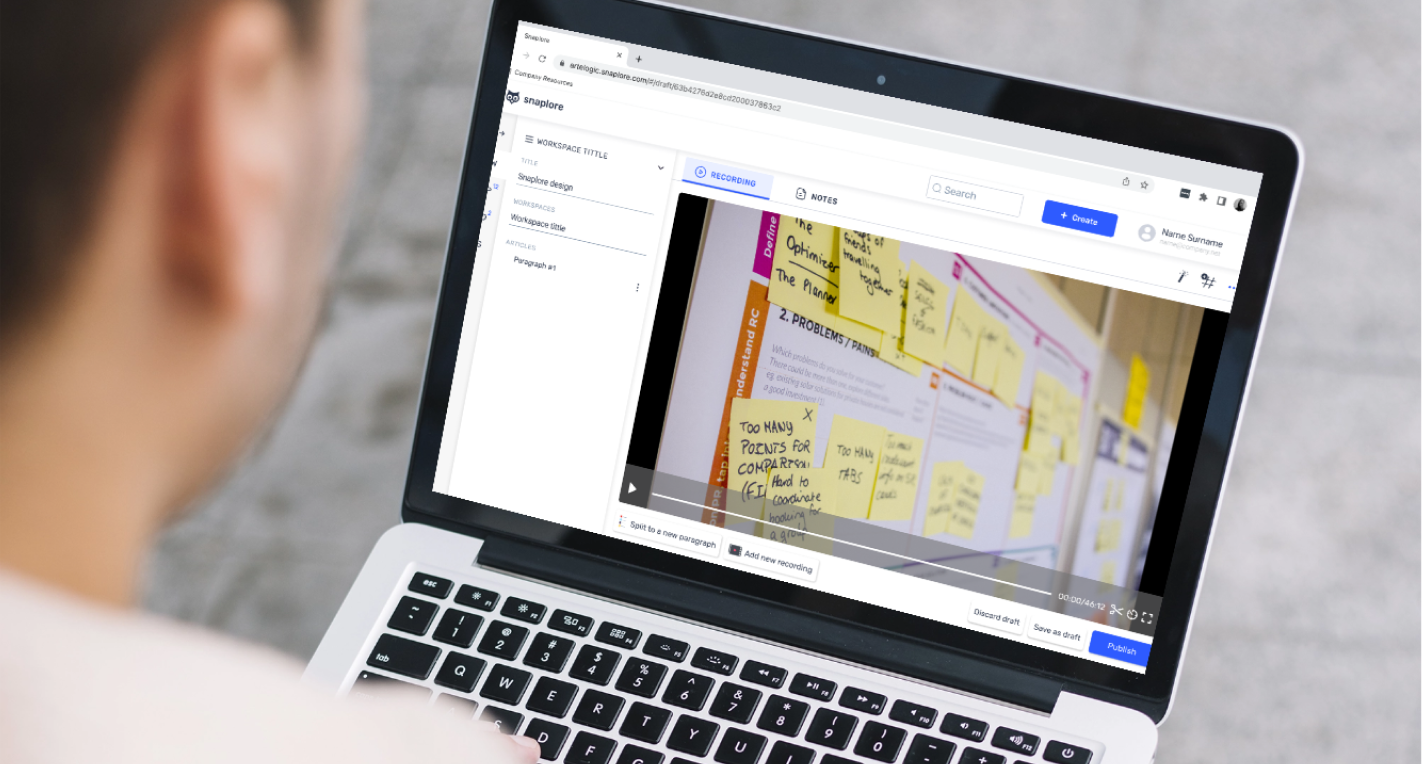 AIRevolutionizing Knowledge Management powered with AISnaplore is unicrew's own product, built and operated in-house. It uses AI to transform how organizations document, structure, and share information, making meetings, training, and project discussions instantly accessible and actionable.Up to 60%Less time on documentation
- AutomationDoubling data-entry throughput with a custom recognition toolunicrew automated a manual data-entry bottleneck with a C# and AWS recognition tool, doubling the data sets the team got through each month.2xData sets processed per month

09Client voices
Clients on the AI work, and on the work underneath it
Our headline result was a controlled experiment showing a roughly 9 percent lift in search success rate. The features built are live in production, and the AI tagging and embeddings work set up our move to vector search. What stands out most is their ability to own work end to end, from user-facing search features to the AI and data layer underneath.
Site was migrated and re-written, the new system is much more stable, and performance highly improved. Excellent technological level. highly responsive and communicative. They are highly committed to the project and business goals.
Our platform has been refactored to Laravel ensuring the code base is more stable, easier to maintain and easier to add new features. Their professionalism and quality of work have stood out in the partnership. We have had the code audited by a 3rd party who was extremely complimentary of the work.
Our business simply wouldn’t function without the Order Management system. We have made numerous functional and performance enhancements that has increased productivity and allowed us to maintain double digit growth without a substantial increase in staffing.
We’ve seen a 15-20% increase in revenue, which is through the efficiency gains and the ability to accurately track time on a permanent basis rather than just by a quarter hour or an hour. I’ve worked with a lot of development teams over the years and these guys have been the best. It’s nice to finally find a team that we can work with.
Book your AI Readiness Assessment
Tell us which systems are in scope and what the board is asking for. We will confirm the scope, the fee and a start date on the call.
What happens after you contact us
- We reply within one business dayA senior engineer reads what you send, not a bot.
- A short scoping callWhich systems are in scope, and what you want AI to do inside them.
- Scope and fee, in writingThe scope, the fee, and the week we can start. Most engagements start within two to four weeks.
- NDA, then kickoffSigned before any access is granted.
10Questions
More about the AI Readiness Assessment
The questions we get on almost every enquiry, answered the way we would answer them on the call.
A short, fixed-scope review of your systems, data and integration surface that establishes whether AI can deliver value here, and what has to change first.
A useful one ends in writing, with three things:
- a keep, rebuild or remove map of the systems in scope
- a shortlist of use cases ranked by expected return against delivery risk
- a costed plan for the first build
Ours takes two calendar weeks.
One fixed fee, agreed in writing before we start and unchanged at the end. No hourly billing and no open-ended discovery.
The number comes on the scoping call, once we know how many systems and data sources are in scope. It covers the whole two weeks: audit, shortlist, data and API readiness, costed plan, readout. If your estate is unusually large we say so on that call, not halfway through.
Two calendar weeks, in four stages, each ending in a named deliverable.
From you we need:
- a named owner who can arrange read access
- short interviews with the people who know the systems
- one prioritization call with whoever holds the budget
- decision-makers in the room at the readout
Across our fixed-scope offers as a set that comes to between four and ten hours of your team's time, depending on the offer. Everything else is on us.
A data readiness assessment stops at the data. This one starts there and keeps going, because clean data on its own has never made an AI feature ship.
We read the schemas, the pipelines and the access paths, then ask what the rest of the estate does with them: whether the integration surface can carry an AI feature, whether the codebase is safe to change, and which use case is worth funding first. Where the data is the blocker, the plan says so and data engineering is what comes next.
Four, in ours: the data, the systems around it, the use cases, and the first build's cost.
- Data readiness: who owns each source, who can reach it, how clean it is
- Technical readiness: the architecture, the integration surface, and whether the codebase is safe to change
- Use-case readiness: candidates scored on expected return against delivery risk, then ranked
- Commercial readiness: a costed, sequenced plan for the top one
Most frameworks add talent, culture and a governance review. We assess systems and data; your people are not ours to score.
Read access to the relevant repositories, schemas or a data dictionary, and any API documentation.
NDA before any access. For the assessments and audits we work from read-only, least-privilege access, agreed with your technical contact before anything starts. Read-only means what it says: nothing is changed or deployed during the two weeks.
Where the real question is a buyer's security review or a regulated-data obligation, that is the Security and Compliance Readiness Sprint.
Then that is the finding, and two weeks is a cheap way to reach it. Two quarters and a failed pilot is the expensive way.
It is rarely a flat no. More often it is "not this use case yet", or "not until somebody owns the data", and the deliverable changes shape to match: what to fix, in what order, and what each fix unlocks. The keep, rebuild or remove map is worth having whatever you decide about AI.
You have the four documents and the decision is yours. Nothing is withheld, and nothing about it is contingent on what you do next.
Three routes lead out of it:
- fund the first build, with the scope and estimate already written
- fix what the map flags first, then build
- take the document to your own team or another vendor
Build the first use case with us and that work is AI integration: the estimate becomes the starting point, so you never pay for the same discovery twice.
11Where to go next
If this is not the right starting point
The other five fixed-scope offers, and the services an assessment can lead into. All six, compared side by side.
A working voice or call-AI pilot, when the use case is already clear.
Cut cloud waste and get the platform ready for AI workloads.
When a buyer's security review is what blocks the deal.
A fixed-scope first release, when users need something to touch.
Stabilize a failing system, so there is something safe to put AI on.
The open-ended version of this conversation, for decisions that do not fit a two-week box.
Working AI inside the systems you already run, rather than a new product beside them.
The remediation half of a data and API readiness audit: pipelines, schemas, and one source of truth.
The rebuild half of a keep, rebuild, or remove map, done module by module without downtime.