
30-Day Conversation Intelligence Pilot on your own calls
We build a working pilot on your own data in 30 days: one structured output, and an honest accuracy read on your calls.
From the team behind Snaplore, whose clients report up to 60% less time on documentation.
The offer, in full
- Fee
- Fixed scope, agreed before we start
- Duration
- 30 days
- You receive
- 4 deliverables, one of them running
- What we need
- A sample of real conversations, and a technical contact
- Typical start
- 2 to 4 weeks from signature
- Ends with
- A pilot you have used, and an accuracy read
NDA before any access. Read-only, least-privilege, and agreed with your technical contact before anything starts.
01Track record
The team behind the pattern
The engineers who would run your pilot are the ones who build and operate our own two conversation products. Same pipeline, same failure modes.
- 100+Senior in-house engineers, six countries
- 5.0Unified rating across 61 client reviews on Clutch
- ISTQBCertified QA inside every sprint
- ISO 27001Certified security practice, audited by Quay Audit UK
02Overview
Thirty days, on your own audio
A conversation intelligence pilot is a short, fixed-scope build that runs transcription and a language model over a slice of your real calls or meetings and produces one agreed structured output, so accuracy gets judged on your own data instead of on a vendor demo. Ours takes 30 days and runs the pattern we operate ourselves: audio in, Whisper or AssemblyAI transcription, GPT processing, one output your process can actually use. Conversation and voice intelligence is the specialty behind it.
03The answer
What a pilot settles that a demo cannot
Build versus buy has an easy end: where a product's standard output already fits your process, that product is the cheaper answer. This is the other end, where the output you need is not on anyone's feature list, and three questions decide it.
- Test 01
Does it hold up on your audio?
Your accents, your background noise, the product names only your customers use, two people talking at once. We score the output from your own recordings against examples your team checks, so the accuracy read is about your archive rather than a curated reel.
- You see
- Output from your own recordings
- Test 02
Is the output worth acting on?
We agree one structured output up front and build that one properly. A shallow bit of everything is how a pilot ends without a decision in it.
- You see
- The agreed output, in your format
- Test 03
What would production actually take?
Where the pattern is reliable, where it is not, and what closing the gap costs. Including the answer where the gap is not worth closing.
- You see
- A scoped build and an estimate
A free POC tests their product. This builds yours.
A free vendor POC runs your audio through their product and ends in a decision about their subscription. Run this beside those trials: it ends in your own output, your pipeline and your accuracy read, yours to keep whoever builds the production version.
04Fit
Should you pilot, or wait?
One list says pilot now. The other says what has to come first, and links to where that work happens.
Pilot it if
Good fit- Your business runs on calls, support conversations or meetings, and none of it is searchable once the call ends.
- You know roughly what you want out of them, a summary, a compliance check, a CRM field, and want to know whether a model can produce it reliably.
- Two or three tools have demoed well, and you want the same claim tested on your accents, your vocabulary and your workflow.
- You need evidence for a build decision inside this quarter, not a discovery phase that runs into next year.
Wait if
Better elsewhere- You are not sure AI belongs in your stack at all yet. That is the wider question: start with the AI Readiness Assessment.
- Your conversations are not recorded or retained anywhere. There is nothing to pilot against, and data engineering comes first.
- You want a finished, integrated feature in 30 days. That is a build rather than a pilot: see AI Integration Services.
- A buyer's security review is what is actually blocking you. Clear that first with the Security and Compliance Readiness Sprint.
A demo runs on clean audio and someone else's words, so the accuracy figure it shows you is a fact about the demo. Your own recordings are where you meet the two people talking over each other, the product name nobody spells the same way twice, and the caller who is always on speakerphone in a car. That is not a reason to skip a pilot. It is the whole reason to run one.
 Andrii BurdaSenior Engineering Manager
05Deliverables
What lands on day 30
Four things land on day 30, and the first one runs. The other three exist to be argued with: worked examples under the accuracy read, named integration points under the build plan.
- 01
A pilot running on your data
Not a demo dataset. A slice of your real calls or meetings, going through the pipeline end to end.
- Format
- Working software, access for your team
- 02
One structured output, built properly
The single output we agreed on day one, produced well enough to judge rather than well enough to demo.
- Format
- The agreed output, in your format
- 03
An honest accuracy read
Where the pattern holds on your audio and where it does not, against real examples you can check yourself.
- Format
- Findings log, with worked examples
- 04
A scoped production build
What the full version takes: integration points, sequence, team shape, timeline and cost.
- Format
- One-page plan and estimate
06Delivery
The 30 days, week by week
Four stages, each ending in something you can look at.
- Scope the signal (days 1 to 5)We agree which conversations carry value, the one structured output the pilot will produce, and how we will judge whether it worked. Access is settled here as well, read-only and least-privilege, before any audio moves. Most engagements start within two to four weeks.You getThe success criterion, agreed in writingFrom youA technical contact, and a sample of real conversations
- Build the pilot (days 6 to 20)We stand up the transcription and processing pipeline on your data and tune it against real examples until the output is worth reviewing.You getA working pipeline on your own audioFrom youAccess to the recordings, and someone who knows the domain vocabulary
- Test on real conversations (days 21 to 27)You and your team use it on live calls or meetings and see the structured output in practice rather than in a slide.You getHands-on access for the people who would use itFrom youA few hours of real use, and what you think of the output
- Readout and decision (days 28 to 30)The accuracy read, the honest limits, and a scoped plan for the production build if you want one.You getThe accuracy read and a costed build planFrom youA working session with whoever makes the call
07Proof
We run this pattern on ourselves
Two conversation products of our own in the market, and client builds where the answer came from a measurement rather than a demo, including the AI search under an education platform.
- The pipeline is a product here, not a proposalSnaplore turns meetings, calls and screen recordings into searchable knowledge on Whisper and GPT. Talkmetry is call intelligence for HubSpot. Both are ours, both are sold, and both run the audio-to-structured-output pattern your pilot would run.2Conversation-AI products we build, run and sell
- A proof of concept that became the systemHuman-in-the-loop recognition doubled a client's data-entry throughput, with an operator releasing or correcting each record before anything is written. It started as a proof of concept, and the client said so in 2022, in a review Clutch anonymises: "We first needed a proof of concept to ensure that everything was working."2xData sets processed per month, from about 5,000 by two operators typing by hand
- Recordings are the most sensitive data you holdWhere transcription and model processing run, and what is retained, are agreed before any audio moves. Prompt injection, data leakage and model access are part of the setup rather than a review afterwards, because we have had to answer those questions for our own products first.ISO 27001Certified security practice, audited by Quay Audit UK
08Case studies
AI we have put into production
Our own conversation product in the market, AI tagging and embeddings under an education platform's search, measured by a controlled experiment, and an internal agent that lifted timely work-time logging compliance by 30% across our own team.
See all case studies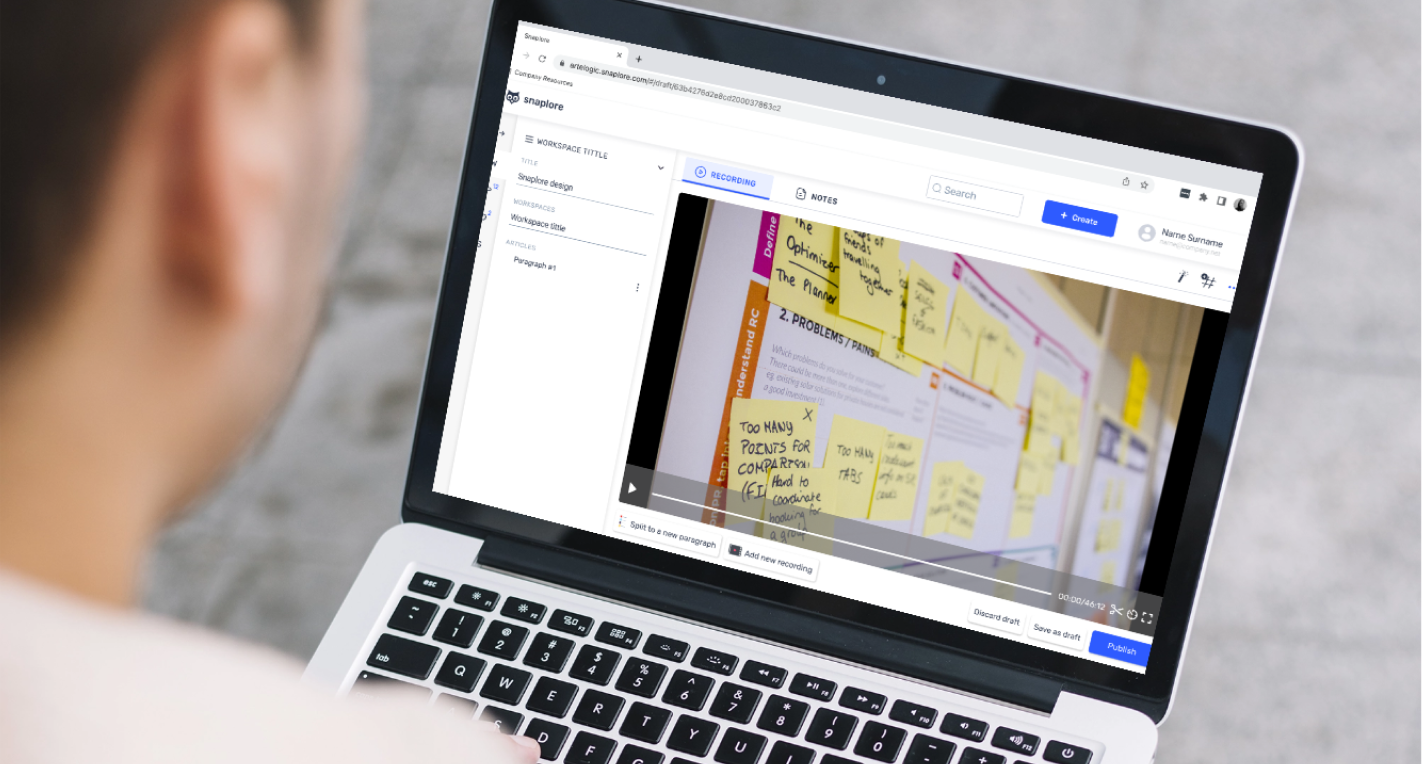 AIRevolutionizing Knowledge Management powered with AISnaplore is unicrew's own product, built and operated in-house. It uses AI to transform how organizations document, structure, and share information, making meetings, training, and project discussions instantly accessible and actionable.Up to 60%Less time on documentation
 AIAI-Powered Automation for Project ManagementAn AI bot that enhances operational efficiency by automating a critical, time-consuming, internal administrative task.30%Improvement in timely work-time logging compliance
09Client voices
Clients on the AI, automation and data work
Our headline result was a controlled experiment showing a roughly 9 percent lift in search success rate. The features built are live in production, and the AI tagging and embeddings work set up our move to vector search. What stands out most is their ability to own work end to end, from user-facing search features to the AI and data layer underneath.
Two people typing data into the database went about 5,000 new data sets per month. With this component, we’re reaching twice the amount of data sets per month. Their knowledge of different technologies is astounding. We can raise any technical issue with them and find someone within their team to work with that specific technology.
We were able to get the work completed in the expected time frame. There were little to no defects which was very nice because it allowed us to release and move on to our next project without having to back peddle. They were very accessible and took the time to understand our needs. They truly felt like part of the team.
The quality of their coding was outstanding to our standards. Overall, their work was key for us. They were dedicated to solving our problems as a customer; their team was collaborative, listened to us, and fully engaged in our space to commit to the project.
Artelogic’s work had a very positive impact on our team’s morale. As our development quality was improving, our engineers were more confident in what they were doing, allowing them to work faster and with more confidence. As a result, our releases took less time and were less stressful.
Put 30 days against the question
Tell us which conversations your business runs on, and what you wish you could get out of them. We will name the one output worth proving and what the 30 days would cover.
What happens after you contact us
- We reply within one business dayA senior engineer reads what you send, not a bot.
- A short scoping callWhich conversations, and the one output that would matter most.
- The scope and the number, in writingWhat the 30 days cover, what they cost, and the week we can begin.
- NDA, then kickoffSigned before any recording moves.
10Questions
Questions we get before a pilot
What buyers ask before they commit a month to this, answered before the call.
A short, fixed-scope build that runs transcription and language-model processing over a slice of your real calls or meetings and produces one agreed structured output. Elsewhere the same thing is sold as a proof of concept, or POC.
A useful one ends in three things:
- the pilot itself, running on your own data
- an honest accuracy read against examples you can check
- a scoped, costed plan for the production build
Ours takes 30 days.
Fixed scope and fixed price, both agreed in writing before we start. That is the fixed-price model rather than time and materials.
Scope is what moves it. A pilot on a thousand support tickets and a pilot on regulated advice calls are not the same engagement, so we quote once we know which conversations are in and which output you want proven.
Four to ten hours of your team's time in total, depending on the offer, is what our fixed-scope engagements ask as a set.
On this one that is:
- a technical contact to arrange access
- someone who knows the domain vocabulary well enough to tell us when the output is wrong
- a few hours of real use in week four
- a working session at the readout
Transcription, processing and the security setup around your data are ours.
NDA before any access. For the assessments and audits we work from read-only, least-privilege access, agreed with your technical contact before anything starts. A pilot runs on the same terms: read-only access to the sample in scope, nothing granted before the NDA.
Where transcription and processing run, what is retained, and what happens to the sample after day 30 are settled before any audio moves, under our ISO 27001:2022 certified practices. Prompt injection, data leakage and model access are part of the setup rather than a review afterwards.
No model is trained on your recordings as part of the pilot. Producing the agreed output takes transcription plus prompting on existing models, so nothing in the 30 days requires it.
That leaves the providers in the pipeline, which we settle at scoping rather than afterwards: which service transcribes, which model processes, what each retains, and what its terms say about customer data. You see that list before any audio moves.
You do, and it stays yours: under GDPR the recording notice and lawful basis sit with you as controller.
So we pilot on what you already hold lawfully and scope around the rest:
- a sample your existing recording notice covers
- redaction before anything leaves your systems, where the sample is sensitive
- a freshly consented set, where the archive will not carry it
Our project managers and engineers work from Ukraine, Poland, Estonia and the UK, four of the six countries the team spans, so GDPR is our own regime too.
Then that is the finding, and 30 days is a cheap way to reach it.
The accuracy read is written to be usable either way: where the pattern holds on your audio, where it breaks, and whether the gap closes with better prompting, a different model, cleaner source audio, or not at all. Some conversation data is too noisy or too thin for the output someone hoped for, and a month is the right amount to spend finding that out.
Usually not, and that is deliberate. Integration is the expensive half and it proves nothing about whether the output is any good, so the 30 days go into the part that is actually in question.
What you get instead is the output in the shape your system would consume, plus the integration points named and costed in the build plan. If a specific integration is the thing you need to see working, say so at scoping and we build the pilot around it.
If it proves the value, the pilot becomes the brief for a production build inside your systems, and nothing is thrown away: the pipeline, the prompts and the evaluation set all carry forward.
If it does not, you have an evidence-backed reason not to spend further, which is a good outcome for a month. Either way the output is yours and the decision is yours, including if the production build never comes to us.
11Where to go next
If a pilot is not the right first move
Five more fixed-scope offers, and the four services a pilot most often turns into. See the six side by side.
If conversations are one candidate among several, this is where you find out which one to fund first.
If the real question is what this compute costs to run once it works.
If a buyer's security review will meet this feature before your customers do.
If what you need is a first product for users to touch, not an experiment on data you already hold.
If the system holding the conversations is the thing that keeps falling over.
The full specialty behind this pilot: voice agents, call intelligence, and the pipelines under them.
Wiring a proven output into the CRM, helpdesk or workflow it has to live in.
When an off-the-shelf model is not enough and the evaluation work becomes the project.
Pipelines, storage and retention for conversation data that has to stay searchable and defensible.