
Custom software development services built to fit your business.
Custom software development is building an application around how your business actually works, instead of reshaping the business to fit a product designed for the average of a market.
- 120+Projects delivered across 12 countries since 2012
- 100+Senior in-house engineers, six countries
- 5.0Unified rating across 61 client reviews on Clutch
- ISTQBCertified QA inside every sprint
- ISO 27001Certified security practice, audited by Quay Audit UK
01Overview
Who builds it, and what the first purchase is
unicrew builds custom systems, and the first thing you buy is the decision rather than the build. Discovery produces the scope and the estimate before any budget is committed, and it weighs a custom build against the off-the-shelf products and low-code tools that could cover the same need. The work has run that way since 2012, staffed by senior in-house engineers, and no project is passed down a subcontractor chain.
- Frontend and backend in one teamOne team owns the whole stack, so the seams between the layers are not your problem to manage.
- Data engineeringPipelines, warehousing, and reporting your product and your models can trust.
- Project-based deliveryA named scope, named deliverables, and a release rhythm you can plan the rest of the business around.
- Domain-specific expertiseFintech, healthcare, logistics and hospitality: four sectors we have already built in, which is the difference between reading a regulation and having shipped under one.
- In-house, not brokeredThe 100+ engineers are unicrew's own rather than subcontractors, and our QA engineers are ISTQB certified.
02Proof
Custom software, years after launch
In January 2019 unicrew led The Manifest's Top 100 Custom Software Developers list. The evidence that has lasted longer is the systems themselves, still carrying an operation years after we built them.
- MiniMoves, a national moving operation, runs on our order platformIt handles inventory selection, pricing and order tracking for the moves the company books. VP of IT Jeff Sides, on Clutch: "double digit growth without a substantial increase in staffing".Double digitgrowth, maintained without a substantial increase in staffing
- WaiverKing has grown on software we have maintained since 2014A document management business serving gyms and studios, on a platform we refactored and have kept releasing for over a decade. CEO Craig Elsdon-Dew credits us with growing the platform "from a couple hundred companies to around 2,000" (verified Clutch review).~2,000companies on the platform, which carried a couple hundred when the engagement started
- Scale that carries an industryWe built the vehicle-inspection platform that runs paperless inspections for Jack Cooper, one of the biggest US providers of logistics and transportation services. The company has managed inventory and inspections on well over 9 million vehicles.9M+vehicles supported, the scale of Jack Cooper's own inventory and inspection operation
03Compare
Custom software, off-the-shelf, or low-code?
Start by settling whether to build at all. Buying wins whenever the market has already solved your problem. Where it has not, the choice is between a custom build for the process you compete on and low-code for a simple internal tool or a quick prototype. Our build-or-buy guide works the arithmetic through in full.
| Custom softwareunicrew | Off-the-shelf SaaSBuy | Low-code / no-codePrototype |
|---|---|---|
| Best forA process or product that is core to how you compete, or that no off-the-shelf tool fits. | Best forA common, solved problem (email, basic CRM, accounting) where your needs match the market. | Best forA simple internal tool or a quick prototype with modest logic and scale. |
| What it asks of youAn up-front investment of time and budget, which pays back where the software is a differentiator rather than a commodity. | What it asks of youAdapting to the tool, paying per seat indefinitely, and running the same software as your competitors. | What it asks of youAccepting a ceiling on complexity, performance and integration, and often a proper rebuild once it matters. |
| You end up owningThe code, the roadmap, and the data. | You end up owningA subscription and your export files. | You end up owningA platform account and a migration project. |
Quick self-check
Tick what is true for you. The read-out updates as you go.
0 of 4 true
Build where you compete, buy the rest
Custom software earns its place where the workflow is how you compete. Discovery tests your process against the tools already on the market before any budget moves, so the build goes where it pays.
Talk it throughOne signal, one conversation
A single gap is often closed by configuration or one integration rather than a rebuild. Thirty minutes settles which it is, so the budget matches the job.
Talk it throughWorth scoping before you budget
Two signals usually mean the gap is structural rather than a settings problem. Discovery turns that into a scope and an estimate you can take to whoever signs.
Book a discovery callNow it is a sequencing question
What is left to settle is what ships first and what waits, and that order is what discovery writes down.
Book a discovery callFour for four
Nothing on that list is a settings problem, and each quarter it waits adds another workaround somebody has to maintain.
Start with discoveryWe build custom software where the process is the reason customers choose you, and integrate off-the-shelf tools for the rest. We design each custom system to be cheaper to change in year two than it was to build in year one.
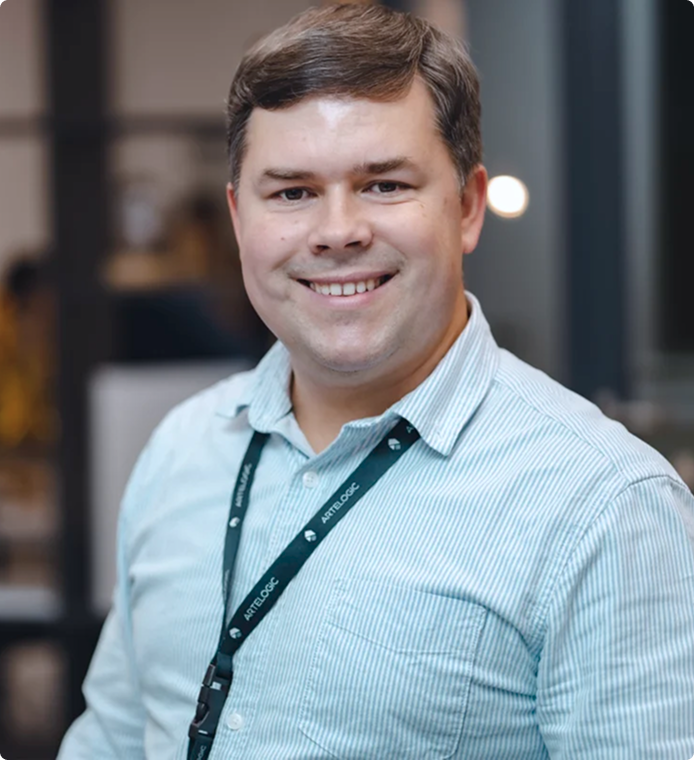 Oleksandr TrofimovChief Technology Officer, unicrew
04Capabilities
What do you need built?
Custom software is a category, not a single service. Start with the build you need: each one is a team that already ships it, and each links to the page that goes deeper.
- Custom application development
Customer platforms, portals, dashboards, and internal tools, built in React, Next.js, .NET, or Laravel. Usually the build the rest of the system has to fit around.
- Custom application development
A mobile app
iOS + AndroidNative or cross-platform apps in React Native or Flutter that share one backend with your web product, so you build the logic once.
- Custom enterprise software development
An enterprise platform
EnterpriseScalable architecture for large organizations: platforms that carry complex workflows, keep systems in step across departments, and protect the data moving between them.
- Cloud-native modernization
To modernize a legacy system
Module by moduleRe-architect or rebuild an aging system module by module, while the business keeps running, instead of a big-bang rewrite.
- Cloud infrastructure and CI/CD
Cloud-native and DevOps
FinOpsCloud-native backends, migration, and CI/CD that scale under load and keep the bill under control with FinOps discipline.
- AI-infused custom software
AI-powered features
In productionWorking AI inside the product rather than beside it: hosted models, a retrieval layer over your own data, or agents built to your specification instead of ours.
- SaaS product engineering
A SaaS product
MVP to platformDiscovery, design, and engineering in one team, from a first release that proves the idea through to the platform it turns into.
- Dedicated development team
A team to build and own it
Named podA dedicated, senior team that plugs into your process and stays with the product as it grows, not a rotating bench.
05Trust
Outcomes of our custom software development services
Delivery shows in the count a client keeps. The CEO of a Nashville software consulting firm counted six out of seven executions on time and on budget in his review. The other two figures belong to Barrett Values Centre and Lookgood.
- Six out of sevenProject executions on time and on budgetCounted by the CEO of a Nashville software consulting firm, over engagements of at least six months each
- 2 weeksLead time to assemble a teamPatrick McGuire, Director IT at Barrett Values Centre
- 200-300Bookings per vendor each monthPei Shan Wong, Founder of Lookgood, on the appointment booking platform we built
06Stack
Stacks we build on, and stacks we inherit
A custom system has to speak to whatever you already run, so the stack is constrained before it is chosen. The choice that matters is rarely the frontend framework; it is whatever the data has to move through, and whether the team that inherits it in three years will recognize any of it.
 React
 Next.js
 Flutter
 Node.js
 .NET
 Java
 AWS
 Azure
 Kubernetes
07Engagement
How a custom build is shaped, and how you pay
Three models, and they are not exclusive: a project scoped under one can move to another as the scope firms up. Which model you start in is settled before you sign rather than discovered afterwards, and so are the ownership and transfer terms, which go in the agreement before work starts instead of being negotiated at the end.
Time and materials
Most commonScope evolves as you learn, against a monthly cap you set, so the bill stays predictable while the plan does not have to be.
- Best when
- The product will change as users touch it
- You pay
- Billed hourly, quoted per project
- Typical start
- Two to four weeks
Fixed price
Defined buildOne named deliverable at one price, quoted once discovery has made the scope concrete enough to hold to.
- Best when
- Requirements are settled and signed off
- You pay
- Outcome based, quoted per project
- Typical start
- Two to four weeks
Team extension
Long-runA named senior pod that works only on your roadmap and grows or shrinks as you need it to, which takes recruitment and bench management off your plate.
- Best when
- You need senior engineers and continuity for years
- You pay
- Billed monthly, per team member
- Typical start
- Two to four weeks
A written audit first, and the delivery is a separate decision
Whichever model you pick, a takeover starts with a short technical audit: what the code does, what it costs to run, what is fragile, and what should be rewritten rather than rescued. You get that as a written document with a prioritized plan, and handing us the delivery afterwards is a separate decision. If the build has stalled rather than aged, that is a project rescue.
08Industries
Industries we build for
Six sectors with delivered work behind them. In most of them the hard part is not the feature list, it is the rule, the auditor, or the system you do not control and cannot change.
Logistics and transportation
Order management, warehouse and fleet tooling for operations that have to keep running while they change, from a national moving operation to automotive logistics.
Hospitality and leisure
Booking, membership and venue systems that have to survive a season's peak rather than an average week, including a platform for the entertainment industry.
Fintech and trading
Payment flows, accounting integrations, and commodity trading (CTRM/ETRM) platforms. We built the commodity trading platform and the accounting integration behind a financial advisory firm.
Healthcare
Monitoring platforms, patient-facing products, and integrations with clinical systems, including a home health monitoring platform we stabilized and scaled.
E-commerce
Storefronts that have to agree with an ERP, a marketplace and a warehouse at the same time, including a manufacturer selling B2B and B2C across seven European countries.
EdTech and learning
Learning platforms and research tooling, including a time-tracking tool built for a university research group whose users were its own project leaders.
Tell us what you need built, and get a straight answer
Bring the process that will not fit, and whatever you have already tried to make it fit. That is usually enough to say whether you are looking at a build or a configuration job, and what it would take.
What happens after you contact us
- We reply within 1 business dayA written reply that says whether this looks like a build, and what is missing before anyone could scope it.
- A scoping call, not a sales qualifierYour goals, your constraints, and whatever already exists.
- A written scope and an indicative rangeApproach, team shape, and what it would take. In writing.
- You decide, with no pressureOn your own timeline, with the written scope in hand.
09Delivery
How a custom software engagement works
Four stages, each ending in a named deliverable you can hold us to. No stage ends on a status update.
- DiscoveryWe run deep-dive workshops to analyze your requirements, business goals, and technical constraints, and agree what done looks like. You provide the people who know the process, whatever already exists (mockups, sample data, the current system), and someone who can settle what is in scope.You getA written scope, a detailed estimate, and a phased release plan.
- ArchitectureArchitecture is where the cheap changes of year three get decided, and where the expensive ones get locked in. We choose the stack against what you already run and write down why, rather than leaving it to be inferred later. You provide access to the systems it has to integrate with, and the constraints we cannot see from outside: contracts, compliance rules, and anything already promised to a roadmap.You getAn architecture blueprint and a stack decision, with the trade-offs recorded.
- Agile developmentYou see the software while it is being built, in short iterations, rather than at a reveal near the end. That is what makes steering cheap. You provide one person who can review each iteration and accept the work, plus test data that behaves like production data.You getWorking software at the end of each iteration, reviewed and accepted by your side before it counts as done.
- EvolutionPost-launch we support, update, and scale the software, so it keeps earning its keep as your business and load grow. You provide production access and the priorities for the next release.You getMonitoring, scheduled releases, and a roadmap that is kept current rather than frozen at launch.
10Client voices
Our clients say
I’ve been impressed by their work ethic and how they put me as the customer first. They’re always ready to jump in and go the extra mile. They put great effort into communicating to ensure that tasks are updated in a timely manner. The team keeps us apprised of exactly what they’re working on.
They’ve been helping us grow our platform together since the beginning, from a couple hundred companies to around 2,000. Artelogic has been front and center in this process.
Our platform has been refactored to Laravel ensuring the code base is more stable, easier to maintain and easier to add new features. Their professionalism and quality of work have stood out in the partnership. We have had the code audited by a 3rd party who was extremely complimentary of the work.
unicrew met deadlines and stayed on budget. The team went above and beyond what I expected; unicrew was excellent. It was more of a full-service provision than expected, so I was delighted.
The quality of their coding was outstanding to our standards. Overall, their work was key for us. They were dedicated to solving our problems as a customer; their team was collaborative, listened to us, and fully engaged in our space to commit to the project.
11Case studies
Our case studies
Six industries, six systems, no two of them the same shape. Read the one closest to your own operation rather than the one with the biggest number on it.
See all case studies SaaSWaiverKing: Software Development for Waiver Form CreatorWaiverKing is a document management business serving primarily the health and fitness industries. The platform is partnered with MindBody Online, one of the largest business-systems providers for gyms and yoga studios.Weeks to hoursTime for an update to reach live
 HospitalityHighly Adjustable Platform for entertainment industriesunicrew developed a platform for Booked It that enhanced the customer experience for nightclub, entertainment center, and festival goers.600+Businesses using the platform
 LogisticsCustom software for USA moving companyAn end-to-end SaaS platform for managing household moves and every business operation of a logistics company.Built from scratchAn end-to-end SaaS for household moves and the operations behind them
 LeisureSaaS modernization for Paddle Sports Center in CaliforniaA kayaking and paddleboard rental business in the Santa Barbara area wanted one system for equipment, customers, time and billing. That system is Adventure Rental System.15-20%Increase in revenue
- AutomationDoubling data-entry throughput with a custom recognition toolunicrew automated a manual data-entry bottleneck with a C# and AWS recognition tool, doubling the data sets the team got through each month.2xData sets processed per month
- EducationThe custom time-tracking tool that got around 40% more project leaders tracking time at RWTH Aachen Universityunicrew built a custom time-tracking web app for a research group at RWTH Aachen University, in place of spreadsheets or off-the-shelf software.~40%More project leaders tracking time
12Questions
More about custom software development with unicrew
The questions we are asked on almost every first call, answered the way we would answer them on the call.
Custom software development is building an application specifically for your business rather than buying a ready-made product, shaped around your workflow and your data, with you owning the code and the roadmap. Discovery sets it against the off-the-shelf tools already on the market, so custom is chosen where it earns its place.
It depends on scope, so we scope the work with you before we quote rather than publishing a headline price that would be wrong for most projects. Cost is driven by the number of features, integration complexity, the stack, and how much design and QA the product needs. We work under three billing models: time and materials, billed hourly and quoted per project; fixed price, outcome based and quoted per project; and team extension, billed monthly per team member. Discovery produces the estimate and the phased plan before you commit budget.
Timelines correlate with complexity. There is no minimum engagement period. How long the work runs is a scoping question rather than a contractual floor. In our delivery experience, an MVP might take a few weeks when development is supported by AI, or 3 to 4 months with a traditional approach, while a complex enterprise system can take over 12 months. Discovery produces the roadmap and the timeline estimates, and most engagements start within two to four weeks.
Two things. We are senior and in-house: 100+ engineers across six countries, on the market since 2012, first as Artelogic, which is the name several of the client reviews on this page were written under. Our engineers work from Ukraine, Poland, Estonia and the UK, and a fifth office is a US business address in Ormond Beach, Florida. You are not handed junior developers or a subcontractor chain. The second answer comes from a client: the CEO of a Nashville software consulting firm, comparing us with the other teams he works with in a verified Clutch review, said "I work with nine different teams. Their team is one of three that I never have to worry about the quality of their deliverables." The public record behind that is 61 verified client reviews on Clutch and a unified 5.0 rating, as of 31 July 2026.
Yes: the ERP or CRM you already run, payment providers, carrier or supplier APIs, and your data warehouse. On an end-to-end platform for a household moving company we put four payment gateways and Twilio voice behind one billing interface, so an operator never needs to know which gateway is processing a transaction. We map those integrations during discovery, because that is where schedule risk actually lives. The co-founder of a rental-equipment SaaS put the result this way in a verified Clutch review: "When we agree to a development phase, there aren’t any huge roadblocks that come up because of something we hadn’t anticipated or tested."
Two things decide it: how the system is split up, and what the pipeline runs before a change ships. We use microservices and containers (Docker, which packages a service with everything it needs to run) to keep services independent and easy to update and scale, and we embed security into the CI/CD pipeline, a DevSecOps approach, so a change is checked for vulnerabilities before it ships. The work runs under our ISO 27001:2022 and ISO 9001:2015 certifications, renewed through a multi-stage audit with Quay Audit UK, and our QA engineers are ISTQB certified.
Both. We build greenfield products, and we take over existing codebases that need a steadier hand or a modernization. If the main job is rescuing or re-architecting an aging system, that is our legacy modernization service, and we will point you there. Either way we start with a short assessment, so we understand the code and the constraints before we commit to a plan. An executive at a UK SaaS company described the result of one such takeover in a verified Clutch review: "We’ve made far better progress than we were two years ago with a different team."