
Conversational AI and Voice AI Development built for the conversations you are already having.
Conversational AI development turns the calls, meetings and voice notes your business already records into one structured result your own systems can search, report on and act on.
- 120+Projects delivered across 12 countries since 2012
- 100+Senior in-house engineers, six countries
- 5.0Unified rating across 61 client reviews on Clutch
- ISO 27001Certified security practice, audited by Quay Audit UK
- ISO 9001Certified quality management, audited by Quay Audit UK
01Overview
What conversational AI development means here
The listening half of the category, not the talking half. We build the pipeline that takes the speech your business already captures, transcribes it, pulls out the fields somebody would otherwise have typed, and lands them where your team works. unicrew runs that pipeline in two products of its own and builds it to order for clients.
- Products of our own in productionTalkmetry runs call intelligence inside HubSpot and Snaplore turns meetings into searchable knowledge. Both are revenue-generating unicrew products, on the pattern a client build runs.
- Accuracy settled on your recordingsAccents, crosstalk, which is what a transcript makes of two people talking at once, and the words only your business uses move accuracy further than the model does. So the evaluation set comes out of your recordings rather than quoted at you first.
- Security decided before audio movesWhere the audio is processed, what is kept and who may reach it get settled at scoping, not after a pilot. A recording of your customer is the most sensitive thing in the build.
- When the job is not a conversationAgents when the next step is acting on what was said, AI integration when the data is already structured, and AI QA and evals when accuracy is the whole question.
02Proof
Why unicrew for conversational and voice AI
Conversation AI is easy to demonstrate and hard to keep running, and a demo only shows the first half.
- meinUnterricht put a number on our language-model workThe German edtech platform embedded one of our engineers on its search and discovery team, working the full stack of search: the user-facing features on top, the AI tagging and embeddings underneath. That embeddings layer is what a conversation pipeline searches once speech has become text, and it set up their move to vector search.~9%higher search success rate, from a controlled experiment on their own users
- Two conversation AI products we own and runSnaplore and Talkmetry are unicrew's own and revenue-generating, and Snaplore has active users. What we recommend comes from running conversation AI rather than from watching somebody else run it: the model upgrades, the enterprise-security requirements, and the integrations that go down when a third party ships a change.2conversation AI products we built and still sell, so the failure modes here are ones we live with
- Audited, and specific about what that coversWhoever signs off on a recording of your customer leaving the building asks what certification stands behind the team that will process it. Ours is current, renewed through an outside audit, and we name the auditor rather than only the standard.ISO 27001:2022 and ISO 9001:2015, renewed through a multi-stage audit with Quay Audit UK
03Compare
Build it, buy a tool, or use the AI already in your stack?
What decides this is whether anything downstream is waiting for the output. If a readable recap is all anyone will open, the AI inside your meeting tool writes one for free, and we would rather say so here than in month two. One answer the table leaves out is doing nothing yet: at low volume, or with nobody to own the structured result, building it changes nothing.
| A custom buildunicrew | An off-the-shelf conversation toolBuy | The AI already in your stackBuilt-in |
|---|---|---|
| Best forOutput that has to land in your own systems, a vocabulary or compliance rule specific to you, or audio that cannot leave your control. | Best forStandard call scoring on a mainstream CRM, where your process matches the market and recordings can live in the vendor's cloud. | Best forA readable recap where the meeting happened, with no integration work and no budget. |
| Trade-offSlower and dearer than signing up for a product, and the wrong answer when a mainstream tool covers what you need. | Trade-offYou adopt their taxonomy, pay per seat indefinitely, and the structured data mostly stays inside their product. | Trade-offGeneric prompts, no domain vocabulary, and no fields you can query, report on or route. |
| You end up owningThe pipeline, the prompts, the evaluation set, and the data. | You end up owningA subscription, and whatever their export gives you. | You end up owningA pile of recaps nobody can query. |
Quick self-check
Tick what is true of your calls and meetings. The verdict changes with each one.
0 of 4 true
Conversation intelligence is the wrong buy
Nothing here says build one. At a handful of conversations a week, a person reading them beats any pipeline we could build. If the job you want automated is not a conversation, that is AI agent development; if the data is already structured and sits in the wrong system, that is AI integration.
Tell us anywayOne signal is a workflow, not a pipeline
A single symptom usually points at one process rather than a data problem, and a pipeline bought to close it produces a field nobody has agreed to use.
Talk it throughWorth the pilot, not the build
Two signals is usually real value with an unsettled scope. That is what the 30-day pilot is for: one agreed output, measured on your own recordings, and a readout allowed to say no.
Book a discovery callA build is the likely answer
At three signals the question is no longer whether the value is there. What is left is which output comes first, and which system it has to land in.
Book a discovery callAll four, and the model is not the risk
Here the schedule risk sits in the integrations and the compliance rules rather than in transcription, so retention, residency and access get agreed before any audio moves. Most engagements start within two to four weeks.
Talk about the workPilots are designed to be impressive. They use clean data, willing stakeholders, and narrow scope. Production is the opposite: messy data, resistant processes, and breadth that exposes every assumption the pilot made.
 Tural MamedovChief Executive Officer, unicrew
04Capabilities
What we build
Conversation intelligence is a category, not one feature. These are the builds we take on, each linked to the work or the page behind it. All of them sit inside our AI development services.
- Call intelligence software development
Call intelligence for sales and support
Transcribe, score, summarizeTranscribe, score and summarize every call, then push the structured result into your CRM or helpdesk instead of a dashboard nobody opens. This is the Talkmetry pattern, which we run inside HubSpot, applied to your stack.
- Meeting intelligence development
Meeting intelligence and searchable knowledge
Sources you can checkMeetings, recordings and voice notes become a searchable knowledge base with sources you can check. Snaplore, our own product, is this pattern in production: its assistant joins the meeting and records the discussion, and Snaplore's clients report up to 60% less time spent on documentation.
- Speech-to-text pipeline development
Voice and transcription pipelines
Accents, crosstalk, domain wordsSpeech-to-text pipelines that hold up under real audio: accents, crosstalk and domain vocabulary no general model has heard before. The evaluation harness is built alongside the pipeline, because that is the only way to prove accuracy on your own recordings.
- Conversation analytics and compliance recording
Conversation analysis and compliance recording
An audit trail per recordStructured extraction from regulated conversations: disclosures made, commitments given, topics covered, with an audit trail behind every record.
- Real-time audio and video streaming
The streaming layer underneath
iOS and AndroidWe ship the transport layer too. For a German security and building-management company we contributed to their production iOS and Android apps, built on the web client they already ran, working on layout, theming and video streaming. It ended in their production apps and a prototype.
- Custom speech and language models
Custom models when off-the-shelf will not do
Fine-tuning, classifiers, retrievalSometimes the hosted model cannot hear your domain, and the answer is fine-tuning, a custom classifier, or a retrieval layer over your own corpus. We say when that line has been crossed rather than assuming it from the start.
05Trust
What a conversation build hands over
Three things come out of a conversation build, and the middle one is what lets you argue with the first: one agreed output, a way to score it on your own audio, and the data rules written down before any recording moved.
- One outputA single structured result, agreed on day oneA call summary, a compliance check, a searchable transcript, or a field in your CRM
- Your own audioAn evaluation set built from your recordingsSo accuracy is measured on your accents and your vocabulary rather than quoted at you
- Written downWhere the audio runs, what is kept, and who may reach itIncluding where transcription and model processing happen, agreed before the first recording moves
06Stack
The stack behind our conversation work
This is what is running rather than what we would pick on a greenfield. Whisper, GPT models and AssemblyAI are Snaplore's, with WebRTC and AWS underneath it; Talkmetry runs GPT models and AssemblyAI inside HubSpot; iOS and Android come from the streaming work rather than from a transcription build.
 iOS
iOS Android
 WebRTC
 Whisper AI
- OpenAI / ChatGPT
- NLP
 AWS
AWS
07Engagement
How you engage us on a conversation build
Three shapes, and the first is deliberately the smallest commitment on this page. What changes is how much you commit before you have heard the pattern run on your own audio, and who owns the pipeline once it is live. There is no minimum engagement period.
The 30-day pilot
Start hereOne agreed output, measured on your own recordings, and a readout allowed to say the pattern did not hold. It is the cheapest way to find out that we are the wrong answer.
- Best when
- You want an accuracy read on your own audio before funding a build
- You pay
- Outcome based, quoted per project
- Typical start
- Two to four weeks
A scoped production build
Defined buildThe pipeline, the integrations into the systems your team works in, and the security decisions written down. Scope firms up as the integration surface is mapped, which is where the schedule risk lives.
- Best when
- The pilot held and someone is waiting for the output
- You pay
- Billed hourly, quoted per project
- Typical start
- Two to four weeks
A dedicated team
Long-runModels change, vendors change, and so does your audio, so accuracy is something somebody has to keep watching. A named senior pod stays with the pipeline instead of handing it back at launch.
- Best when
- Conversation AI is a roadmap rather than a project
- You pay
- Billed monthly, per team member
- Typical start
- Two to four weeks
An accuracy read on what exists, before anyone argues about replacing it
Where transcripts are already being produced and nobody trusts them, a takeover starts by measurement: we score what exists against an evaluation set built from your own recordings, on the audio it actually gets. You get a written read on where it holds, where it does not, and a fix, replace or stop recommendation.
08Industries
Where conversation intelligence pays for itself
Conversation intelligence earns its keep where the volume of talk is high and the written record of it is thin. These are the sectors we already build in, so we ramp on the rules and the vocabulary instead of learning them on your budget.
Logistics and transportation
Dispatch calls, driver check-ins and customer calls carry the exceptions that never reach the system of record, and we build those systems: one national moving company runs its operation on an order platform of ours.
Hospitality and leisure
Booking calls, guest requests and reviews are the operational record here, and almost none of it is structured today. The systems that would receive it are ones we build: hotel PMS, booking and payment integrations, and one platform for the entertainment industry.
Fintech and accounting
Bookkeeping, reconciliation and the security around financial data. On a 2017 engagement for a London advisory firm we took over a part-built platform, automated the bookkeeping reconciliation against their invoices and put encryption and account protection around the data, and proposed the language-processing methods for the part of the brief that read transaction descriptions.
EdTech and learning platforms
We had an engineer inside one German edtech platform's search team, building the tagging and embeddings layer beneath the product. That is the same language layer a conversation pipeline runs on once speech has become text.
Healthcare
Clinical conversations are the most regulated audio anyone records, and where patient data may travel decides the architecture long before the model does. We work in the systems around it, including the home health monitoring platform we were brought in to stabilize and scale.
E-commerce
Storefronts, ERP and marketplace integrations, on both sides of the B2B and B2C split. One European manufacturer selling in seven EU countries ran a catalogue past 10,000 products, more than its old systems could keep performing under. Support conversations sit on top of stacks of that shape.
Tell us which conversations carry the value, and get a straight answer
The first call is about which conversations you already record and what you would do with them once they were searchable. If the volume or the data does not justify building anything, that is what you will hear.
What happens after you contact us
- We reply within one business dayThe reply names the one output worth proving first, or the thing we would have to hear before this could be scoped at all.
- A call about which conversations carry valueWhich calls or meetings matter, the single structured output that would change something, and whether your volume justifies building anything at all.
- A written pilot scopeThe target output, how accuracy will be judged, and the data access and security plan, including where transcription and model processing would run.
- Contracts and NDAs, then a start dateSigned before anyone touches a recording. Most engagements start within two to four weeks.
09Delivery
How a conversation intelligence build works
Five stages: agree the output, run it on your recordings, read out the accuracy, integrate, then harden. The first three are the fixed-scope 30-day pilot, and the last two start only if the readout says the pattern held on your audio. Sometimes it does not, and that is a result too.
- Agree the one output (days 1 to 5)We settle which conversations carry value, the single output the pilot produces, and how we judge whether it worked. From you we need real conversations, a technical contact who can arrange secure access, and a decision on the one output that matters most.You getA written pilot scope: the target output, the accuracy criteria, and the data access and security plan.
- Run it on your recordings (days 6 to 27)We stand up transcription and processing on a sample of your own calls or meetings and tune it against real examples. In the final week your team uses it on live conversations, so accuracy is judged on your audio and your vocabulary. From you that is people willing to use it for a week and say where the output is wrong.You getA working pipeline producing the agreed structured output on your own conversations.
- The accuracy read, and your call (days 28 to 30)We take you through what held, what did not, and what a full build would have to fix before the output is worth wiring in. If it is not worth building, that is the readout you get. From you we need whoever makes that decision in the room while we go through it.You getAn accuracy read on your data, the limits named, and the scope of the production build that would follow.
- Integrate where the work happensThe output lands inside your CRM, helpdesk or workflow tools, with authentication, permissions, retention and residency handled. How long it takes depends on how many systems it touches, which is why we map that surface during scoping. From you we need the systems it has to reach and whoever owns the fields inside them.You getStructured conversation data inside the systems your team already uses.
- Harden and runEvaluation suites, cost controls and drift monitoring keep quality and spend predictable when the model, the vendor or the audio changes. From you we need one name: whoever owns accuracy once it is live, on your side or ours.You getAn eval suite you can rerun, cost and latency baselines, and a monitoring and review cadence.
10Client voices
In our clients' words
Our headline result was a controlled experiment showing a roughly 9 percent lift in search success rate. The features built are live in production, and the AI tagging and embeddings work set up our move to vector search. What stands out most is their ability to own work end to end, from user-facing search features to the AI and data layer underneath.
Even though Artelogic didn’t have a background in this area, they learned quickly and repurposed technologies they’d used before in order to solve the business problem. I was very impressed with this ability, as most of the people we contacted before implied that they’d need to spend a lot of time of trying to understand our business logic.
The project led to the release of our production apps and a prototype showcasing new features. They were reliable, responsive, and consistently addressed our needs very well. We were impressed by their strong technical and interpersonal skills and how smoothly they adapted to our team, processes, and product.
Artelogic’s work had a very positive impact on our team’s morale. As our development quality was improving, our engineers were more confident in what they were doing, allowing them to work faster and with more confidence. As a result, our releases took less time and were less stressful.
Site was migrated and re-written, the new system is much more stable, and performance highly improved. Excellent technological level. highly responsive and communicative. They are highly committed to the project and business goals.
11Case studies
Conversation and language AI in production
Snaplore is unicrew's own product and the other study is a client's platform. Artelogic appears in two of the quotations above: that is unicrew's former name, left as the clients wrote it.
See all case studies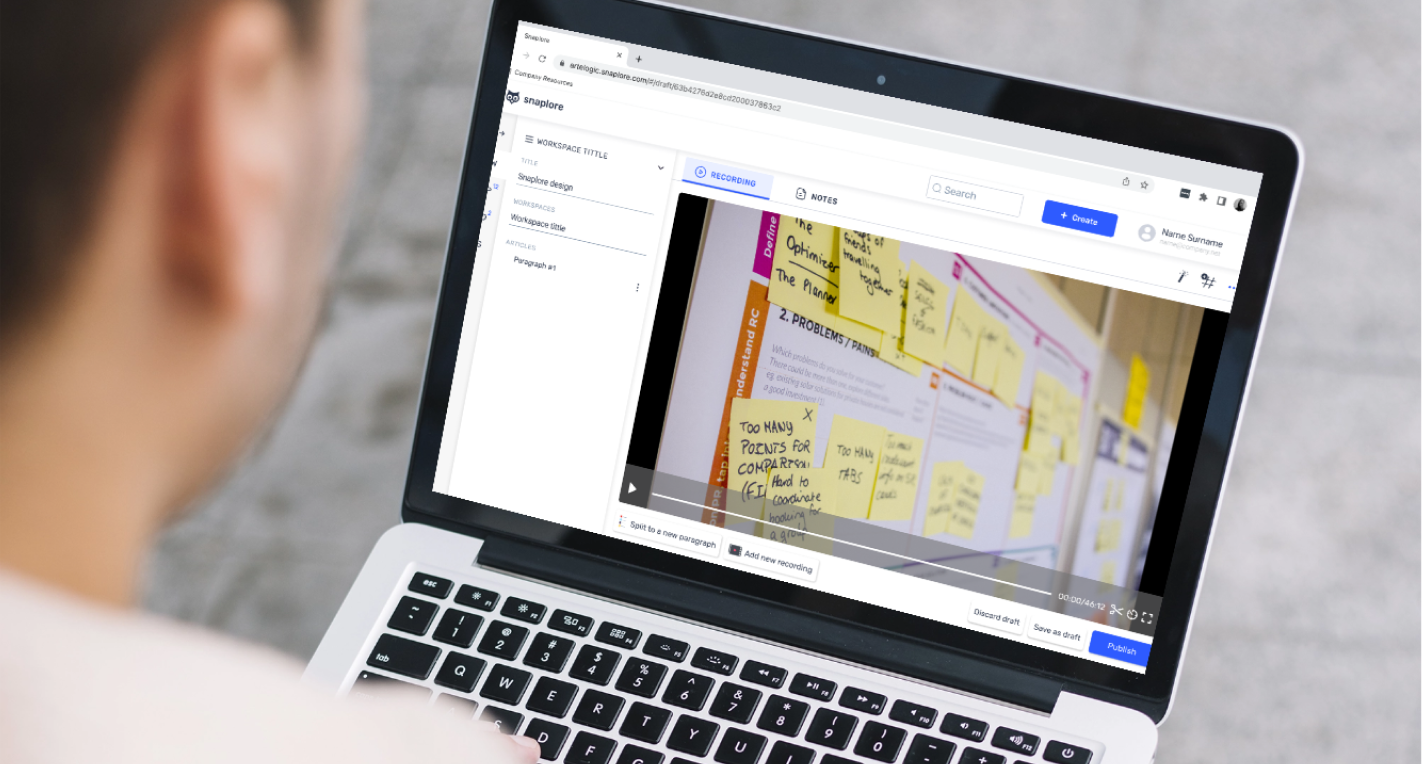
12Questions
About conversational AI and voice AI development
The question underneath most of these is where the audio goes and what happens to it after, so that is the one answered at length.
Conversational AI development builds software that understands human conversations, spoken or written, and turns them into structured, usable data. In practice that means transcription (Whisper, AssemblyAI), language-model processing (GPT-class models), and integration into the tools your team already works in. It covers call intelligence, meeting intelligence, voice pipelines and conversation analysis. The same phrase is used across the industry for customer-facing chatbots and voice agents that talk back; that is the other half of the category, and this page is about the listening half.
There is no honest headline price, so we scope before we quote. Four things drive the number: how much audio you process, how many systems the output has to reach, how high the accuracy bar is, and what compliance obligations the data carries. The 30-day pilot keeps the first commitment small and fixed in scope, and the estimate for the full build comes out of what the pilot measured. If you want an ongoing team instead, that is team extension, billed monthly per team member.
In our delivery experience the answer is weeks rather than quarters, provided the recordings exist and somebody can grant access to them. Our fixed-scope conversation intelligence pilot runs 30 days and ends in an accuracy readout on your own recordings and a decision. A production build after that depends mostly on how many of your systems the output has to reach, which we map during scoping.
Yes, and it is usually the larger half of the work. Talkmetry, our own product, is call intelligence living inside HubSpot. Snaplore works standalone or alongside Slack and Google Workspace, and its assistant joins meetings on Zoom and Google Meet; keeping those integrations stable across fragmented platforms was the hard part of building it. We map your integration surface during scoping, because that is where the schedule risk lives.
Buy when a generic feature set fits your process and your recordings can live in someone else's cloud. Build when the value sits in your own workflow, vocabulary or compliance rules, or when the output has to land inside your systems. We operate our own products, so we can read your case honestly, and sometimes the answer is a tool.
We do not know until we run it on your recordings, and neither does anyone quoting you a percentage before hearing them. Accents, crosstalk, line quality and domain vocabulary move accuracy more than the choice of model does. So the pilot builds an evaluation set out of your own conversations and scores the output against it, which is the AI QA and evals discipline applied to audio. You get the numbers, including where the pattern falls short.
Conversation data is as sensitive as data gets. We are ISO 27001:2022 and ISO 9001:2015 certified, renewed through a multi-stage audit with Quay Audit UK, and we design each build around data minimization, access controls and your residency requirements, including where transcription runs, where model processing runs, and what is kept afterwards. Prompt injection and data leakage are reviewed with our in-house security practice, a dedicated security engineer plus a part-time senior security consultant. The people who would handle your recordings are unicrew's own employees, working in Ukraine, Poland, Estonia and the UK. We are not SOC 2 certified and will not claim otherwise.
The proven core is Whisper and AssemblyAI for transcription, GPT-class models for processing, WebRTC for real-time audio and video, and AWS for infrastructure. That is the stack behind Snaplore, and we pick per case rather than per habit. The pattern matters more than the logo list: audio in, transcription, model processing, structured output inside the tool your team already works in.
Every full-service vendor claims transcription, processing and integration, this one included, so the category separates nobody. Three checks do, they work from outside, and they should be put to us as well. First, ask what accuracy anyone will commit to before hearing your audio, and how that number would be produced and on whose recordings. Ours is that nobody honestly can, which is why a pilot starts by building an evaluation set out of your own conversations. Second, ask where the audio goes and what is kept, because transcription and model processing each run somewhere and retention is a decision rather than a default. Ours is settled in writing at scoping, before a recording moves. Third, ask for a link to a review rather than a score: each quotation in the grid above opens the client's own Clutch interview.
When your team handles a handful of conversations a week, because a person reading them is cheaper than any pipeline we could build. When nobody will own the structured output, since a field nobody agreed to use changes nothing. And when what you need is a contact-center voice bot on a telephony platform in a few weeks: hire a specialist in that platform, because on that job we would be learning your dialer on your budget. If the job is not a conversation at all, that is AI agent development.
Three things: a sample of real conversations to pilot on, a technical contact who can arrange secure access to them, and agreement on the single output that would matter most, whether that is a call summary, a compliance check, or a field in your CRM.