Enterprise AI Roadmap: From Pilot to Production in 2026
88% of enterprises now use AI. Only 39% see real results. Here's the step-by-step roadmap to move from pilot to production in 2026.

Tural MamedovChief Executive Officer
Published
Share
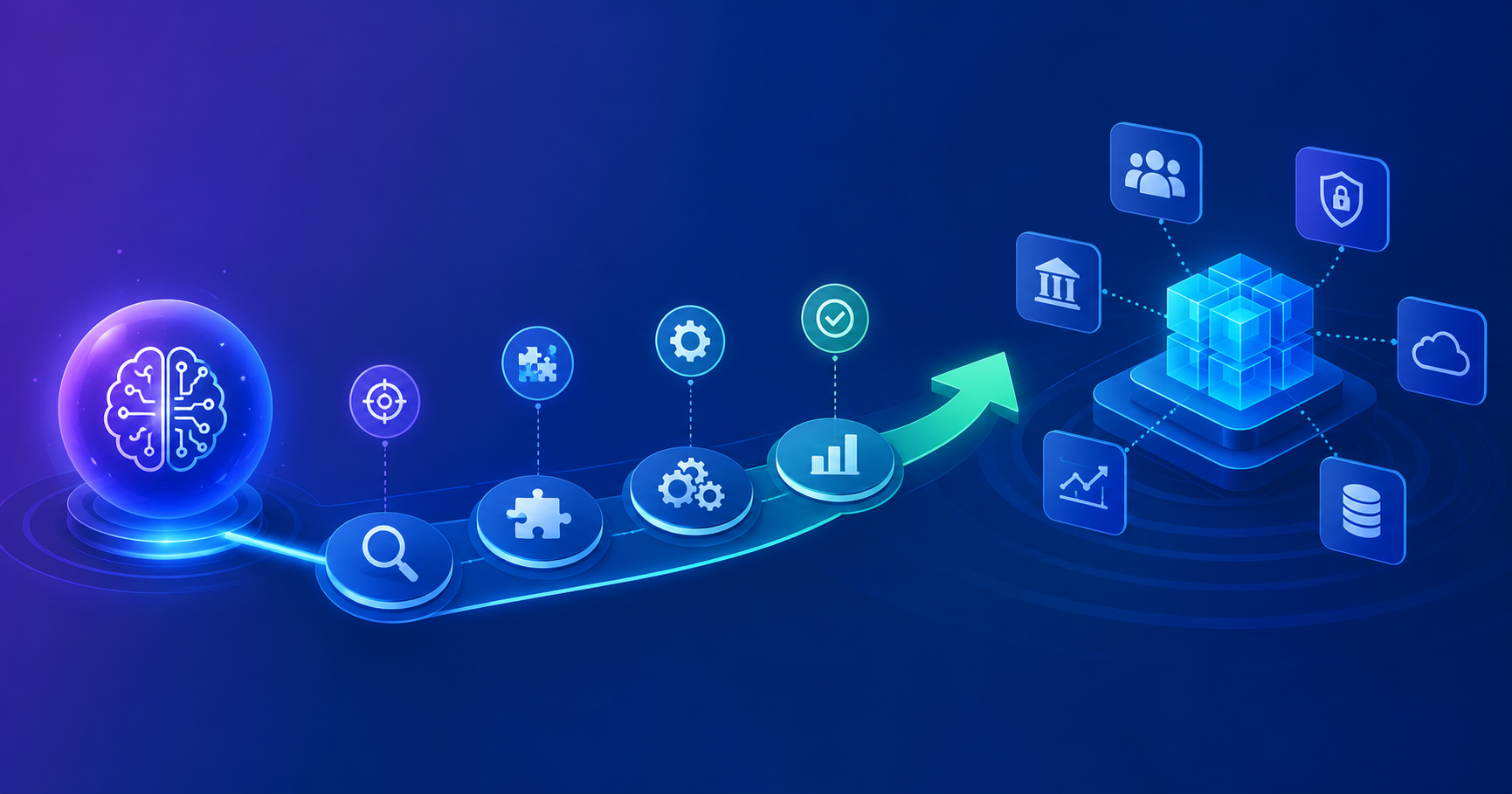
Enterprise AI integration means embedding AI capabilities into your existing business systems and workflows so they deliver measurable value, not just a proof of concept. The roadmap has five stages: readiness assessment, use case selection, integration approach, governance, and iterative scaling. Most organizations skip the first two and wonder why their AI initiative stalls.
The evidence is hard to ignore. According to McKinsey's November 2025 State of AI report, 88% of organizations now deploy AI in at least one business function. Yet only 39% report any measurable EBIT impact. The gap between adoption and value creation is not a technology problem. It is a sequencing problem.
This guide covers what that sequence actually looks like in 2026.
Most AI Programs Are Stuck at the Pilot Stage
Gartner projects that 40% of enterprise applications will include task-specific AI agents by end of 2026, up from less than 5% in 2025. That trajectory sounds impressive until you look at what's actually in production: only 23% of organizations are scaling agentic AI across the enterprise right now. Another 39% are still experimenting (McKinsey, Nov 2025).
The pilot-to-production gap exists for a reason. Pilots are designed to be impressive. They use clean data, willing stakeholders, and narrow scope. Production is the opposite: messy data, resistant processes, and breadth that exposes every assumption the pilot made. The organizations closing this gap are not smarter. They are more deliberate about the steps between ideation and scale.
Step 1: Run an AI Readiness Assessment
Before selecting a tool or signing a vendor contract, assess what you actually have. A readiness assessment covers three dimensions: data, systems, and people.
Data. Gartner estimates 60% of agentic AI projects are at risk of failure due to poor data quality. AI does not improve bad data. It amplifies it. You need to know where your data lives, how complete it is, and whether it is accessible in a form that AI systems can use. Data that exists in siloed spreadsheets, inconsistent formats, or systems that lack APIs will slow every subsequent step.
Systems. Determine which parts of your current infrastructure can support AI integrations without a full overhaul. Many organizations can layer AI capabilities onto existing platforms without replacing them. Others have legacy systems where modernization is a prerequisite. Knowing the difference before you start saves months. If you have significant technical debt, it is worth looking at legacy software modernization as a parallel track.
People. The most underestimated dimension. Who in the organization will own AI outputs? Who will be responsible when an AI recommendation is wrong? Change management is not a soft skill add-on. It is one of the main reasons AI programs fail to cross from IT projects into operational reality. Having a dedicated AI strategy lead, whether in-house or fractional, significantly accelerates this.
Why data readiness is where most programs stall
Most organizations discover during the readiness assessment that their data is less ready than assumed. Customer records across three CRMs with no shared ID scheme. Financial data that requires manual reconciliation before it can be analyzed. Operational data locked inside systems that predate modern APIs.
The honest response to this finding is not to delay AI indefinitely. It is to tackle data infrastructure in parallel with an initial AI use case narrow enough to work with what you have. This produces early value while the broader data foundation matures.
Step 2: Pick Use Cases That Can Actually Show ROI
The best enterprise AI use cases in 2026 share three characteristics: they involve repetitive, high-volume tasks; they have clear success metrics that are already being tracked; and they sit close enough to existing systems that integration is feasible without a ground-up build.
Business process automation is one of the fastest paths to demonstrable return. Document processing, invoice handling, customer query routing, and internal knowledge retrieval are all areas where AI delivers measurable time savings quickly. A useful example: unicrew's Snaplore project showed clients reporting up to 60% reduction in time spent on documentation tasks after integrating AI-driven knowledge management into their workflows.
What makes a good first AI use case
A strong first use case has a baseline you can measure against: average handling time, error rate, cost per transaction. It also has a defined human review step, so AI outputs are validated before they affect anything irreversible. And it is in a part of the business where stakeholders are motivated to make it work, not just watching to see if it fails.
Avoid starting with use cases that require perfect data, involve high regulatory exposure, or replace a function that employees feel strongly about. Save those for version two, when you have organizational credibility built up.
Step 3: Choose Your Integration Approach
There is no single right answer here, but there are two main paths, and choosing the wrong one wastes significant time.
API-first integration means connecting to an existing AI service (OpenAI, Azure AI, Google Vertex, etc.) via API and configuring it for your use case. This is faster, cheaper, and lower risk for most common tasks. It works well when your requirements fit within what these platforms already do, and when data privacy and compliance constraints allow it.
Custom AI/ML development is the right choice when your use case requires a model trained on proprietary data, when off-the-shelf APIs cannot meet your accuracy requirements, or when IP considerations make relying on a third-party model problematic. Custom AI/ML development takes longer and costs more upfront but can produce significant competitive advantage when the use case is core to the business.
Most enterprises in 2026 are not choosing one or the other across the board. They are using API-first integration for commodity tasks and custom development for differentiating capabilities. The key is being deliberate about which category each use case falls into, rather than defaulting to custom development because it sounds more serious, or defaulting to APIs because they are faster.
Step 4: Build Governance Before You Scale
Governance is not a compliance checkbox at the end of the project. It is the infrastructure that makes scaling possible without creating unmanageable risk. Organizations that treat governance as an afterthought find themselves pausing AI rollout later to retrofit controls that should have been there from the start.
At minimum, your governance framework needs to cover:
Accountability. Who is responsible for AI decisions in each domain? If the AI recommends an action that causes a problem, where does the escalation path lead? This needs to be defined before deployment, not after something goes wrong.
Data access and privacy. Which data can AI systems use, and under what conditions? This is especially important for AI tools that send data to third-party APIs. Organizations in regulated industries need to verify that their chosen integration approach is compatible with GDPR, HIPAA, or whatever frameworks apply to their context.
Output validation. High-stakes AI outputs should have a human review step, at least initially. As the system proves itself on a specific task, the review threshold can be adjusted. But building without review loops from the start creates situations where errors compound before anyone notices.
The AI consulting process typically spends significant time on governance architecture, because the technical integration is often the simpler part. Getting the accountability model right requires understanding the organization's risk tolerance, existing compliance obligations, and how decisions are actually made day to day.
Step 5: Measure, Iterate, and Expand
AI integration is not a project with a launch date. It is an ongoing program with cycles of measurement, learning, and expansion.
Define your success metrics at the use case level before deployment. Time saved per transaction. Error rate reduction. Cost per outcome compared to the previous baseline. These metrics need to be pulled from real operational data, not user surveys.
Review them on a fixed cadence: monthly for the first six months, quarterly after that. The goal is to identify quickly whether the integration is performing as expected, where it is falling short, and why. Performance problems in AI integrations almost always trace back to one of three sources: data quality issues that were not caught in the readiness phase, edge cases the initial configuration did not handle, or workflow adoption problems where people are working around the AI rather than with it.
Each review cycle feeds the expansion decision. Which use cases are ready to broaden? Which need adjustment before scaling? What has the first wave of integration taught you about organizational readiness that should inform the next one?
The enterprises pulling ahead in 2026 are not necessarily those with the most AI tools. They are the ones running this loop consistently. That finding from McKinsey's research, which shows that only 6% of organizations are capturing disproportionate AI value, correlates directly with disciplined measurement and iteration, not with the sophistication of the tools chosen.
For context on how this affects your technology partner choices, our post on what AI is changing about software outsourcing covers what to demand from any external partner supporting your AI program.
Key Takeaways
The pilot-to-production gap is not a technology problem. It is a sequencing and governance problem. The enterprises producing real AI ROI in 2026 share a common pattern: they assessed readiness honestly before committing to tools, chose initial use cases with clear metrics, built governance into the architecture early, and measured consistently enough to learn from every deployment cycle.
If you are at the assessment stage or trying to determine the right integration approach for a specific use case, our AI consulting team works through exactly these questions with engineering and business leadership. You can also explore our AI integration services to see how we approach the technical side of the problem.
Frequently asked questions
An AI readiness assessment. Before selecting tools or platforms, you need to understand the state of your data, systems, and organizational readiness. Skipping this step is the most common reason enterprise AI programs stall or fail to produce measurable results.
The three most common causes are poor data quality (Gartner estimates 60% of agentic AI projects are at risk on these grounds), insufficient governance frameworks, and a failure to define success metrics before deployment. Pilots succeed because they are controlled environments. Scaling requires confronting the messiness of real operations, which most organizations are not adequately prepared for.
Not always. In many cases, AI capabilities can be layered onto existing infrastructure via API integrations without replacing the underlying systems. Where legacy modernization is required, it is better treated as a parallel workstream than a prerequisite that delays everything. The readiness assessment will surface which approach applies to your situation.
AI integration means connecting existing AI capabilities (APIs, platforms, pre-trained models) to your business systems. AI development means building custom models trained on your own data. Most enterprises use a combination: integration for commodity tasks, custom development for use cases where proprietary data creates competitive advantage.