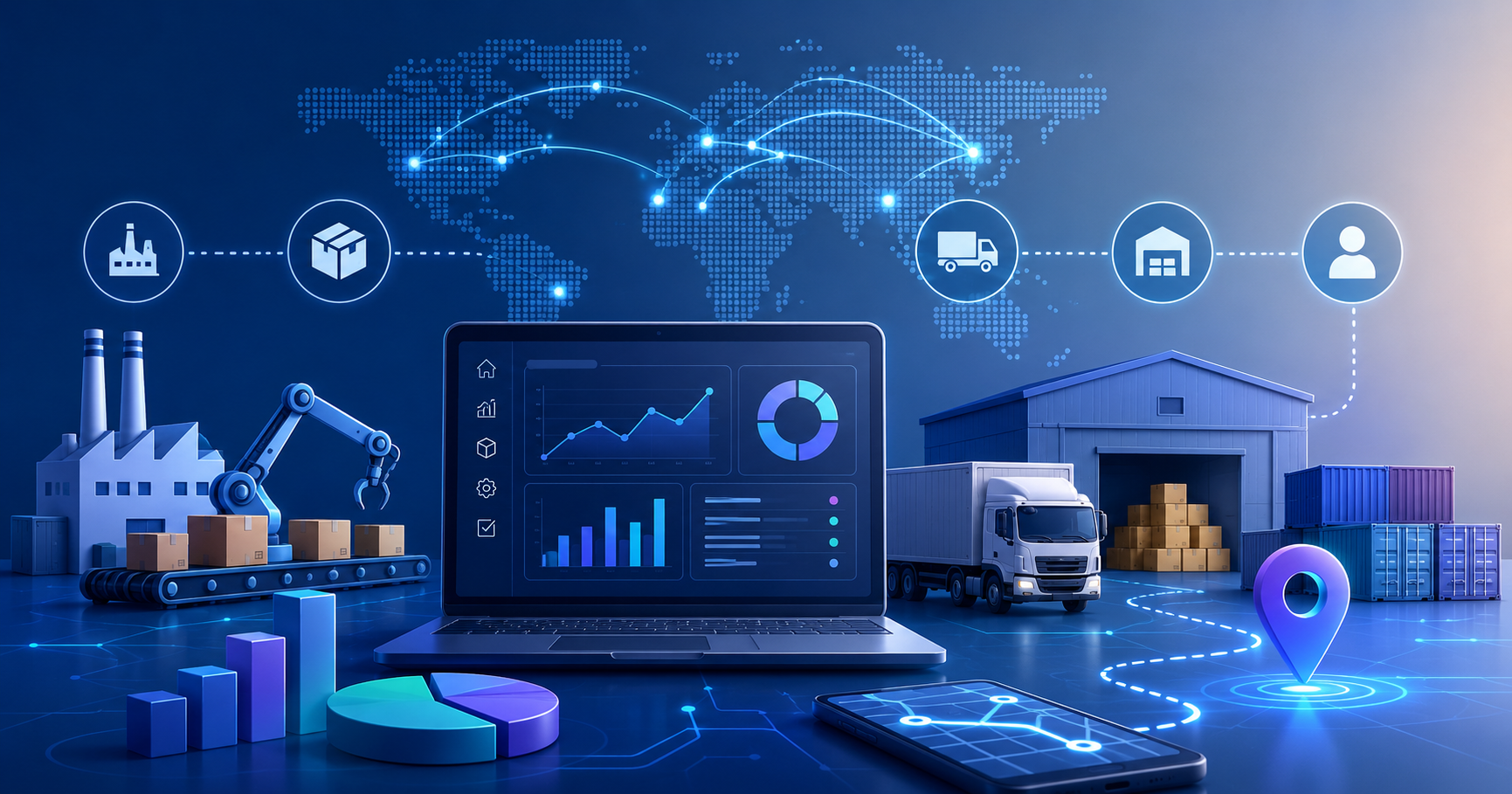
Buy, Build, or Blend? Logistics API Integration Guide
Should you buy a logistics API, build custom integration, or blend both? A practical decision framework from two real supply chain platforms.

Tural MamedovChief Executive Officer
Published · Updated
Share
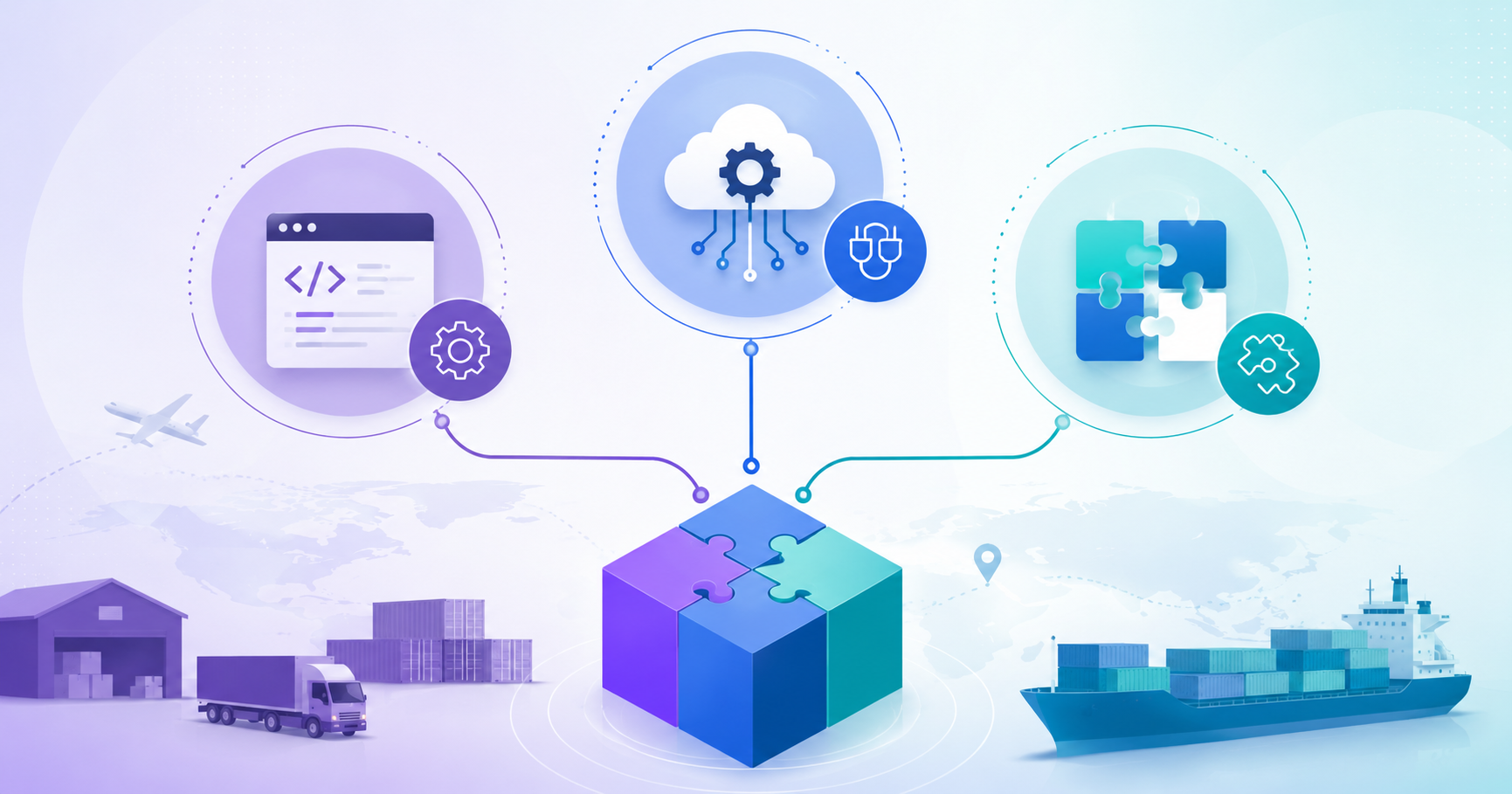
Choose buy when the capability is a commodity standard, like payments or telephony. Choose build when the integration is your differentiator or has to outlive a vendor's API. Choose blend when neither extreme survives contact with a real supply chain workflow. Most logistics platforms end up blending, and that decision should be deliberate, not accidental.
That is the short version. The longer version is what this post is about: a working framework for logistics API integration that we have used on real supply chain projects, from moving company SaaS to multi-app warehouse management. We will walk through when a third-party logistics API is the obviously right call, when custom integration earns its keep, what a thoughtful blend looks like in production, and a six-factor decision matrix you can pull into your next architecture review.
The stakes are not academic. The API logistics market is valued at USD 2.09 billion in 2025 and projected to reach USD 13.21 billion by 2035, a 20.2% compound annual growth rate, according to FactMR's API Logistics Market analysis. Gartner's 2024 Hype Cycle for APIs found that 82% of organizations use APIs internally and 71% consume third-party APIs from SaaS vendors or AI providers, per Boomi's point of view on the same report. Logistics platforms are deep in this growth, but the decisions made today (which APIs to lean on, which to wrap, and which to refuse outright) are decisions you live with for years.
The real question isn't buy vs build
Framing logistics API integration as a binary choice (buy a SaaS or write everything yourself) tends to produce both bad architectures and bad budgets. The honest framing is closer to a portfolio decision: every capability your platform needs sits on a spectrum from "pure commodity" to "pure differentiator," and the right answer changes per capability inside the same product.
A moving company SaaS does not differentiate on how it charges credit cards. A 4PL warehouse platform does not differentiate on how it sends SMS. But that same moving SaaS may differentiate sharply on how it manages affiliate referrals, multi-leg job orders, and the choreography between movers, customers, and van lines. And that warehouse platform may differentiate on the modular app store that lets customers extend the WMS without code changes.
So the useful exercise is mapping each capability against two axes: how standardized is the underlying problem, and how much does the way you solve it shape the product's value. Standardized plus low differentiation pushes you toward buying. Bespoke plus high differentiation pushes you toward building. Almost everything else lands in the blend zone.
When buying a logistics API is the right call
Buying (or more precisely, integrating a hosted API) wins when the underlying capability is a regulated standard, a network effect, or a stack of operational concerns that would take you years to match. We see this pattern repeatedly in supply chain platforms, and it lined up cleanly when our team built the moving company SaaS for Cloud Van Lines.
Commodity capabilities with a regulated standard
Payments is the textbook example. For Cloud Van Lines, the platform needed to charge customers reliably across multiple processors and account types. The right architectural answer was to integrate four established payment providers (Authorize.Net, PayPal, USAePay, and BluePay) rather than build anything that touches card data directly. Authorize.Net alone maintains PCI DSS Level 1 certification, the highest tier in the Payment Card Industry Data Security Standard, with annual third-party audits covering encryption, access logging, and incident response. Building an equivalent in-house would have meant taking on PCI scope, ongoing certification cost, and a security surface area unrelated to the actual product.
The same logic applies to other commodity capabilities common in supply chain logistics: address validation, geocoding, currency conversion, tax calculation, and identity verification. When the underlying problem is standardized and the cost of being wrong is high (chargebacks, regulatory exposure, data-breach liability), there is little upside to building.
Communication channels you'll never out-engineer
Telephony and messaging are the second clean buy case. For Cloud Van Lines, the platform integrated Twilio for both the call center workflow and quote follow-up. The Twilio integration is not glamorous, but it is the kind of capability that quietly underwrites the entire sales motion of a moving operation. Inbound calls land in queues tied to lead records. Outbound follow-up calls and SMS pull data from the CRM the team already lives in. Trying to build that on top of carrier SIP trunks would have replaced a weekend of integration work with a year of telecom engineering.
The pattern generalizes. Multi-carrier shipping rate APIs like ShipEngine, real-time tracking APIs like Tive, and freight-data APIs like Flexport all fall in this category. The value is not in the code that calls the API; it is in the network the API gives you access to. We covered the broader landscape in our companion post on the top logistics APIs for the supply chain industry.
When custom integration earns its keep
Custom integration is not just "writing the API client yourself." It is taking the time to design data models, workflows, and contracts that the rest of your platform depends on, and choosing how to expose those internally and externally. Done well, custom integration outlives any specific vendor and becomes part of the architectural moat.
Your differentiator lives in the workflow, not the data
For Bitergo, the German warehouse management vendor we worked with, the Warehouse Star suite was designed as a collection of more than 15 modular standardized web and Android apps. The product strategy depended on customers being able to deploy and combine those apps without rebuilding everything from scratch. unicrew implemented the Angular components against a detailed style guide and UX concept, and then completed the backend integration via REST. To stretch our resources further, we used Storybook to build universal components that could be dropped into the new grid of each application.
That sounds like a front-end story. It is actually an integration story. The reusable component library plus the REST contracts behind it are how a 15-app suite stays coherent. If those interfaces had been bolted on per application, the suite would have ossified within a release cycle. After the launch of the Business App Store, Bitergo's Managing Director Andreas Trautmann noted that the website provided a steady source of sales leads through a rapid increase in test accounts, which is exactly the kind of payoff you get from a clean integration foundation.
You need a platform other systems can plug into
The Warehouse Star suite is described by Bitergo as having "the ability to integrate other systems." That phrase is doing a lot of work. A WMS that only consumes data is a feature; a WMS that lets other systems plug in is a platform. Building that capability is unavoidably custom. There is no third-party API that gives you "be the integration target." You have to design the contract, version it, document it, and operate it.
The same shape shows up in transportation management systems, supply chain visibility platforms, and any product where customers want to embed your data into their own ERP or BI environment. If a customer's first question is "do you have an API?", you are in build territory whether you like it or not.
When to blend: the hybrid most supply chain platforms actually need
In our experience across logistics and warehousing projects, the realistic answer is rarely all buy or all build. It is blend, with discipline. Hybrid integration models are gaining popularity because they let organizations combine cloud-based APIs with on-premises systems and custom workflows, achieving what FactMR describes as an optimal balance between agility and control. The trick is making the blend deliberate.
Wrap APIs in your own domain model
The most common blend pattern is one we used heavily on Cloud Van Lines: integrate proven third-party APIs, but route them through internal domain services that speak your business language, not the vendor's. A "ChargeCustomer" service inside the platform does not expose Authorize.Net request payloads or BluePay session tokens to the rest of the codebase. It exposes a moving-industry concept: a payment against a quote against a job order. Internally, that service decides which processor to call.
Two benefits follow. First, replacing or adding a payment provider becomes a localized change, not a rewrite. Second, the rest of the platform stays oblivious to vendor churn (Authorize.Net deprecates an endpoint, PayPal rotates an SDK, USAePay updates webhook formats), which would otherwise propagate through the codebase as a slow tax.
Keep replacement cost low with adapter patterns
Adapter patterns are the unsexy infrastructure that makes hybrid logistics integration survive five-year vendor lifecycles. Each external API gets a thin adapter that translates between the vendor's contract and your internal model. The adapters can be tested in isolation, swapped without touching business logic, and bounded so that PCI scope, GDPR scope, or SOC 2 control surfaces do not bleed across the system.
This is the same architectural instinct behind the REST backend we built for Bitergo's Angular front end: define the contract first, treat the implementation as replaceable, and never let the UI know which underlying service is answering the call.
A six-factor decision matrix for logistics integration
When teams ask us how to decide between buy, build, and blend on a specific capability, we walk through six factors. None of them is sufficient on its own; together they usually produce a clear answer.
1. Strategic differentiation
Does the way you solve this problem shape the product's value? If yes, lean build. If no, lean buy. For Cloud Van Lines, "how we charge a card" was not differentiation. "How we choreograph movers, agents, and van lines around a single job order" absolutely was.
2. Regulation, compliance, and audit scope
Capabilities that pull you into PCI, HIPAA, KYC/AML, or export-control scope are usually cheaper to buy. Every line of code you write that touches cardholder data, for example, is a line that has to be audited. Established vendors absorb that audit cost across their entire customer base.
3. Time-to-value vs lifetime cost
Buying delivers faster initial value; building delivers lower marginal cost at scale. Capterra's 2023 SMB Tech Trends Survey found that 33% of software buyers experience buyer's remorse from products that fail to meet expectations, which means time-to-value is real but cuts both ways: a fast integration with a wrong-fit vendor is a worse outcome than a slower build that fits.
4. Vendor lock-in and API churn risk
Some APIs are remarkably stable for a decade; others rotate authentication schemes every two years. Read the changelog before you commit. The blend pattern (adapter wrappers around vendor APIs) is the cheapest insurance policy against churn. If you cannot picture replacing a vendor in 18 months without rewriting the product, you are locked in.
5. Data ownership and observability
Where does the data live, who owns it, and can you see what is happening in the integration? Some vendors return rich event streams; others give you a single status field. For supply chain platforms, observability is not a nice-to-have. Real-time visibility into where a shipment, an order, or a payment sits in its lifecycle is often the product itself.
6. Team capability and run-cost
The hidden line item in every build decision is the run-cost: on-call rotation, security patching, dependency upgrades, and the institutional knowledge needed to operate the integration after the original engineers move on. Build only when you can credibly fund the run-cost, not just the initial sprint.
Common integration mistakes in supply chain projects
Three patterns show up often enough in supply chain integration projects that they are worth naming.
The first is treating every API as equal. A payments API and a custom carrier scraping integration carry wildly different risks, but they often get the same review depth. They should not. The higher the regulatory exposure or the network effect, the more weight the buy decision deserves.
The second is letting vendor data models bleed into the core. When the rest of the codebase starts speaking Stripe-ese or Authorize.Net-ese, the integration has won and the product has lost. Internal services should speak the business's language. The adapter is where translation lives.
The third is building integration platforms before having anything to integrate. The Bitergo pattern (REST backend, clean contracts, modular front-end via Storybook) worked because the apps came first and the integration story followed. The reverse, an integration platform with no concrete consumers, tends to optimize for hypothetical needs and underdeliver on real ones. We touched on related pitfalls in our post on choosing reliable logistics software for supply chain success.
Where to go from here
The buy-build-blend decision is rarely a one-time call. It is something you revisit as your supply chain platform grows, as vendors evolve, and as differentiation shifts. The teams that get this right tend to do three things consistently: they map capabilities to differentiation, they design replaceable integrations from day one, and they keep their domain language clean of vendor concepts.
Talk to our supply chain integration team
If you are working through a similar decision (a new payment provider you are not sure about, a custom WMS integration that is drifting into vendor lock-in, or a logistics platform you want other systems to plug into), our team has worked through these exact tradeoffs on production supply chain software. We would happily walk through your architecture with you and pressure-test the decision before you commit.
Book a logistics integration scoping call with unicrew →
You can also see how we work in the logistics and transportation services hub and the platforms development and integration practice.
Frequently asked questions
Short-term, buying a logistics API is almost always cheaper. Long-term, the answer depends on volume, vendor pricing curves, and how central the capability is to your product. For commodity capabilities like payments or SMS, the API stays cheaper at almost any scale. For capabilities tied to your differentiation, custom integration usually pays off within two to three years because vendor per-call or per-seat pricing scales with you while engineering cost amortizes.
Build when the workflow itself is the product. A moving company's quote-to-invoice choreography across customers, movers, affiliates, and van lines is rarely served by an off-the-shelf SaaS. The same applies to a 3PL's multi-tenant inventory rules or a freight forwarder's customs document automation. Buy the commodities (payments, telephony, geocoding) and build the parts that customers actually pay you for.
The three biggest risks are vendor lock-in (your platform inherits the vendor's roadmap), API churn (breaking changes you did not ask for), and data leakage (sensitive shipment or payment data sitting in someone else's environment). All three are manageable with adapter patterns, contractual SLAs, and clear data classification, but they need to be designed for, not assumed away.
Wrap every external API in an internal service that speaks your domain language, keep contracts small and well-versioned, and run integration tests that can swap one vendor for another. If a hypothetical migration would take longer than the original integration, you are already locked in. The Cloud Van Lines payment integration is a good model: four providers behind a single internal billing service, so the platform can route, fall back, or replace any of them without touching business logic.
A hybrid logistics integration architecture typically has three layers: thin vendor adapters that translate between external APIs and your internal model, a domain layer that exposes business-meaningful services (a billing service, a notification service, a tracking service), and the application layer that depends only on the domain. Bitergo's Warehouse Star suite is a clear example: an Angular front end talks to a REST backend, the REST backend orchestrates internal services, and those services can integrate other systems without exposing the integration plumbing to the apps.