Enterprise Application Modernization: A Framework for 2026
Enterprise app modernization is the #1 CIO priority in 2026. A practical framework for assessing, phasing, and executing modernization the right way.
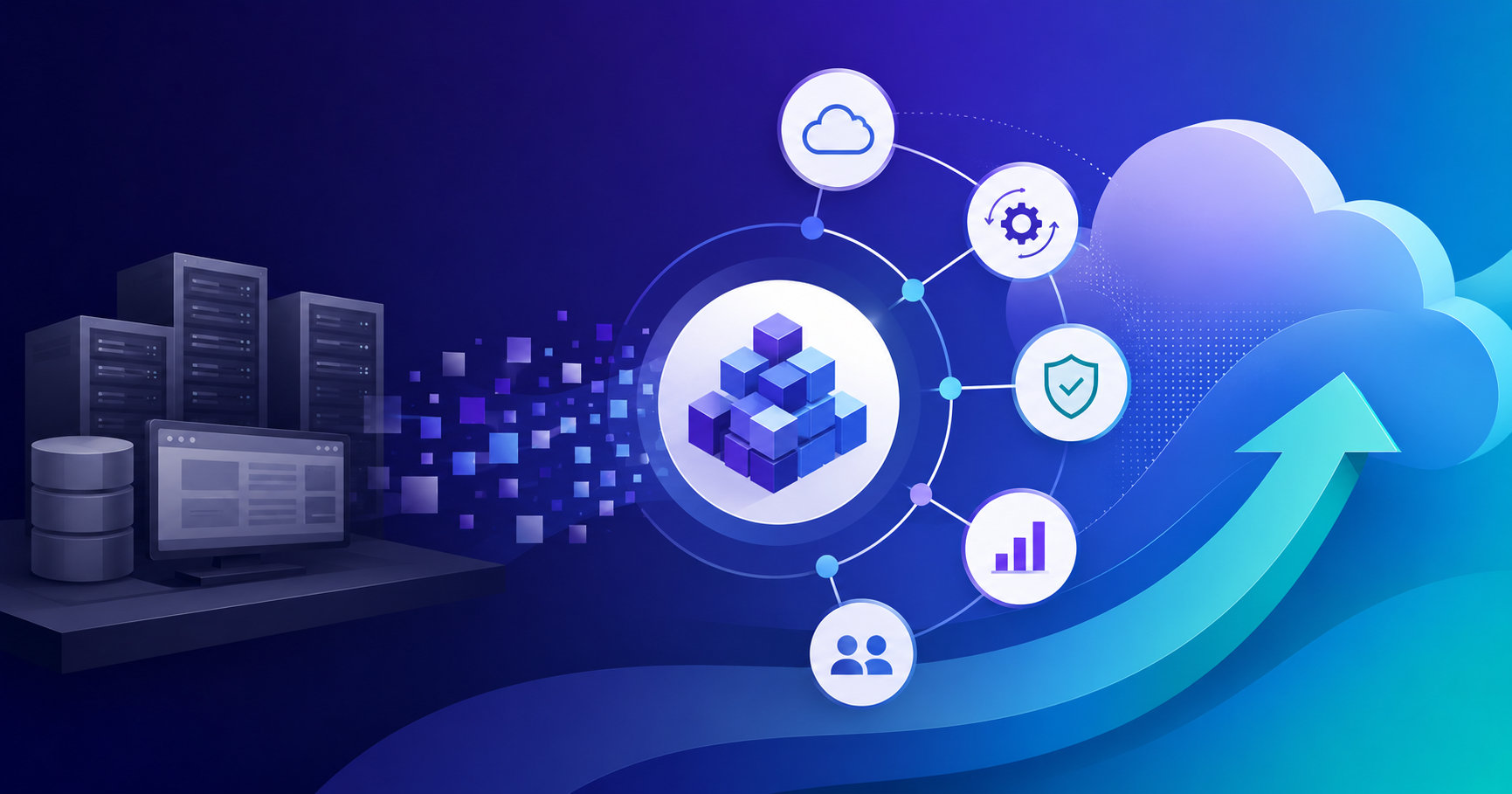
Enterprise app modernization means updating or restructuring legacy business applications to meet current technical and business requirements. The goal is not to rebuild everything at once, but to reduce technical debt, improve integration capability, and position your systems to support AI-driven workflows. Done well, it cuts maintenance costs by 40-60% and accelerates every initiative that depends on clean data access.
If you are a CTO, VP of Engineering, or a technology leader trying to figure out where to start, this post lays out the decision framework worth following: how to assess your portfolio, choose the right modernization path for each system, phase the work to reduce risk, and build for AI-readiness from day one.
Table of Contents
- What Enterprise App Modernization Actually Means
- Why 2026 Changed the Calculus
- The Four Paths: Choosing the Right Modernization Strategy
- Why Enterprise App Modernization Projects Fail
- A Practical Framework for Enterprise App Modernization in 2026
- How AI Is Reshaping the Modernization Process Itself
- Beyond the App: Smart Enterprise as the Modernization Outcome
- Frequently Asked Questions
What Enterprise App Modernization Actually Means
Before getting into the framework, it is worth being precise about what enterprise app modernization is and what it is not.
Modernization is the process of updating legacy application software to align with current technical standards, business requirements, and integration needs. It is not a synonym for cloud migration (though cloud migration is often part of it), and it is not a greenfield rebuild by default.
A legacy system, for these purposes, is any application that is technically outdated or architecturally constrained in ways that limit the organization's ability to move fast, integrate with modern tools, or build on top of it. Age alone does not make a system legacy. A 15-year-old system with clean APIs and documented behavior is a different problem from a monolith with undocumented business logic that only two engineers still understand.
The modernization question is always a business question first: what is this system's role in our future architecture, and what does it cost us to operate it in its current state? That framing keeps the conversation grounded and prevents the common mistake of modernizing systems that should be retired entirely.
It also separates enterprise app modernization from the adjacent concept of application development. Modernization preserves existing business logic while updating the technical substrate. The business processes encoded in a legacy ERP or supply chain system represent years of organizational knowledge. A good modernization approach captures that knowledge and carries it forward, rather than discarding it in favor of a clean-slate rebuild.
Why 2026 Changed the Calculus
Enterprise app modernization has been on IT roadmaps for years, but 2026 is different for one specific reason: AI readiness has become a hard architectural requirement, not a future-state aspiration.
According to Gartner, 40% of enterprise applications will feature task-specific AI agents by the end of 2026, up from less than 5% in early 2025. That is not a slow trend. It is a rapid architectural shift that assumes your applications can accept, process, and act on AI-generated inputs. Legacy systems that lack APIs, run on monolithic architectures, or store data in formats that ML pipelines cannot consume are excluded from this shift by default.
The global application modernization services market was valued at $23.33 billion in 2025 and is growing at a 13.51% CAGR, projected to reach $56.68 billion by 2032. The growth reflects a real forcing function: CIOs can no longer defer this work. In Gartner's 2026 CIO agenda survey, application modernization ranked as the #1 priority for 71% of respondents.
The cost of inaction is also more concrete now. According to legacy modernization research from Keyhole Software, 70% of Fortune 500 companies still operate software that is more than two decades old, and 70% of third-party libraries in those systems contain unpatched vulnerabilities. More than 40% of businesses have faced revenue losses tied directly to legacy system constraints and infrastructure fragility.
The pressure from boards and investors has shifted too. Where modernization was once an internal IT conversation, it is now a due diligence item in M&A processes, a prerequisite for AI investment return, and a question investors ask directly. For more on the enterprise AI integration side of this, our post on building an enterprise AI roadmap from pilot to production covers the technical prerequisites in detail.
The Four Paths: Choosing the Right Modernization Strategy
Not every application needs the same treatment. The most common mistake in enterprise app modernization programs is applying one approach uniformly across the portfolio. A practical framework uses four distinct paths, applied per system based on business value and technical complexity.
Rehost (Lift and Shift)
Move the application to new infrastructure with minimal code changes. This is the fastest option and the most limited. It reduces infrastructure costs and sometimes improves reliability, but it does not address architectural constraints or meaningful technical debt. Rehost is appropriate for systems with low business-critical priority that need to come off end-of-life infrastructure quickly.
Re-platform
Migrate to a modern platform with targeted changes: switching databases, containerizing the application, or moving to managed services, without redesigning the core application logic. This is often the right call for systems that have sound business logic but run on outdated infrastructure or a technology stack that has become difficult to staff. It delivers real operational improvement without the full cost and risk of a re-architecture.
Re-architect and Re-engineer
Restructure the application itself: decompose a monolith into services, refactor the data model, rebuild integrations with modern APIs, or replace outdated frameworks. This is the highest-effort option per application, but it is the path that genuinely extends the system's useful life and makes it integration-ready for everything that follows. Our legacy software modernization service covers this path in full, including code refactoring, UI/UX modernization, integration services, and security improvement.
Replace
Retire the system and replace it with a modern commercial solution or a custom rebuild. For some systems, the accumulated technical debt and the cost of re-architecting exceeds the cost of replacement. This is especially common with internal tools that have grown far beyond their original scope over many years of patchwork additions.
The decision between these four paths depends on three variables: the system's current business value, its integration requirements going forward, and the cost and risk of each change option. A simple scoring model across these dimensions makes portfolio decisions defensible and communicable to non-technical stakeholders.
Why Enterprise App Modernization Projects Fail (And How to Avoid It)
The failure rates in this space are high enough to deserve honest treatment. Research on legacy modernization trends shows that 79% of modernization projects encounter failures, with each failed attempt costing organizations around $1.5 million and taking up to 16 months to resolve. Separately, 68% of modernization projects miss their original scope, timeline, or budget.
These are not rare edge cases. They are the statistical norm. Understanding why they fail is more actionable than treating the risk as manageable by default.
Scope defined by technology, not outcomes. Projects framed as "migrate to microservices" or "move to Azure" without clear business outcomes get de-prioritized when costs rise. Projects framed as "reduce order processing latency by 40%" or "enable real-time inventory visibility across systems" retain stakeholder support because the value is legible to non-engineering leadership. The framing determines whether the program survives contact with competing priorities.
Underestimating data migration complexity. Application logic is usually the easier problem. Data is the harder one. Legacy systems often carry decades of data in formats that reflect defunct business processes, contain duplicates and inconsistencies, and lack documentation. A modernization plan that does not budget significant time and engineering effort specifically for data assessment and migration planning will fail on data.
No change management. The technical team delivers a modernized system and adoption is poor because the business users who relied on the old system's quirks were not involved in the transition. We have written about this pattern in depth, covering the 11 most common failure modes across transformation programs and how to address each one.
Big-bang execution. Full portfolio modernization attempted simultaneously, without phasing or sequencing, overwhelms engineering capacity and creates interdependency chaos. Phased execution, starting with high-value and lower-risk applications, produces early wins that build organizational confidence and demonstrate ROI before the larger, harder systems are touched.
A Practical Framework for Enterprise App Modernization in 2026
The framework below is built around four steps, intended to be opinionated and sequenced rather than a menu of optional actions.
Step 1: Portfolio Assessment (Not App-by-App Decisions)
The assessment unit is the portfolio, not individual applications. Map your entire application estate before deciding anything. For each application, capture: business criticality (what breaks if this goes down), integration dependencies, technical debt level, staffing risk (how many people understand this system), and estimated annual maintenance cost.
This produces a portfolio map with clear clusters: systems to retire, systems to leave as-is, systems to re-platform, and systems that need deeper modernization work. Decision-making becomes significantly faster once the map exists, because every conversation has a shared factual baseline rather than competing assumptions. Exploring the enterprise application development trends shaping 2026 gives useful context for evaluating where each application sits relative to current architectural standards.
Step 2: Business Outcome Mapping
Before writing a line of code, map each modernization initiative to a specific, measurable business outcome. Examples: reduced processing time, lower error rate, faster new feature delivery, enabled AI integration, or reduced operational cost expressed in hours or dollars.
This step is not documentation for its own sake. It is the mechanism that keeps modernization programs funded and prioritized when they compete with new product development for engineering capacity. Programs with clear business outcomes survive budget conversations. Technology-framed programs often do not.
Step 3: Phased Execution, Sequenced by Value and Risk
Sequence your modernization roadmap to deliver value quickly on lower-risk applications before tackling the most complex legacy systems. A common sequencing heuristic: start with systems that have high integration dependencies but moderate technical complexity. These often deliver the most downstream value once modernized, because other systems can connect to them.
Save the systems with deep business logic complexity and significant data migration challenges for later phases, when the team has operational momentum and the program has demonstrated value to the organization. This is not avoidance; it is risk management.
Step 4: Build for AI-Readiness from the Start
In 2026, a modernized application that cannot participate in an AI pipeline is not fully modernized. AI-readiness is an architectural requirement, not a future-phase addition.
In practice, this means: clean APIs with documented schemas, event-driven data flows where appropriate, data stores that ML pipelines can query or subscribe to, and clear data ownership models that support governance. Applications rebuilt without these properties will require another round of modification within 18-24 months as AI integration requirements arrive in force.
How AI Is Reshaping the Modernization Process Itself
A notable development in 2026 is that AI is not only the destination for modernized systems. It is also changing how modernization work gets done.
McKinsey estimates that AI tools are cutting modernization project timelines by 40-50%. AI-assisted code analysis can map legacy codebases in hours rather than weeks, identify dead code, document undocumented logic, and generate migration candidates. This is particularly valuable in the portfolio assessment phase, where the effort of manually mapping a large codebase has historically created months of delay before actual modernization work can begin.
More than 75% of enterprises are now incorporating AI tools into their modernization strategy. The tools being applied span automated code documentation, AI-assisted refactoring, test generation for legacy systems with minimal test coverage, and dependency mapping.
The caution is real, though. Gartner predicts that over 40% of agentic AI projects will be canceled by end of 2027 due to unclear business value and inadequate risk controls. AI tools accelerate modernization work; they do not replace the judgment required to sequence it correctly or the engineering quality needed to make results durable. The organizations getting the most value from AI in modernization programs are using it for specific, well-scoped tasks rather than delegating architectural decisions to it.
The practical takeaway: treat AI tooling as an accelerant for the assessment and documentation phases, where its ability to process and summarize large codebases delivers the most immediate return. Be more measured about AI's role in actual re-architecture decisions, where the stakes of getting it wrong are higher. Our post on how our engineering teams use AI-augmented delivery covers specific tooling and workflow practices in more detail.
Beyond the App: Smart Enterprise as the Modernization Outcome
Individual application modernization is necessary but not sufficient for enterprises that want to operate as genuinely integrated, data-driven organizations. The full modernization outcome requires thinking at the platform and process layer, not only at the application layer.
This is the perspective behind our Smart Enterprise services: treating modernization as a program that produces interconnected, intelligent operational infrastructure rather than a collection of individually updated applications.
Platform integration. Modernized applications need to connect with each other and with the external tools and data sources the organization depends on. Platforms development and integration work ensures that modernized systems are operationally wired together, with data flowing reliably across systems rather than sitting in disconnected silos.
Business process automation. Modernization creates the technical preconditions for automation that legacy systems could not support. Once APIs are in place and data is clean and accessible, significant manual workflows can be automated. Our business process automation work focuses on replacing manual workflows with reliable, auditable automated processes, an outcome that directly reduces operational cost and error rates. Our post on business process automation and team productivity covers the practical approach in detail.
Data engineering. Modernized applications produce data the organization can actually use, but data utility depends on how it is stored, modeled, and made accessible. Data engineering and consulting builds the pipelines and architecture that turn modernized application data into a real analytical and operational asset, including the data layer required to support the AI integration programs most enterprises now have on their roadmaps.
Where to Go From Here
Enterprise app modernization in 2026 is not a one-size-fits-all exercise, and the programs that succeed treat it as a business transformation initiative with clear outcomes rather than a technology project with a finish line. The framework above, portfolio assessment, outcome mapping, phased execution, and AI-readiness by design, gives a starting point that holds up against the real failure modes in this space.
If you are at the assessment stage or evaluating options for a specific set of legacy systems, our legacy software modernization services and technology advisory practice are good starting points. We work across the full spectrum from targeted re-engineering to Smart Enterprise platform buildout.
Frequently asked questions
Enterprise app modernization is the process of updating or restructuring legacy business applications to meet current technical standards and operational requirements. This includes code refactoring, re-architecting monolithic systems, migrating to modern infrastructure, improving integrations, and building API-first data access. The goal is to reduce technical debt, lower maintenance costs, and position applications to support modern workflows including AI integration.
Timeline varies by the number of applications, their technical complexity, and the modernization path chosen. A single application re-platform can take 2-4 months. A full re-architecture of a complex legacy system often runs 6-18 months. Portfolio-level modernization programs covering multiple systems are typically planned in 18-36 month roadmaps with phased delivery. AI-assisted tooling is reducing assessment and documentation phases by 40-50% compared to programs run 3-5 years ago.
The most consistent failure point is scope and expectation misalignment between the technical team and business stakeholders. Projects framed as technology initiatives rather than business outcome programs lose support when costs or timelines shift. Data migration complexity is the second most common source of failure: legacy data quality issues regularly take longer and cost more than anticipated. A phased approach with clear business-outcome milestones reduces both risks significantly.
Cloud migration moves existing applications to cloud infrastructure, which may involve no code changes at all (lift and shift). Application modernization changes the application itself: its architecture, code, data model, or integrations. Cloud migration and application modernization often happen together, but they are distinct activities. Migrating a legacy monolith to the cloud without re-architecting it leaves most of the technical debt in place while adding cloud infrastructure costs.
Yes, and in 2026 this is non-negotiable for most enterprises. With 40% of enterprise applications expected to feature task-specific AI agents by end of 2026, applications rebuilt without accessible APIs, clean data schemas, and event-driven data flows will require further modification within 18-24 months. Building AI-readiness into the modernization design from the start is more efficient than retrofitting it later.