Conversation Analysis: Turning Calls and Meetings Into Structured Insight
Conversation analysis turns calls and meetings into transcripts, sentiment, and structured insight. Here's how the engineering pipeline actually works.
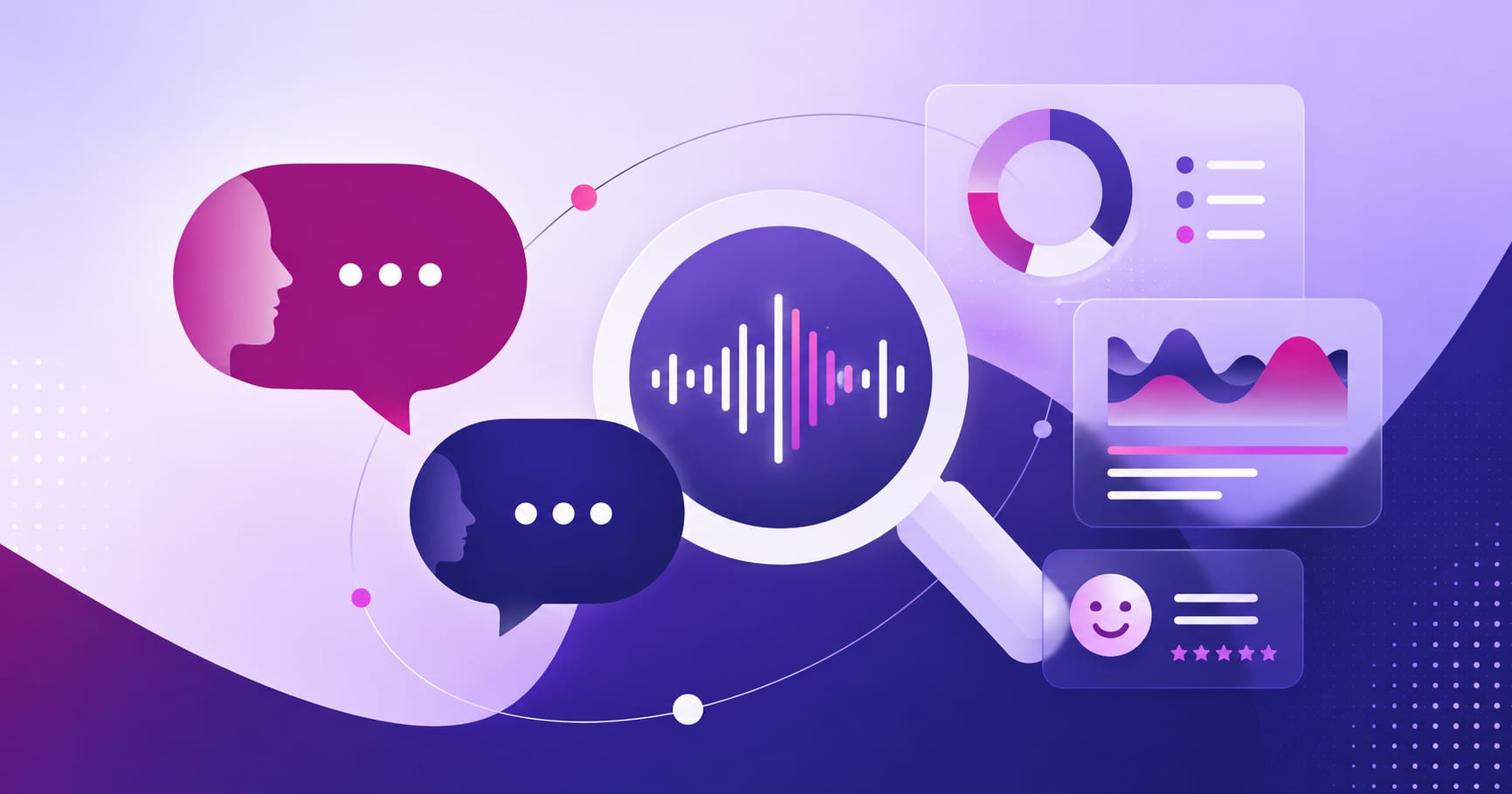
Conversation analysis is the process of turning spoken audio, a sales call, a support ticket, a standup, into structured data: who spoke, what they said, what topics came up, and what tone carried the exchange. Under the hood it’s an engineering pipeline (capture, transcription, diarization, NLP), not a single algorithm, and the quality of each stage determines whether the output is genuinely useful or just a searchable transcript with extra steps.
That distinction matters more than the marketing copy around “conversation intelligence” tools usually lets on. Most vendor content treats this as a shopping decision: which platform, what price tier, what integrations. Fewer sources explain what’s actually happening between “someone talks into a microphone” and “here’s your sentiment score.” We think that’s the more useful conversation to have, especially if your team is deciding whether to buy a platform, build one, or just understand what you’re already paying for.
What Conversation Analysis Actually Extracts
Before touching architecture, it helps to be precise about the output, because “conversation analysis” gets used as a catch-all for at least four distinct data products.
Transcripts and speaker turns. The base layer is a time-aligned transcript with each segment attributed to a speaker: Speaker 1 said this at 00:04:12, Speaker 2 responded at 00:04:19. This sounds simple and is the part most likely to go wrong in practice, particularly with overlapping speech, accents, or noisy audio.
Topics, entities, and intent. Once the words exist as text, a second layer extracts what the conversation was about: named entities (product names, competitor mentions, dates), topic segments (the part about pricing, the part about onboarding), and intent signals (a question, an objection, a commitment).
Sentiment, tone, and talk-time metrics. A third layer scores emotional tone across the conversation and computes structural metrics like talk-to-listen ratio, interruption frequency, and pace. These numbers are popular in sales coaching because they’re easy to benchmark, though they’re also the layer most prone to overreach if the underlying transcript or diarization is shaky.
Action items and structured metadata. The final layer, increasingly handled by an LLM summarization pass, converts the raw conversation into commitments, follow-ups, and decisions: a structured record a CRM or knowledge base can actually use.
Each of these layers depends on the one below it. A wrong speaker label cascades into wrong sentiment attribution and a wrong action item assigned to the wrong person. That dependency chain is exactly why treating this as an engineering problem, not a single API call, matters.
How the Pipeline Works
Audio capture and preprocessing. Calls and meetings arrive through different channels (VoIP, WebRTC-based video platforms, dialed telephony) at different sample rates and codec qualities, and preprocessing normalizes this before anything else happens: resampling, noise reduction, and voice activity detection to strip silence and cross-talk before the expensive modeling steps run.
Speech-to-text (ASR). This is the stage most people equate with “the whole system,” and it’s the one with the most measurable accuracy tradeoffs. Word error rate (WER) for Whisper Large v3, currently one of the most widely deployed open speech recognition models, ranges from roughly 4.1% to 10.1% depending purely on which infrastructure provider serves the model, according to Artificial Analysis’s 2026 benchmark across agent conversations, public speech recordings, and earnings call transcripts (Artificial Analysis, 2026). That’s the same model producing more than double the errors depending on deployment choices alone, before you even get to accents, domain vocabulary, or audio quality.
Speaker diarization. This is the “who spoke when” layer, and it’s harder than ASR in most real-world conditions because it has to handle overlapping speech, similar-sounding voices, and variable numbers of participants without knowing any of that in advance. On the DIHARD benchmark, which specifically tests difficult acoustic domains like clinical interviews, courtrooms, and meetings with heavy cross-talk, diarization error rates for real-time streaming systems ranged from 19.8% for the best-performing system tested to 39.2% for others, roughly double, evaluated without special scoring adjustments for overlapping speech (pyannoteAI, 2026). Academic work on ASR-guided diarization is still actively trying to close this gap by having the recognition and diarization stages inform each other rather than running as separate passes (arXiv:2507.17765).
The NLP layer. With a time-aligned, speaker-attributed transcript in hand, this stage runs topic modeling, sentiment scoring, entity extraction, and (increasingly) an LLM pass for summarization and action-item extraction. This is also where domain-specific tuning happens: a sales call and a clinical intake conversation need different entity vocabularies and different definitions of what counts as an “objection” or a “symptom.”
Structuring output for retrieval. The last engineering problem, and the one buyer’s guides skip almost entirely, is making the output searchable and usable after generation: indexing transcripts and metadata so a person can find “the call where the client raised pricing concerns” without re-listening to forty recordings. In our experience building this exact pipeline for Snaplore, an AI-powered meeting knowledge platform, this retrieval layer is what separates a pile of transcripts from something a team actually adopts. The build used Whisper for transcription, WebRTC for live meeting capture, and an AWS-hosted backend, and the teams using it cut documentation time by up to 60% once the recordings became searchable rather than just archived (unicrew case study, 2026).
Deployment model. A choice that cuts across every stage above is whether models run behind a managed API or self-hosted on your own infrastructure. Managed APIs (the Whisper, Deepgram, and AssemblyAI endpoints referenced throughout this article) are the fastest path to a working pipeline: no GPU provisioning, no model maintenance, pay-per-minute pricing. Self-hosting an open model like Whisper trades that convenience for control over latency, data residency, and per-minute cost at volume, at the price of owning GPU capacity planning and model updates yourself. Teams with strict data residency requirements or high call volumes where per-minute API pricing adds up tend to gravitate toward self-hosting once they’ve validated accuracy; teams still proving out the use case are almost always better served starting with a managed API and revisiting the decision once volume and requirements are clear.
Conversation Analysis vs. Adjacent Terms
The terminology in this space overlaps enough that it’s worth laying out plainly what each term actually implies, since vendors use them interchangeably in marketing but not in scope. Getting this vocabulary straight before a vendor call is worth the five minutes: a sales rep pitching “conversation intelligence” while your actual need is a reliable single-call transcript will steer you toward dashboards and coaching features you don’t need yet, at the expense of the transcription and diarization accuracy you do.
| Term | Core Output | Typical Scope | Real-Time Capable |
|---|---|---|---|
| Call recording | Raw audio/video file | Storage and playback only | N/A |
| Speech analytics | Keyword spotting, basic metrics | Rules-based flags on transcripts | Sometimes |
| Conversation analysis | Structured transcript + topics, sentiment, entities | Single-conversation depth | Depends on architecture |
| Conversation intelligence | Aggregated insight across many conversations | Cross-call trends, coaching, forecasting | Often, for enterprise tiers |
The practical distinction: conversation analysis operates on one conversation at a time, producing structured output from it. Conversation intelligence is what you get when you aggregate that structured output across hundreds or thousands of conversations to spot patterns, most commonly in sales and customer experience contexts. You need reliable conversation analysis as the foundation before conversation intelligence claims mean anything, which is why a platform’s accuracy at the single-call level is worth scrutinizing before its dashboard.
Real-Time vs. Post-Call Analysis
These are genuinely different engineering problems, not a feature toggle, and conflating them is a common source of disappointment when evaluating a build-or-buy decision.
| Factor | Real-Time Analysis | Post-Call Analysis |
|---|---|---|
| Latency budget | Sub-second to a few hundred ms | Minutes acceptable |
| Architecture | Streaming ASR, incremental diarization, in-flight NLP | Batch processing, full-context models |
| Accuracy tradeoff | Lower accuracy for speed (see DER gap above) | Higher accuracy, full-conversation context available |
| Common use cases | Live agent assist, compliance flagging, escalation detection | Coaching, QA scoring, documentation, analytics |
| Failure cost | A missed prompt during a live call | A delayed report |
Real-time systems have to make decisions with incomplete information, a diarization model can’t know a speaker turn is complete until it already is, which is exactly why streaming diarization error rates run meaningfully higher than offline benchmarks. If your use case is agent coaching or after-the-fact documentation, post-call batch processing gets you materially better accuracy for the same underlying models. If your use case is live compliance flagging or in-call assist, you’re accepting an accuracy tax as the cost of speed, and it’s worth knowing that tradeoff exists before committing to a real-time-only vendor.
Common Failure Modes and Edge Cases
Benchmark numbers describe controlled conditions. Production audio rarely cooperates, and the gap between a vendor’s published accuracy and what a team actually experiences usually traces back to one of a handful of recurring failure modes.
Accented and code-switched speech. Most published WER figures come from clean, monolingual benchmark datasets. Real conversations, especially in multinational teams or customer bases, often mix languages mid-sentence or carry strong regional accents the base model wasn’t tuned on. Research on code-switched speech recognition found a baseline Whisper model’s error rate jumped to 11.49% on a code-switching benchmark, and naive attempts to fine-tune for it made things worse, with one approach producing up to a 193% relative increase in errors before a more careful adaptation method brought performance back down (arXiv:2606.21990). If your conversations regularly mix languages, the vendor’s advertised WER is not the number you should plan around.
Low-quality and compressed telephony audio. Cloud video meetings capture clean, high-bitrate audio. Phone calls routed through legacy telephony infrastructure are often compressed to 8kHz narrowband audio, which strips exactly the frequency information that helps ASR and diarization models distinguish similar voices. A pipeline validated on Zoom recordings can degrade sharply the moment it’s pointed at a call center’s PBX feed.
Overlapping speech and cross-talk. Diarization models have to decide who is speaking during moments when two or more people talk simultaneously, which happens constantly in real meetings and is exactly the scenario the DIHARD benchmark was designed to stress-test. As noted above, missed speech during overlap is the single largest contributor to diarization error on that benchmark, not confusion between distinct speakers.
Domain vocabulary drift. A model tuned for general conversation will mis-transcribe product names, clinical terminology, or industry jargon it has never seen, and it will do so silently, producing plausible-sounding but wrong text rather than an obvious error. Teams evaluating a vendor or a build should test against their own domain vocabulary specifically, not a generic demo.
None of these are reasons to avoid conversation analysis. They’re reasons to validate a pipeline against your actual audio, your actual domain, and your actual mix of languages and accents before trusting its output for anything higher-stakes than a rough first pass.
Where Conversation Analysis Creates Value
The commercial case for building or buying this capability isn’t theoretical. The conversation intelligence software market is projected to grow from $28.54 billion in 2025 to $32.25 billion in 2026, and to more than $52 billion by 2030, a roughly 13% annual growth rate driven largely by rising adoption of call transcription and sales enablement tooling (ResearchAndMarkets, 2026). That growth shows up concretely across a few functions.
Sales and revenue teams. This is the most mature use case, and the data backs the investment. High-performing sales organizations use conversation intelligence at more than three times the rate of underperforming ones (73% versus fewer than 20%), according to 2026 research from Apollo cited in industry benchmarking (Dad’s Growth Lab, 2026). The gap isn’t coincidental: teams that frequently act on AI-surfaced conversation data reported 77% more revenue per representative (Gong Labs, 2025), and separate Gong Labs research found deal guidance recommendations correlated with a 35% higher win rate across more than a million tracked opportunities (Gong Labs, 2024), both figures compiled in Dad’s Growth Lab’s 2026 benchmark review.
Customer support and quality assurance. Traditional QA programs review only 5-10% of calls manually, simply because full manual review doesn’t scale (Gong Labs, 2024, via Dad’s Growth Lab, 2026). Automated conversation analysis makes 100% coverage feasible, which changes QA from spot-checking to genuine trend detection: which agents struggle with which issue types, where scripts break down, where a policy change caused confusion.
Knowledge management and documentation. Meetings and calls contain decisions, context, and institutional knowledge that otherwise lives only in whoever attended. This is the problem we tackled directly in building Snaplore: meeting recordings and screen demos that used to sit unwatched became searchable documentation, with teams that previously resisted writing things down contributing naturally once the system did the capture work for them (unicrew case study, 2026).
Compliance and risk. Regulated industries use conversation analysis to flag required disclosures, detect script deviations, and maintain audit trails automatically, work that used to require sampling a small percentage of interactions and hoping the sample was representative.
Build vs. Buy: Evaluating Your Options
| Factor | Build | Buy |
|---|---|---|
| Time to first value | Months (model selection, pipeline, tuning) | Days to weeks |
| Accuracy control | Full control over ASR/diarization model choice and tuning | Locked to vendor’s model and update cadence |
| Domain customization | Unlimited, at engineering cost | Limited to vendor’s configuration options |
| Data residency and compliance | Fully controllable | Dependent on vendor’s architecture and contracts |
| Ongoing cost driver | Engineering and infrastructure maintenance | Per-seat or per-minute licensing |
| Best fit | Proprietary data, specific domain vocabulary, or compliance requirements a vendor can’t meet | Standard use cases where speed to deployment matters most |
The honest version of this decision rarely comes down to cost alone. Buying gets you to production faster with a known accuracy ceiling; building gets you a pipeline you can tune to your actual audio conditions and compliance requirements, at the cost of owning the WER-versus-latency tradeoffs described above yourself. Teams with unusual audio environments (heavy accents, industry-specific vocabulary, multilingual meetings) or strict data residency requirements tend to get more out of a custom build than a general-purpose vendor tier can offer. Teams that just need standard call coverage across a sales team are usually better served buying.
There’s also a lock-in dimension worth naming directly. A vendor’s diarization or ASR model improves on the vendor’s timeline, not yours, and switching platforms later usually means re-processing historical recordings against a new model to keep metrics comparable, which is rarely trivial once years of calls are archived under the old model’s quirks. A custom build carries the opposite risk: you own upgrades, but you also own the decision of when to take them, rather than inheriting a vendor’s release schedule along with whatever accuracy regressions come with it. Neither path avoids maintenance; they just place it in different hands.
Compliance and Data Handling
Conversation analysis runs on recorded human speech, which means privacy law applies before a single model runs. Under GDPR, recording a call generally requires a lawful basis under Article 6, most commonly consent or, in specific call-center contexts, legitimate interest, though regulators and privacy authorities have scrutinized the legitimate-interest basis closely enough that many organizations default to explicit consent to avoid the ambiguity (GDPR-Text.com, Article 6; IAPP, 2025).
US teams face a separate patchwork rather than one federal standard. Twelve states, including California, Florida, and Pennsylvania, require all-party consent before a call can be recorded, meaning every participant has to know and agree, while the remaining states and the District of Columbia only require the recording party’s own consent under a one-party standard (Recording Law, 2026). A conversation analysis pipeline that captures calls across multiple states, or a multinational team spanning both GDPR and US jurisdictions, needs consent handling built as a configurable rule per region, not a single toggle.
Beyond the initial recording, the analysis pipeline itself raises separate questions: how long transcripts and derived sentiment data are retained, whether processing happens in-region or crosses borders, and who can access the structured output versus the raw audio. These aren’t afterthoughts bolted onto a compliance checklist; they’re architectural decisions that need to be made at the same stage as choosing an ASR model, because retrofitting data residency into a pipeline built without it is far more expensive than designing for it from the start.
Key Takeaways
Conversation analysis is a multi-stage pipeline, not a single feature, and each stage (capture, transcription, diarization, NLP, retrieval) has its own accuracy tradeoffs worth understanding before you evaluate a vendor or a build. Real-time and post-call processing solve different problems with different accuracy ceilings, and the “conversation intelligence” dashboards most vendors sell are only as reliable as the conversation analysis foundation underneath them. If your team is weighing whether to buy a platform or build a pipeline tuned to your own audio and compliance requirements, our AI/ML development and AI integration teams work through exactly this kind of tradeoff with clients building voice and conversation systems.
Frequently asked questions
Conversation analysis (sometimes called conversation analytics) processes a single conversation into structured data: transcript, speakers, topics, sentiment. Conversation intelligence aggregates that structured output across many conversations to surface trends, coaching opportunities, and forecasting signals. One is the foundation; the other is what you build on top of it.
Accuracy varies significantly by component and deployment choice. Word error rates for leading ASR models range from about 4% to 10% depending purely on infrastructure, and diarization error rates on difficult audio can range from roughly 20% to nearly 40% between providers, before factoring in your specific audio conditions (Artificial Analysis, 2026; pyannoteAI, 2026). Always test against your own audio, not a vendor’s benchmark numbers alone.
Yes, but real-time and post-call processing are different engineering problems with different accuracy ceilings. Real-time systems trade some accuracy for low latency because they can’t wait for full conversational context; post-call batch analysis generally achieves better accuracy on the same underlying models.
No system is compliant by default; compliance depends on how you deploy it. You need a lawful basis to record the conversation in the first place (typically consent), plus deliberate decisions about data retention, processing location, and access controls for the structured output the analysis produces.
It depends on how standard your use case is. Buying gets you to production fastest with a known accuracy ceiling. Building makes sense when you have unusual audio conditions, specific domain vocabulary, or compliance requirements that off-the-shelf vendors can’t accommodate, and you’re willing to own the ongoing engineering cost.