RAG Implementation: A Builder’s Guide to Grounded AI
A technical guide to RAG implementation: architecture, chunking, retrieval tuning, and evaluation, so your business AI answers from real data, not guesses.
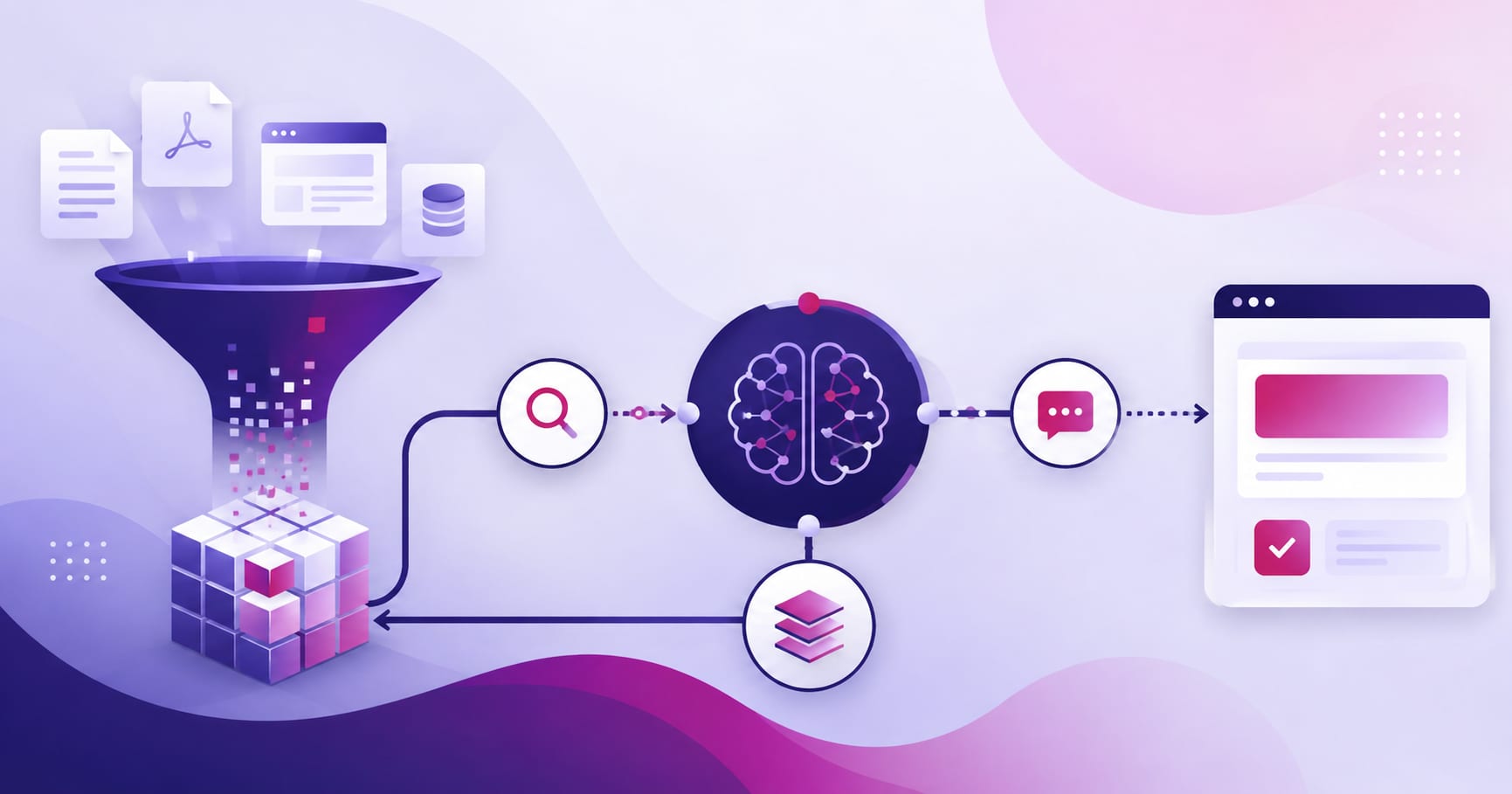
Retrieval augmented generation (RAG) pairs a large language model with a live search step over your own data, so answers come from documents you control instead of whatever the model memorized during training. For most business AI projects, it’s the right place to start: faster to build than fine-tuning, cheaper to maintain, and it keeps every answer traceable back to a source.
That’s the short version. The long version, the one that matters once you sit down to actually build a RAG implementation, involves decisions about chunking strategy, embedding models, retrieval quality, and what to do when the system still gets something wrong. This guide walks through the architecture end to end: what to build first, where teams get stuck, and how to know whether the thing you shipped is actually working.
What Is Retrieval Augmented Generation, and Why Does It Matter for Business AI?
RAG is an architecture pattern, not a product. It sits an LLM on top of a retrieval system: when a user asks a question, the system first searches a knowledge base for relevant passages, then hands those passages to the model as context before it generates an answer. The model isn’t answering from memory. It’s answering from what it just read.
The pattern was formalized by Meta AI researchers in 2020, who described it as a way to give language models access to an explicit, updateable memory they could look up at inference time rather than bake permanently into their weights (Lewis et al., 2020). Half a decade later, that distinction is the whole reason RAG matters for business applications: a general-purpose LLM knows a great deal about the world up to its training cutoff, and nothing at all about your contracts, your product catalog, or last week’s support tickets.
Without retrieval, you’re left with two weaker options: fine-tune the model on your data (expensive, slow to update, and it still doesn’t guarantee accuracy) or hope the model’s training data happens to overlap with what you need, which it usually won’t. RAG sidesteps both by keeping the model general and the data separate, updateable, and swappable.
That shift toward retrieval-grounded architecture isn’t a niche pattern. Gartner predicts that by 2028, 80% of generative AI business applications will be built on top of existing data management platforms rather than models retrained from scratch, which is RAG’s core premise applied at enterprise scale (Gartner, 2025).
The stakes here aren’t theoretical. A 2025 Stanford RegLab study of commercial legal AI tools found that RAG-based products from LexisNexis and Thomson Reuters hallucinated between 17% and 33% of the time on legal queries, compared to prior research showing general-purpose LLMs answering similar queries from memory alone hallucinate 58% to 82% of the time (Magesh et al., Stanford RegLab, 2025). That’s a real improvement. It’s also a reminder that RAG reduces hallucination, it doesn’t eliminate it, and any team implementing RAG needs to plan for the gap that’s left over.
The Core RAG Architecture: How Retrieval Actually Feeds Generation
A production RAG system has four moving parts: ingestion, retrieval, augmentation, and generation. Most of the implementation work, and nearly all of the failure modes, live in the first two.
Ingestion and Chunking: Where Most RAG Systems Fail First
Before anything can be retrieved, it has to be broken into pieces small enough to search and large enough to still make sense on their own. This is chunking, and it’s the step teams underestimate most.
Chunk too large, and you retrieve passages padded with irrelevant text that dilutes the context the model actually needs. Chunk too small, and you fragment ideas across boundaries, so the passage that answers the question is technically in your index but split across three separate chunks, none retrieved with enough confidence to surface. Fixed-size chunking, splitting every N tokens regardless of content, is the easiest approach to implement and the easiest to get wrong for documents with real structure: contracts, technical documentation, and product manuals all carry meaning in their headings, tables, and section breaks that naive chunking throws away.
There’s no single correct chunk size. The fix is matching chunking strategy to document type: semantic chunking that respects paragraph and section boundaries for prose, table-aware extraction for structured documents, and smaller, denser chunks for FAQ-style or reference content where a single fact needs to stand on its own.
Embeddings and Vector Search: Choosing the Right Index
Once content is chunked, each piece gets converted into a vector, a numerical representation of its meaning, using an embedding model. Similar meanings end up close together in vector space, which is what makes semantic search possible: a query about “cancelling a subscription” can retrieve a passage about “ending your plan” even though the two share almost no words.
This is also where a lot of RAG implementations quietly underperform. Dense vector search alone struggles with exact matches: product SKUs, error codes, legal citations, anything where the literal string matters more than the meaning. Most production systems now combine dense vector search with traditional keyword search, commonly BM25, in a hybrid retrieval setup, then merge the results. This isn’t an advanced optimization to bolt on later. For business applications full of exact identifiers and domain-specific terminology, it’s close to a requirement from day one.
Retrieval and Reranking: Getting the Right Context, Not Just Any Context
Vector search returns the passages that are mathematically closest to the query, which isn’t always the same as the passages that best answer it. A reranking step, typically a smaller, more precise model that re-scores the initial candidates, closes that gap. Retrieval finds twenty plausible passages fast; reranking picks the three that actually matter before they get sent to the LLM.
Skipping reranking is one of the more common corners cut in early RAG implementations, largely because it adds latency and a second model call. The tradeoff is worth naming honestly: without it, the generation model has to do more work filtering noise from its context window, and that’s exactly where accuracy erodes.
Augmentation and Generation: Feeding Context to the LLM Without Losing It
The final step hands the retrieved, reranked passages to the LLM along with the user’s question, usually through a prompt template that instructs the model to answer only from the provided context. That sounds simple, but it runs into a real limitation of how LLMs process long context: a widely cited Stanford study found that models are noticeably better at using information placed at the very beginning or end of their context window than information buried in the middle, a pattern the researchers called “lost in the middle” (Liu et al., 2024). If your retrieval step returns eight passages and stuffs them into the prompt in plain retrieval-rank order, the most relevant one might land exactly where the model pays the least attention.
The practical fix is context ordering: placing the highest-confidence passages at the start and end of the context window, not just at the top, and keeping the total number of passages tight rather than maximizing recall by dumping in everything remotely related.
RAG vs. Fine-Tuning vs. Long-Context Prompting: Which Should You Start With?
These three approaches get compared constantly, and the honest answer is that they solve different problems.
| Approach | Best for | Update speed | Cost profile |
|---|---|---|---|
| RAG | Grounding answers in current, proprietary, or frequently changing data | Update the index, not the model; near-instant | Retrieval infrastructure plus per-query inference; no retraining cost |
| Fine-tuning | Teaching a model a specific tone, format, or narrow skill it doesn’t have by default | Requires retraining; slower, with a real cost each time | Training compute plus ongoing retraining as data changes |
| Long-context prompting | Small, static, well-defined document sets that fit entirely in the model’s context window | Instant, but doesn’t scale past context limits | Higher per-query token cost as context grows |
For most business applications, the data itself is the reason to reach for RAG: proprietary documents, a knowledge base that changes weekly, or records that legally cannot be baked into a third-party model’s weights. Fine-tuning still has a place, adjusting output format, tone, or teaching narrow classification tasks, but it answers a different question than getting a model to know your business in the first place. Long-context prompting can work for small, stable datasets, but it doesn’t hold up once a knowledge base grows past what fits in a single prompt, and per-query costs climb with every token added ahead of the actual question.
None of these are mutually exclusive. Plenty of production systems combine RAG with a lightly fine-tuned model for tone or task-specific behavior. The starting point matters, though, and for teams asking how to ground their AI in what the business actually knows, RAG is almost always where that starts.
Where RAG Delivers the Fastest ROI in Business Applications
RAG’s clearest wins show up wherever an organization has a large body of unstructured knowledge that’s expensive to search manually: internal documentation, support histories, contracts, meeting records, compliance material. The pattern across these use cases is the same: someone already spent the time producing the knowledge, and RAG’s job is to make it retrievable in seconds instead of buried in a folder someone half-remembers.
Knowledge management is a good illustration of what this looks like in practice. Teams generate a constant stream of decisions and context through meetings, recordings, and calls, and that information is only useful if it gets captured and made searchable. On Snaplore, a knowledge management platform our team built, an AI assistant joins meetings independently, transcribes them with Whisper, and uses OpenAI’s models to turn the raw transcript into structured, searchable documentation, running on AWS infrastructure and integrated with the tools teams already use, including Slack, Google Workspace, Zoom, and Google Meet. Clients using the platform have reported up to 60% less time spent on documentation tasks, along with fewer repeat questions and more consistent contributions from teams that had previously resisted writing things down at all.
That’s a retrieval problem before it’s a generation problem: the hard part isn’t producing an answer, it’s making sure the right information was captured, indexed, and searchable in the first place. Customer support and compliance follow a similar shape. A support agent answering from a RAG system grounded in current documentation gives consistent answers that update the moment the underlying docs change, without retraining anything. A compliance team searching years of policy documents and past decisions gets answers with a traceable source, which matters as much for audit purposes as for accuracy.
Common RAG Implementation Mistakes (and How to Avoid Them)
A few patterns show up repeatedly in RAG implementations that underperform, and almost none of them are about the LLM itself.
Treating retrieval as an afterthought is the biggest one. Teams often spend most of their time on prompt engineering and generation quality while treating the retrieval step as “just search,” running on default settings from whatever vector database they picked. In practice, retrieval quality is the ceiling on generation quality. A well-written prompt fed the wrong context still produces a wrong answer.
Skipping evaluation until something goes visibly wrong is the second. Without a way to measure retrieval precision and answer groundedness, teams find out their RAG system has a problem when a user complains, not before.
Ignoring data governance from the start is the third, and it’s specific to business applications: a RAG system will happily retrieve and surface anything in its index, including documents a given user shouldn’t see. Role-based access control on the underlying knowledge base needs to be enforced at retrieval time, not layered on as an afterthought once the system is already in production.
And chasing the newest RAG variant (self-RAG, corrective RAG, graph RAG, and the rest) before getting a solid baseline retrieval pipeline working is a fourth. These variants solve real problems, but they solve them on top of a foundation. Adding self-critique or query decomposition to a retrieval pipeline that’s already returning irrelevant chunks half the time doesn’t fix the underlying issue, it just adds latency to a system that was already wrong.
How to Evaluate Whether Your RAG System Actually Works
“It seems to work” is not an evaluation strategy, and it’s the most common one teams default to. A real evaluation approach measures at least three things: retrieval precision (of the passages returned, how many are actually relevant to the query), groundedness (does the generated answer actually reflect what’s in the retrieved passages, or did the model add something not supported by them), and answer relevance (does the response address what the user asked, independent of whether it’s grounded).
Building a test set of representative queries with known correct answers, even a small one of fifty to a hundred examples pulled from real usage or support logs, gives a baseline to measure against every time chunking strategy changes, embedding models get swapped, or the reranker gets adjusted. Without that baseline, every change is a guess dressed up as an improvement.
This matters more than it might seem, because the risk with RAG systems isn’t usually catastrophic failure. It’s quiet, gradual drift: retrieval quality degrades as the knowledge base grows and nobody notices, because the system still produces confident-sounding answers. Confidence in the output has nothing to do with whether it’s grounded in the right passage.
Building vs. Buying: How unicrew Approaches RAG Implementation
Most of what makes a RAG implementation succeed or fail has little to do with which vector database or LLM provider gets picked and everything to do with the decisions above: chunking strategy matched to document types, hybrid retrieval where exact terms matter, evaluation from day one, and access control enforced at the retrieval layer rather than bolted on afterward.
We treat RAG as one part of a broader AI integration practice: connecting large language models, including GPT-4, Claude, Llama, and Mistral, to a client’s proprietary data sources rather than building models from scratch. That process starts with an assessment of the existing data and systems, moves through data governance and API selection, and ends with integration and workforce training so the system stays useful after launch instead of becoming a proof of concept nobody adopts. In practice, a proof of concept typically takes two to four weeks to validate the approach, while integrating RAG into an existing legacy system runs twelve to twenty weeks depending on how much data cleanup and access control work is required.
That timeline gap, weeks for a proof of concept versus months for a production integration, is usually where the real build-versus-buy decision gets made. It’s rarely about whether RAG is technically feasible. It’s about whether the team doing the work understands the data governance and integration constraints specific to your systems before the twelve-week clock starts.
Retrieval augmented generation is also increasingly a component inside larger agentic AI systems rather than a standalone feature: an agent deciding when and how to retrieve information as one step in a larger plan, sometimes called agentic RAG. Getting the retrieval layer right matters just as much in that context, arguably more, since a poorly grounded retrieval step now feeds decisions an agent makes autonomously rather than a single chat response a human reads and evaluates.
Key Takeaways
RAG earns its place as the default starting point for business AI because it solves the most common problem organizations actually have: a model that doesn’t know their business. Getting it right depends far more on chunking strategy, hybrid retrieval, reranking, and evaluation than on which LLM sits at the end of the pipeline. Skipping any of those steps doesn’t make the system faster to ship, it just moves the failure further downstream to where a user notices it first.
If you’re weighing where a RAG implementation fits into your own AI roadmap, our AI integration services page walks through how we approach connecting LLMs to proprietary data, and our enterprise AI roadmap guide covers how to sequence a project like this alongside the rest of an AI rollout.
Frequently asked questions
RAG (retrieval augmented generation) is a way of connecting a language model to an external knowledge source. Instead of answering purely from what it learned during training, the model first retrieves relevant documents or passages, then uses them as context to generate its answer. It’s the difference between asking someone to answer from memory and asking them to look it up first.
Neither is universally better; they solve different problems. RAG is generally the better starting point when the goal is grounding answers in proprietary or frequently changing data, since updating a RAG system means updating an index rather than retraining a model. Fine-tuning is better suited to changing how a model behaves, its tone, format, or a specific narrow skill, rather than what it knows.
It depends heavily on the state of the underlying data. A proof of concept validating the approach against a sample of real documents typically takes two to four weeks. A full production integration into an existing system, including data governance, access control, and evaluation, more commonly runs twelve to twenty weeks.
Long-context prompting works when a dataset is small and stable enough to fit entirely inside a single prompt, but it doesn’t scale as a knowledge base grows, and per-query costs rise with every token included. RAG scales by searching for the relevant slice of a much larger dataset and including only that slice in the prompt, which keeps costs and context length manageable regardless of how large the underlying knowledge base gets.
The two most common are treating retrieval as a solved problem when it’s actually the main determinant of answer quality, and skipping access control at the retrieval layer, which can surface information to users who shouldn’t see it. Both are avoidable with attention at the design stage, but both are also easy to miss if evaluation and governance are treated as afterthoughts rather than part of the initial build.