Agentic AI Explained: A Guide for Technical Leaders
Agentic AI plans, acts, and adapts without step-by-step instructions. See how it differs from chatbots, copilots, and RAG, with a real production example.
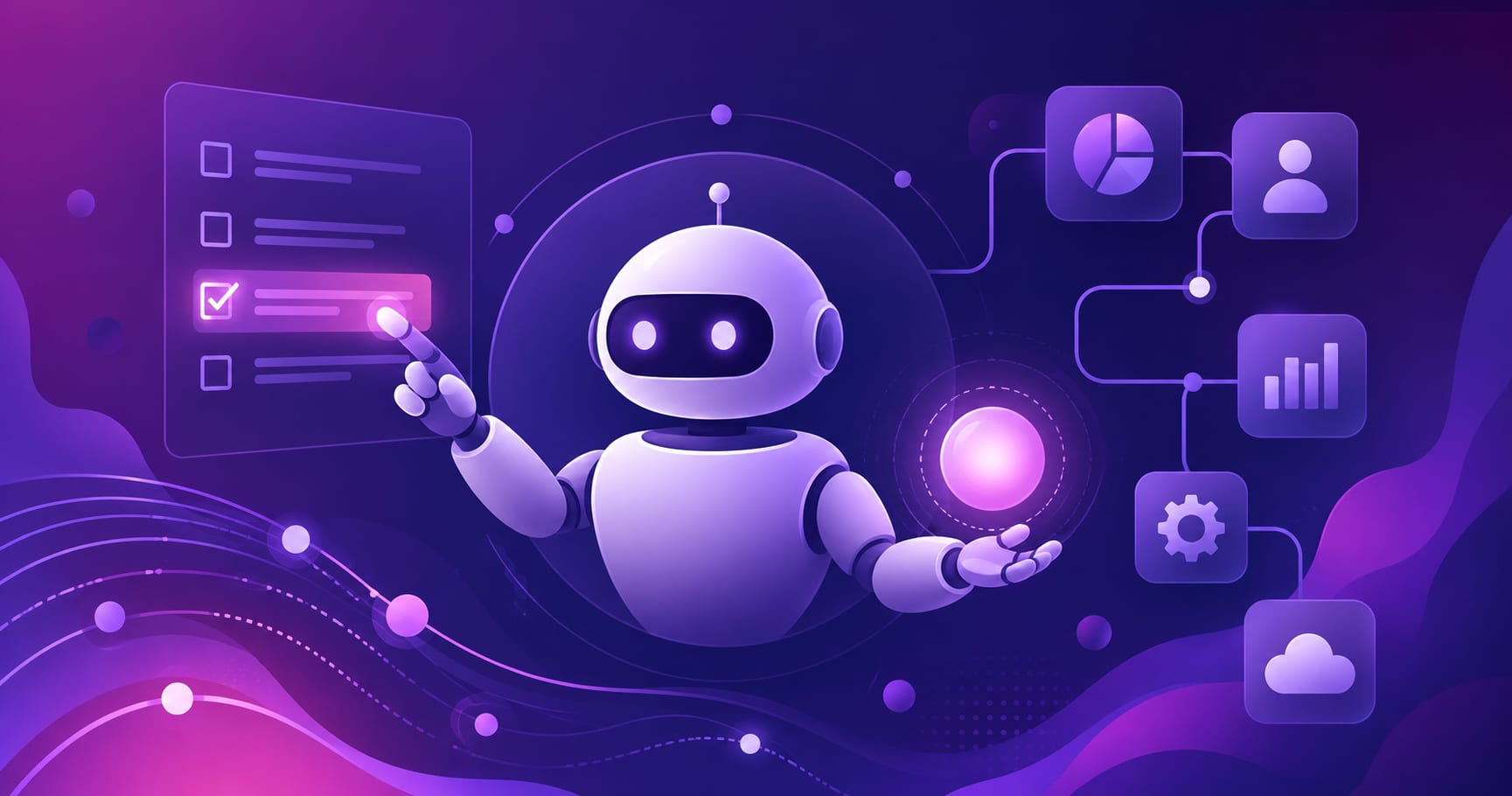
Agentic AI is a system that plans a sequence of steps, uses tools or APIs to carry them out, checks the results, and adjusts, all without a human approving each move. That’s different from a chatbot, which answers one question at a time, and a copilot, which assists a person who stays in control of the task. The difference is autonomy: agentic AI closes the loop between deciding and doing.
That distinction sounds academic until you’re the one deciding whether to buy an “AI agent” product or build one. Vendors have started slapping “agentic” on everything from chatbots to rules-based automation, and the label alone tells you almost nothing about what a system can actually do unsupervised. This guide breaks down what makes a system agentic, how it differs from the tools most teams already use, and what an agentic AI system looks like when it’s running in production.
What Is Agentic AI, Exactly?
Agentic AI describes software built around a loop: perceive the current state, plan a course of action, execute that plan using real tools, evaluate the outcome, and adjust if needed. It keeps running this cycle until a goal is met or it hits a limit it was given. That’s a meaningful jump from a generative model that produces one output per prompt.
The architecture behind an agentic system usually includes a few recurring pieces. A planning layer breaks a goal into steps. A memory component, often a vector store or structured log, keeps track of what’s already happened so the system doesn’t repeat work or lose context mid-task. Tool-use interfaces let the model call APIs, query databases, control a browser, or write and run code. And a reflection or self-correction step lets the system notice when a step failed and try something different instead of stopping.
Gartner projects that 40% of enterprise applications will include task-specific AI agents by the end of 2026, up from less than 5% in 2025. That’s a fast curve, and it’s part of why the term is showing up in every vendor pitch right now, whether or not the underlying product earns it.
Chatbots, Copilots, and Agentic AI: Where the Line Actually Falls
The three terms get used almost interchangeably in marketing copy, but they describe distinct relationships between the software and the human.
Chatbots Answer Questions
A chatbot is conversation-first. It waits for input, generates a response, and waits again. Even a chatbot built on a capable LLM is still reactive: it doesn’t take action in the world beyond producing text, and it doesn’t pursue a goal across multiple turns unless a person keeps steering it there.
Copilots Assist Inside a Workflow
A copilot sits inside an application and helps a person move faster: drafting an email, summarizing a thread, suggesting the next line of code. The person stays in the loop for every meaningful decision. A copilot amplifies a human’s output; it doesn’t replace the human’s judgment about what to do next.
Agentic AI Takes Autonomous Action
An agentic system is handed a goal, not a single instruction, and it decides the sequence of steps needed to reach it. It calls tools, reads the results, and adapts its plan without waiting for a person to approve each step. That’s the autonomy piece that separates it from the other two categories. Guardrails still apply (scope, permissions, budget limits), but within those guardrails the system is making its own sequencing decisions.
| Chatbot | Copilot | Agentic AI | |
|---|---|---|---|
| Interaction model | Reactive, turn-by-turn | Assistive, inside a workflow | Goal-directed, multi-step |
| Who decides the next step | The user | The user, with suggestions | The system, within guardrails |
| Typical output | Conversational text | Drafts, summaries, suggestions | Completed tasks, side effects in other systems |
| Human role | Asks and reads | Reviews and edits | Sets the goal and the boundaries |
In a Gartner poll of more than 3,400 organizations investing in the technology, only 19% reported significant investment in agentic AI, while 31% were still taking a wait-and-see approach or remained unsure. Most of what gets called “agentic” today is still in the pilot stage, which is worth remembering the next time a product page uses the word.
What an Agentic AI System Looks Like in Practice
Definitions only go so far. Here’s what the perceive-plan-act-adapt loop looks like when it’s solving an actual operational problem.
Our team built a proof of concept to fix a recurring administrative headache: tracking down team members with delinquent time logs and notifying them and their managers. Rather than automating this with a fixed script, we engineered an AI agent using the LangChain framework to orchestrate the sequence, hosted the underlying model on AWS Bedrock, and gave the agent the ability to navigate our internal project management tool through browser automation. Given a simple text instruction, the agent logs into the system, identifies who has outstanding time entries from the prior week, compiles that into a report, and sends notifications through Google Chat, all without a person walking it through each step.
That’s the agentic pattern in miniature:
- perceive (read the current state of time logs)
- plan (figure out who needs a notification and what it should say)
- act (navigate the tool, send the message)
- adapt (handle the unpredictable parts of a live web interface rather than failing outright).
The full case study covers the harder engineering problems this surfaced, including the fragility of automating around multi-factor authentication and the way small UI changes can break a browser-based agent’s assumptions. The result was a 30% improvement in timely time-logging compliance, and more importantly, a validated pattern for where autonomous agents make sense inside a larger organization.
The lesson that generalizes: the most reliable early agentic AI deployments tend to be narrow, well-scoped tasks with a clear success signal, not open-ended mandates to “handle project management.” Ambition creeps in later, once the narrow version has proven itself.
Why the Distinction Matters for Your Technology Decisions
The chatbot/copilot/agent distinction isn’t academic if you’re the one signing off on a budget line. Gartner estimates that only about 130 of the thousands of vendors claiming agentic capabilities are building something that actually qualifies, a practice the firm calls “agent washing”: rebranding existing chatbots, RPA tools, or assistants without adding real autonomy. Buying a relabeled chatbot at agentic-AI pricing is an expensive way to learn the difference.
The stakes of getting this wrong are not small. Gartner predicts that over 40% of agentic AI projects will be canceled by the end of 2027, largely due to escalating costs, unclear business value, or inadequate risk controls, not because the underlying technology doesn’t work. Separately, McKinsey’s November 2025 State of AI report found that 88% of organizations now use AI in at least one business function, but only 39% report any measurable earnings impact from it. Autonomy without governance is how a promising pilot turns into a canceled line item.
The practical implication: before evaluating any product as “agentic,” ask what happens when it’s wrong. A chatbot that hallucinates gives you a bad sentence. A copilot that hallucinates gives a person a bad draft to catch. An agentic system that hallucinates its way through a multi-step plan can take real actions, in real systems, based on a wrong assumption three steps back. That’s exactly why governance and scoped permissions matter more here than in either of the other two categories, a point we go into in more depth in our enterprise AI integration roadmap.
How to Evaluate Whether Agentic AI Fits a Use Case
Not every workflow needs autonomy, and forcing it onto a task that would work fine as a simple script or a copilot just adds risk and cost. A few questions help sort out where agentic AI earns its complexity:
Does the task require multiple dependent steps across different systems? If a task is a single lookup or a single transformation, a simpler integration will outperform an agent on cost and reliability. Agentic architectures pay off when a goal requires sequencing decisions across tools that weren’t built to talk to each other.
Is there a clear, measurable definition of success? The projects most likely to survive past the pilot stage have a metric attached before development starts: time saved, error rate, compliance percentage, something concrete rather than a vague sense of “efficiency.” Our own proof of concept above worked because “reduce delinquent time logs” was measurable from day one.
Can the organization tolerate the system taking action without a human checking every step? If the answer is no for a given task, that’s not necessarily a reason to avoid agentic AI altogether. It’s a signal to build in a human-in-the-loop checkpoint for the highest-risk actions while automating the rest.
Is the data the agent needs to act on actually accessible and reasonably clean? An agent that has to guess at incomplete data will make confident, wrong decisions faster than a human would. This is worth assessing before committing to an agentic approach, not after a pilot stalls.
Working through these questions with an experienced AI consulting partner before committing engineering time tends to save far more than it costs, mostly because it catches the “agent washing” problem and the wrong-use-case problem before either one turns into a canceled project.
Key Takeaways
Agentic AI is defined by a loop: perceive, plan, act, adapt, repeated until a goal is met, with minimal human intervention at each step. That’s what separates it from chatbots (reactive, conversational) and copilots (assistive, human-directed). The distinction is not just semantic. It determines what a system can be trusted to do without supervision, how much governance it needs, and whether a vendor’s “agentic” claim is real or relabeled.
The organizations getting real value from agentic AI right now are starting narrow: a single, well-scoped task with a measurable outcome, the kind of proof of concept that either earns the case for expansion or fails cheaply and quickly.
If you’re weighing where agentic AI fits into your own systems, our AI integration and AI/ML development teams work through exactly this kind of scoping before a single line of code gets written.
Frequently asked questions
An AI agent is a single component that handles one well-defined task, like classifying a support ticket or extracting fields from a document. Agentic AI is the broader system that coordinates multiple agents, tools, and data sources to complete a multi-step workflow autonomously. In practice, agentic AI decides which agents to invoke, in what order, and how to handle the handoffs between them.
Retrieval-augmented generation (RAG) retrieves relevant documents and feeds them to a model so it can answer with better context. It’s a technique for improving what a model knows at generation time. Agentic AI is about autonomous action and multi-step planning, and it often uses RAG as one tool among several rather than being an alternative to it. The two are increasingly combined in what’s called agentic RAG, where an agent decides when and how to retrieve information as part of a larger plan.
No. Generative AI produces content (text, code, images) in response to a prompt. Agentic AI can use generative models as part of its reasoning, but it’s defined by the ability to plan and execute multi-step tasks toward a goal, not by content generation. A generative model that only ever answers one prompt at a time isn’t agentic, no matter how good the answer is.
RPA follows a fixed, pre-scripted sequence of steps: click here, enter this value, move to the next screen. It breaks the moment the underlying interface changes or it hits a case the script didn’t anticipate. Agentic AI plans its own sequence based on the current state and can adjust when something unexpected happens, which is a meaningfully more flexible (and more failure-prone, if built carelessly) approach.
Common production examples include agents that autonomously triage and route support tickets, agents that reconcile financial records across systems and flag discrepancies, and agents that monitor internal compliance data and trigger notifications, like the time-tracking compliance agent described above. The common thread is a narrow, measurable task with clear guardrails, not an open-ended mandate.