How unicrew Uses AI in Recruitment Without Losing the Human Touch
Maria Oliinyk, unicrew's Head of Recruitment, explains where AI speeds up CV matching and client submissions, and why hiring decisions always stay human.
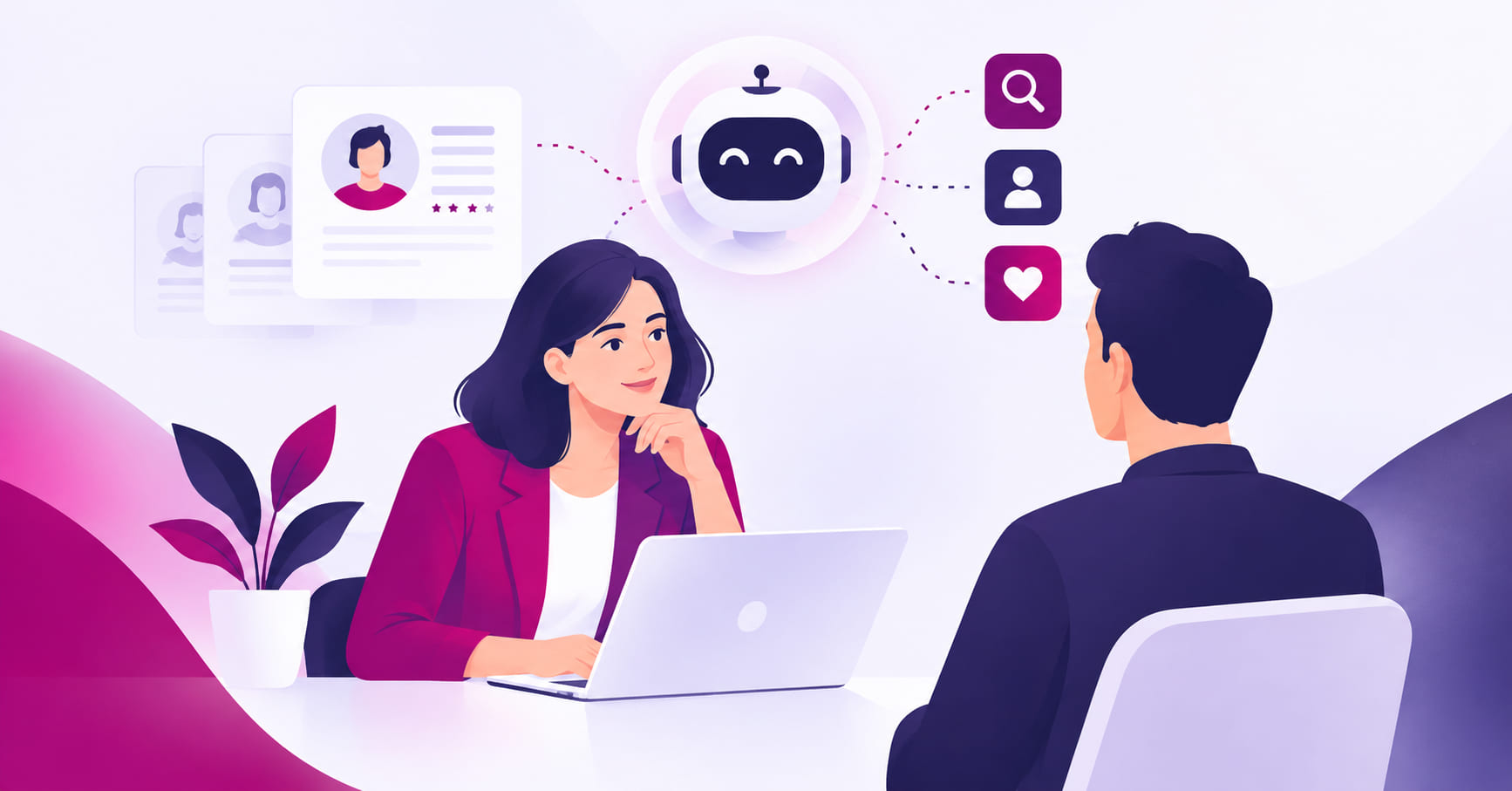
At unicrew, AI in recruitment now matches candidate CVs against job requirements, reformats profiles into client-ready templates, and drafts interview feedback for stakeholders. It does not make hiring decisions, judge culture fit, or write the message when a client project falls through. Those calls stay with Maria Oliinyk’s recruiters.
This is the second article in a series looking at how unicrew’s teams actually use AI day to day, not the marketing version of it, the real one. The first interview in the series was with Sofia Kirichenko, Senior People Partner at unicrew, on how AI shows up in people management and HR. This time, we sat down with Maria Oliinyk, Head of Recruitment, to talk about where AI has actually changed how her team hires, and where she’s deliberately kept it out.
A New Series: How unicrew’s Teams Actually Use AI
We’re publishing this series because “we use AI” has become a meaningless sentence. Every company says it. Few explain what it actually touches, and what it’s kept away from. Sofia Kirichenko opened the series talking about AI in HR, where it drafts reports and summarizes feedback, but never runs a one-on-one or decides who gets promoted. Recruitment turned out to be a good second stop, because it’s a function built almost entirely out of repetitive, high-volume tasks sitting right next to some of the most human decisions a company makes. According to SHRM’s State of AI in HR 2026 report, recruiting is the single biggest use case for AI adoption inside HR functions, with 27% of organizations already using it there, more than any other HR activity, largely because of the repetitive volume and the clear efficiency gains. Maria’s team is a working example of what that adoption actually looks like in practice.
Meet Maria Oliinyk: From Talent Sourcer to Head of Recruitment
Maria has spent six and a half years in recruitment. She started as a talent sourcer at a recruitment agency, moved into an in-house recruiter role at a company of 300-plus people, took on a managerial position, and then joined unicrew. Before any of that, she worked in banking, also in a management track. Recruitment gave her something she wanted more of: a way to help people find where their potential actually fits, and a more direct hand in company growth than onboarding someone after the decision is already made.

She’s been Head of Recruitment at unicrew for four years now, joining a few months after the start of the full-scale war in Ukraine, at an early stage in the company’s growth. Her first months focused on building recruitment operations from the ground up: setting up a CRM, defining a clear process, and getting the fundamentals automated before layering in anything smarter.
Recruitment Ops From Scratch: How AI Entered the Workflow
At unicrew, we started by setting up the internal CRM system, and only after that did we bring AI into the picture. We began with ChatGPT (on a Team plan), alongside a few recruiting tools with AI features built in that we tested on and off along the way.
The earliest AI use sat exactly where you’d expect: sourcing and candidate communication. Messaging prompts, candidate follow-ups, and feedback emails were the first things to move. Next came sourcing itself, writing Boolean searches and X-ray searches faster than doing it by hand. From there, AI moved into the CRM and interview side of the process: interview notes, feedback across every stage of the pipeline, communication with hiring managers, technical interview prep, and job descriptions written both for internal use and for external job boards.
The third area, and the one Maria describes as more strategic, was analytics. As the team grew, recruitment activity lived across a growing set of spreadsheets. Part of Maria’s leadership work has been consolidating that into clearer internal reporting, the kind that ties recruitment activity back to company-level metrics instead of living in its own disconnected tab.
Where AI Moved Fastest: CV Matching and Branded Client Submissions
Ask Maria for the single biggest time-saver AI has given her team, and the answer isn’t sourcing or screening. It’s CV formatting.
For years, before a candidate’s profile went to a client, someone had to manually reformat it into unicrew’s branded template, often using local tools or PDF editors, one CV at a time. It was tedious, repetitive, and it ate hours on every single search. So the team built its own solution in-house, working with a developer colleague from unicrew’s AI development practice and team members who were between client projects at the time. The result is an internal Recruitment Assistant that unicrew has now been using for close to two years.
It does two things. First, it analyzes an incoming CV against the job description and shows a match percentage, giving the recruiter a fast read on relevance before they dig in manually. Second, once a recruiter has approved a candidate, it automatically reformats their CV into unicrew’s client-ready template, which now also comes in a bilingual format.
The impact wasn’t only internal. Clients used to receive candidate profiles in whatever format the candidate originally sent them, inconsistent, occasionally messy, and with no visible connection to unicrew. Some clients, particularly in Europe, still print CVs out before reviewing them. Now, every profile that reaches a client is instantly recognizable as coming from unicrew, consistently structured, and built around a template that highlights what matters for that specific role and role type. The original goal was efficiency. The side effect was brand recall.
Skills-Based Job Descriptions and Smarter Screening
AI also changed how job descriptions get written. Instead of leaning on rigid, traditional job titles, Maria’s team now uses AI to help structure requirements around concrete, specific skills. That shift toward skills-based hiring has directly improved the quality of applicants coming through the funnel, not just the volume.
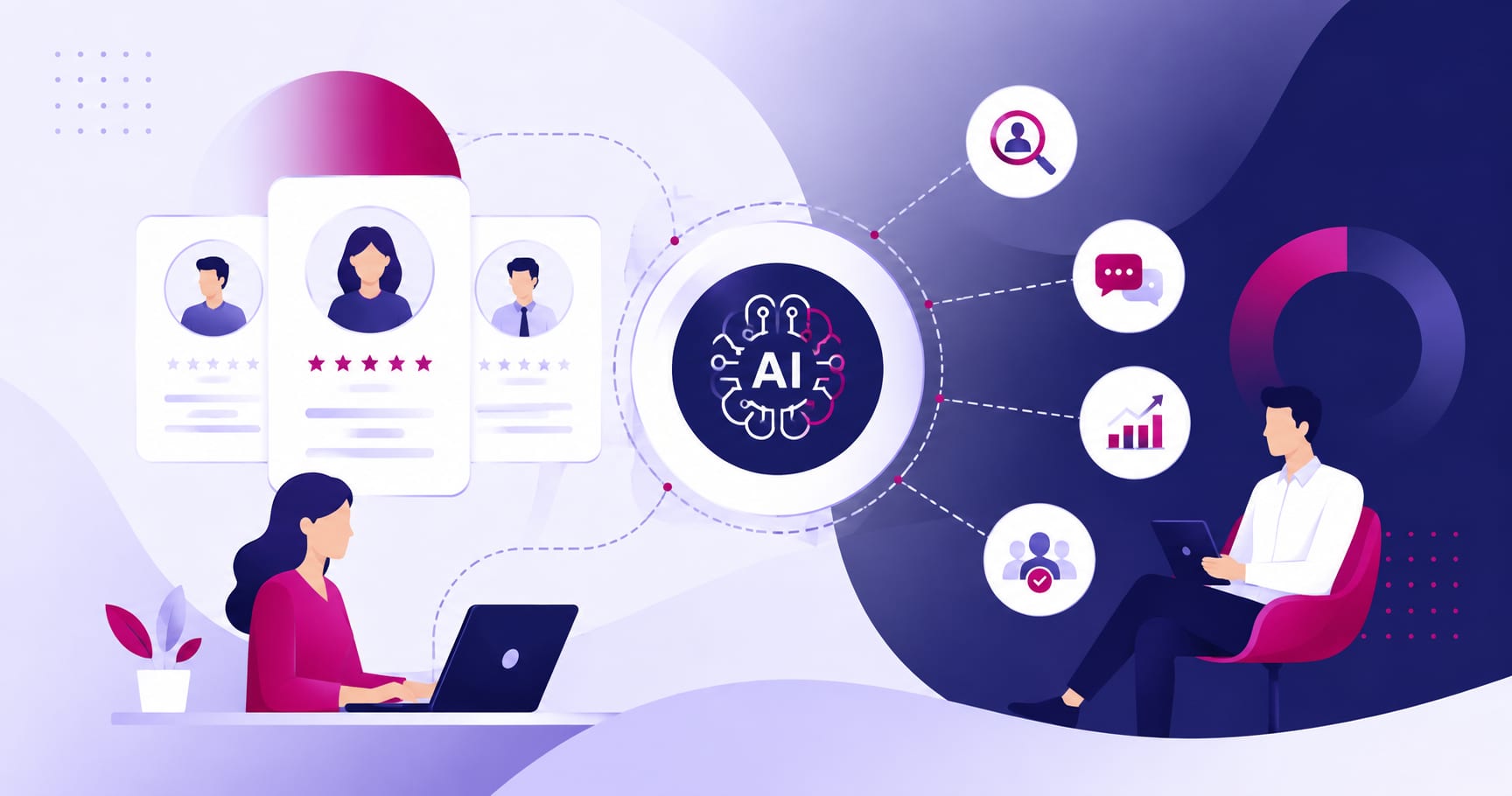
The path from a submitted resume to a shortlist follows a clear split between what AI touches and what it doesn’t. When a CV comes in, AI parses it and matches the candidate’s experience against the role’s criteria, surfacing relevance for the recruiter reviewing it. That’s where AI’s job ends. The actual shortlisting decision, whether this person moves forward, is made manually, by a recruiter looking at the full picture. Once that decision is made, the approved profile is automatically reformatted into the branded client template described above.
Technical Interviews: AI Literacy In, Full Automation Out
At one point, Maria considered going further: building out a fully AI-run technical interview, an AI agent conducting the conversation from start to finish. The idea got as far as a real conversation with engineering managers, unicrew’s CTO, and the founders, and then it was shelved. The reasoning was straightforward. Recruitment, especially in tech, remains one of the most human-driven parts of the hiring process, and candidates still want a human interviewer giving them real feedback, not a transcript evaluated by a model.
What replaced the idea was more targeted. A few months ago, the team added an explicit “AI literacy” competency to its internal technical evaluation matrix, applied across interview types, not just technical ones. Interviewers now ask candidates how they use AI in their work and how they’re building that skill over time, and it’s scored alongside everything else on the evaluation form. Alongside that, technical interviews now include a short live-coding session where candidates work with an AI coding agent while a human interviewer watches and evaluates how they collaborate with the tool in real time. It’s a meaningful shift in what “technical assessment” looks like, but it stops well short of an AI-run interview. That idea is on hold, not in production.
AI also changed what happens after the interview. The team relies heavily on prompts that turn interview notes or recordings into feedback tailored to whoever needs to read it, a technical hiring manager, a non-technical stakeholder, or a client’s own HR or recruitment lead, built around that specific job description. The recruiter still adds their own input on top of the AI-generated draft before it goes out. It’s a small change on paper, but it replaced a lot of manual note-taking and memory-dependent summarizing that used to eat into a recruiter’s day.
Where unicrew Draws the Line
Some parts of the process are deliberately kept out of AI’s reach, and Maria is specific about why. Final hiring decisions stay entirely human. So does evaluating soft skills and cultural fit, reading a candidate’s tone and reactions during an interview, and negotiating an offer. Her reasoning: AI lacks empathy, context, and a read on team dynamics, and trying to generate a soft-skills assessment from interview notes alone would be neither logical nor accurate. Complex or sensitive communication also stays off-limits to AI. If a project falls through, plans change, or a client’s strategy shifts mid-search, that message gets written and delivered personally, not drafted by a model.

This isn’t only a comfort preference. According to Pew Research Center, 66% of Americans say they would not apply for a job that uses AI to help make the hiring decision, a reminder that candidate trust, not just technical capability, sets a real limit on how far this can go. Maria’s team runs what she calls a human-in-the-loop setup for exactly this reason: AI output is informational only and never auto-rejects a candidate. AI can misread a non-linear career path or a self-taught background as a red flag when it isn’t one, so a recruiter always reviews the actual profile before anything moves forward.
The same logic applies after a candidate is placed. Check-ins at the 30, 60, and 90-day marks lean on the CRM and AI-assisted drafting to pull together quality feedback prompts, but the team deliberately doesn’t automate the conversations themselves. Maria describes it as roughly a 50/50 split: AI helps prepare the ground, but the actual face-to-face communication with a newly placed candidate stays human.
What’s Next: Closing the Loop Between CRM, LinkedIn, and Messaging
Maria’s current focus is cutting down manual sourcing work by tying LinkedIn more tightly into unicrew’s internal CRM, including exploring code-based agents that can bridge the two systems directly for integrations, message drafting, and feedback writing. CRM, LinkedIn, and candidate messaging are the three channels her team lives in every day, so that’s where she wants AI working hardest next, not as a new capability bolted on, but as a way to make the existing workflow faster and less manual.
Advice for Recruitment Leaders Just Starting With AI
Maria’s advice comes down to two things, and neither of them starts with picking a tool.
First, start with your own process, not the technology. Her caution is against chasing whatever tool is trending and adopting it without first understanding your team’s actual bottlenecks, where time gets lost, where hiring managers cause delays, where data is scattered across too many places. Analyze the process, find the parts that are genuinely approachable for AI, and only then look for a tool to fit. The goal is process improvement, not AI adoption for its own sake, and those aren’t the same metric.
Second, don’t let adoption happen person by person. Maria has seen how unproductive it is when everyone on a team independently picks up their own favorite tool, with no shared approach and no team-wide coordination. unicrew found this out directly, and now departments, recruitment included, test and settle on tools together instead of everyone experimenting solo. Her team’s own data backs this up: processes close faster, and results are stronger, when AI adoption is a team decision rather than an individual one.
Key Takeaways
AI at unicrew’s recruitment function absorbed the parts of the job that were pure time cost: CV formatting and matching, first-draft feedback, sourcing scripts, and the administrative weight behind every candidate submission. It also reshaped how job descriptions get written, pushing the team toward skills-based hiring, and it changed what a technical interview measures by adding AI literacy as a real competency. What it hasn’t touched, on purpose, is the final call: who gets hired, how soft skills and cultural fit get judged, and how difficult conversations get handled. Maria’s approach isn’t about how much of recruitment can be automated. It’s about being specific enough to know which parts shouldn’t be.
If you’re building out a recruitment function and want to see what that balance looks like in practice, unicrew’s staffing and team extension team works this way every day.