What Agentic AI Workflows Actually Do in Logistics Operations
Agentic AI now handles scheduling, dispatch, and exceptions in logistics. See how it differs from RPA, and how moving and freight operators are using it.
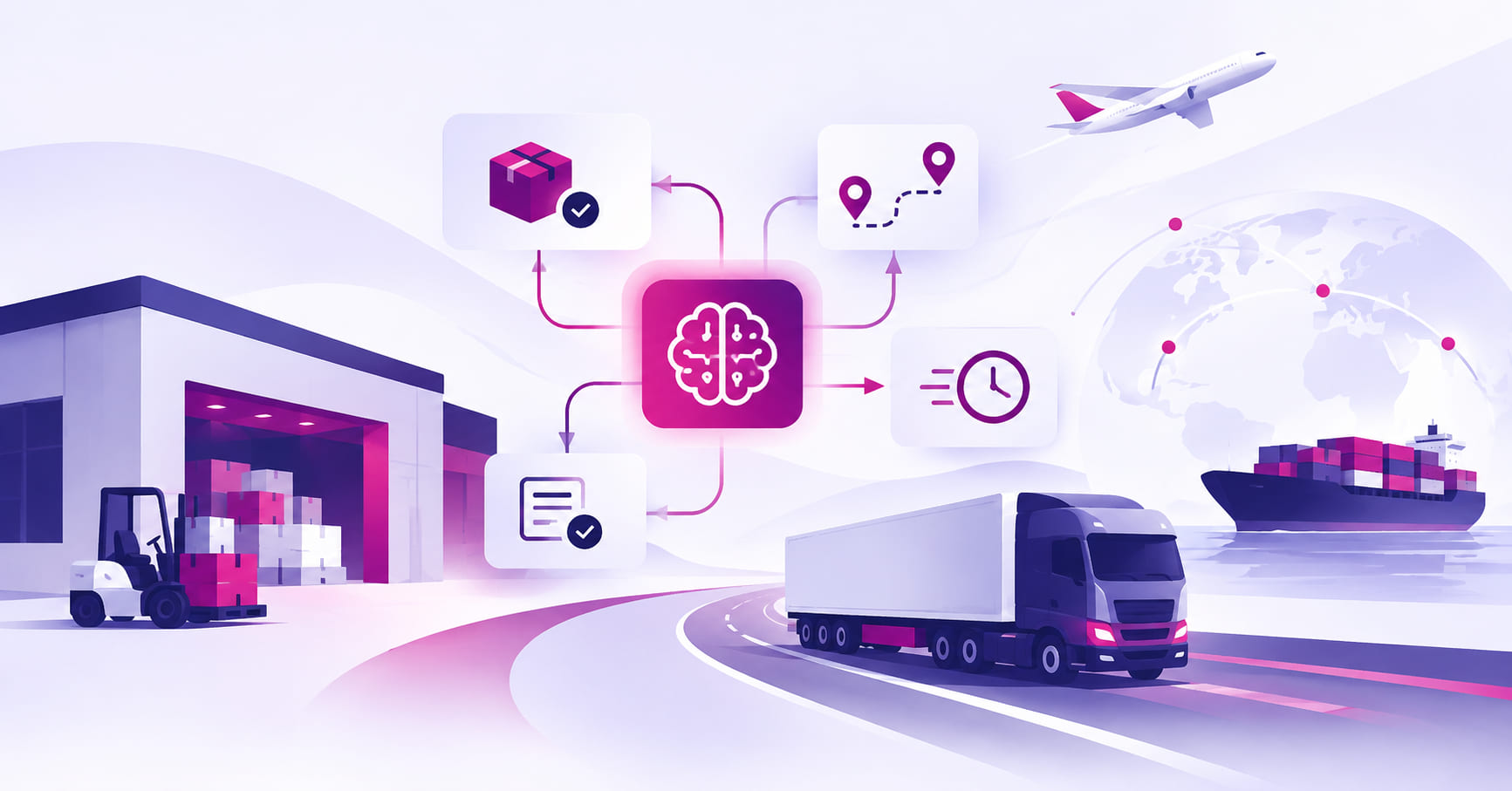
Agentic AI in logistics means software that plans and executes multi-step operations, rebooking a delayed shipment, reassigning a crew, renegotiating a delivery window, without a human writing the rule for that exact scenario in advance. That’s the line between this and the logistics automation software most moving and freight companies already run. Traditional automation follows scripts. Agentic systems make decisions inside guardrails, then act on them.
That distinction matters more than the marketing around it suggests, especially for operations built on constant exceptions: moving, freight, last-mile delivery. This piece breaks down what agentic AI actually does differently, where it fits into scheduling, dispatch, and exception handling, and how to decide whether to buy an off-the-shelf platform, build something custom, or blend the two. We’ll ground the moving-industry examples in real client work rather than hypotheticals.
What “Agentic” Actually Means in Logistics Automation
Every vendor in the logistics space now calls its product “AI-powered,” which has made the word close to meaningless. Agentic AI is a narrower, more useful term: it describes systems that observe a state (an order, a shipment, a schedule), reason about what to do next against a goal, take an action through an API or integration, and then reassess based on the outcome. That loop, observe, reason, act, reassess, is what separates agentic systems from both traditional rules engines and generative AI that only drafts text or summarizes documents.
A transportation management system (TMS) with automation rules can flag a late shipment and send an alert. It can’t decide, on its own, whether to re-route through a different carrier, split the shipment, or hold it for consolidation, weigh the cost and service tradeoffs of each, and then execute the one it picks. That’s the gap agentic systems are built to close, and it’s why 79% of companies surveyed by PwC in its 2025 AI Agent Survey say AI agents are already being adopted somewhere in their organization, with 88% of executives planning to increase AI-related budgets specifically because of agentic capability.
Agentic AI vs. RPA vs. Traditional TMS Rules Engines
The three approaches get conflated constantly, and the confusion drives bad buying decisions. Here’s the practical difference.
| Capability | Rules-based TMS automation | Robotic Process Automation (RPA) | Agentic AI |
|---|---|---|---|
| Handles predefined scenarios | Yes | Yes | Yes |
| Handles novel or unscripted scenarios | No | No | Yes, within guardrails |
| Makes tradeoff decisions (cost vs. speed vs. service) | No | No | Yes |
| Executes multi-step actions across systems | Limited, per rule | Yes, but scripted step-by-step | Yes, dynamically sequenced |
| Requires a human to anticipate every case | Yes | Yes | No, but requires oversight design |
| Typical use | Alerting, status updates, routing by fixed criteria | Data entry, document processing, system-to-system copying | Dispatch decisions, exception resolution, dynamic scheduling |
| Failure mode | Silently misses unscripted cases | Breaks when the underlying UI or format changes | Can act confidently on bad data if ungoverned |
None of these approaches replace the others outright. Most mature logistics operations run all three: RPA for document and data movement, rules engines for compliance and predictable routing, and agentic layers for the decisions that used to require a dispatcher’s judgment call. Treating agentic AI as a wholesale replacement for existing systems is usually the wrong frame; it’s a new layer that sits on top of the data and integrations you already have.
Where Agentic Workflows Fit in Logistics and Moving Operations
The operational value of agentic AI in logistics concentrates in a handful of high-friction workflows. These are the ones worth evaluating first, because they combine high transaction volume with enough variability that static rules break down.
Scheduling and Crew or Fleet Assignment
Scheduling in logistics and moving operations isn’t a single optimization problem, it’s a moving target that shifts every time a job runs long, a truck breaks down, or a customer reschedules. An agentic scheduling system continuously re-evaluates assignments against constraints (crew availability, drive time, equipment, service windows) instead of running a nightly batch optimization that’s stale by 9 a.m. When a two-person moving crew finishes a job early, the system can pull forward the next available job instead of leaving the crew idle until a human dispatcher notices.
According to McKinsey’s 2025 analysis of AI in distribution supply chains, one logistics operator that applied AI to labor scheduling cut scheduled labor hours by 25 to 30% while maintaining full service coverage at its pilot site, without cutting corners on coverage.
Dispatch and Real-Time Route Adjustment
Dispatch is where agentic AI shows up most visibly, because the decisions are frequent and the cost of a bad one is immediate. A shipment gets delayed at a dock, a driver hits unexpected traffic, a customer moves their delivery window. An agentic dispatch layer doesn’t just flag the disruption, it evaluates re-routing options, checks the downstream effect on every other stop on that route, and reassigns before the delay compounds.
The same McKinsey analysis found that one building-products distributor using AI-driven dispatch improved on-time delivery by 20% within six months, while reclaiming more than two hours of supervisor time per day that had previously gone into manual dispatch adjustments.
Exception Handling
This is arguably where agentic AI earns its keep fastest, because exception handling is where most logistics software still dumps everything into a human queue. Damaged shipments, missed pickup windows, customs holds, weather delays, a moving crew that’s short a person: these are the cases legacy automation can’t touch because no one wrote a rule for that specific combination of circumstances.
An agentic exception handler can triage incoming exceptions by severity and cost impact, resolve the low-stakes ones autonomously (rebooking a delivery window, notifying an affected customer, adjusting a route), and escalate only the cases that genuinely need judgment. That triage step alone changes the economics of exception handling: instead of every exception hitting a human queue, only the ones that actually need a human do.
Quoting and Order Intake
Quoting is the front door to most logistics and moving operations, and it’s often the least automated part of the process, still routed through a sales rep manually calculating a quote based on inventory lists and move details. Multi-step quote wizards that guide a customer through item selection, move type, and service options, then generate an instant quote, remove that bottleneck entirely for the majority of standard cases. The agentic layer on top of that intake process is what decides, in real time, whether a given order needs manual review (unusual item mix, long-distance multi-leg move, storage complications) or can flow straight through to booking.
The Moving Industry as a Proving Ground
Moving companies are an unusually good stress test for agentic workflows, because the entire business model is a chain of multi-step, exception-prone operations: a quote turns into an order, an order turns into a scheduled crew and truck, and every step between booking and delivery is a candidate for something changing. That’s a structurally different problem from, say, e-commerce fulfillment, where SKUs and warehouse locations are fixed and most of the variability is in demand, not in the physical execution of the job itself.
We’ve built order management and quoting infrastructure for moving companies directly. For MiniMoves, a national moving company handling local, interstate, and international relocations, we built a React and .NET application centered on a multi-step quote wizard: customers select items, choose move preferences, and get a quote without a sales rep manually building one. The platform also handles order management after booking, letting customers edit order details through secure links, schedule callbacks, and track status, work that previously depended on manual sales-team involvement.
For Cloud Van Lines, another moving company we’ve worked with, the integration challenge was different: connecting four separate payment processors and SMS notifications through Twilio into a single operational platform, detailed in our logistics API integration guide. That’s the kind of integration work that has to happen before any agentic layer can function, an agent can’t make a good rebooking decision if it can’t see payment status or notify the customer through the channel they actually respond to.
Neither of these builds started as an “agentic AI project.” They started as order management and integration problems. That’s a useful data point for anyone evaluating agentic AI vendors right now: the operational foundation, clean data, reliable integrations, a system of record that reflects reality, has to exist before an autonomous decision-making layer has anything trustworthy to act on. Vendors selling agentic capability as a bolt-on to a messy data environment are selling something that won’t hold up past the demo.
Build, Buy, or Blend: Choosing Your Approach
Once a logistics or moving operation decides agentic AI is worth pursuing, the harder question is how to get there. The market has no shortage of off-the-shelf AI dispatch and agent platforms, and building custom is a real, viable path for the workflows that differentiate the business. Most operations land somewhere in between.
| Factor | Buy (off-the-shelf platform) | Build (custom agentic system) | Blend |
|---|---|---|---|
| Time to first pilot | Weeks | Months | Weeks for the wrapped parts, months for custom logic |
| Fit to unique workflow | Generic, may require process changes | Exact fit to your operation | Core differentiators custom, commodity functions bought |
| Data ownership and portability | Often vendor-controlled | Full ownership | Depends on integration design |
| Cost structure | Recurring subscription, scales with volume | Higher upfront, lower marginal cost at scale | Mixed |
| Vendor lock-in risk | Higher | None | Managed through adapter patterns |
| Best fit | Commodity workflows (standard dispatch, tracking) | Workflows that are your competitive differentiator | Most real-world logistics operations |
Where Off-the-Shelf Tools Win
Buying makes sense when the capability is a commodity: standard route optimization, carrier tracking integrations, basic dispatch alerting. These are solved problems with mature vendors, and building them from scratch burns engineering time on something that won’t differentiate the business. It also makes sense when you need to validate that agentic AI delivers value in your operation before committing to a larger build, a pilot on a bought platform is a reasonable way to test the concept without months of development time.
Where Custom Development Pays Off
Custom development earns its cost when the workflow itself is the differentiator, or when the integration needs to outlive whatever platform you’d otherwise depend on. A moving company whose quoting logic reflects years of pricing refinement isn’t well served by a generic SaaS quoting engine built for a different business model. The same logic that applies to supply chain software generally applies here: build when your process is the competitive advantage, buy when it’s a commodity, and don’t confuse company size with the right answer. A five-person operation with genuinely unusual pricing logic may need custom software sooner than a much larger company running standard freight lanes.
Governance and Human-in-the-Loop Design
This is the part most agentic AI coverage treats as an afterthought, and it’s the part that determines whether an autonomous system is trustworthy enough to actually run unsupervised. Every agentic workflow needs an explicit answer to three questions: what can the system decide on its own, what does it need to escalate, and how does a human audit what it did after the fact.
The safest pattern for logistics operations is graduated autonomy: start with an agent that recommends actions for human approval, track its accuracy over a defined volume of decisions, and only expand its autonomous scope for the categories of decisions where it’s proven reliable. A system that’s earned autonomy over standard rebooking decisions hasn’t necessarily earned it over decisions that touch a customer’s total cost or a regulatory requirement. Treating all decisions as equally safe to automate is how agentic pilots turn into incidents.
What Implementation Actually Requires
Agentic AI implementations succeed or fail on unglamorous foundations, not on model selection. Three things matter more than which AI vendor you pick.
Clean, consolidated data is the first requirement. An agent making a dispatch decision needs a real-time, accurate view of orders, fleet status, crew availability, and customer commitments. If that data lives in four disconnected systems with different refresh rates, the agent is reasoning against a picture of reality that’s already stale.
Reliable integrations come second. The agent’s decisions are only as good as its ability to act on them, rebooking a shipment, notifying a customer, updating a payment record. That means solid API connections to the systems of record, not screen-scraping or brittle point-to-point integrations that break every time a vendor changes their interface.
Phased rollout comes third. Start with one workflow, one decision type, one measurable outcome. PwC’s 2025 survey found that among companies already running AI agents, 66% report measurable value from increased productivity, but that’s the number for organizations that have gotten past initial deployment. Many AI supply chain implementations require $1 million or less in initial investment when scoped as a focused pilot rather than an enterprise-wide rollout, according to McKinsey’s analysis, which makes a narrow, well-instrumented pilot the more defensible starting point than a platform-wide agentic transformation.
The logistics automation market overall reflects this shift toward practical, incremental adoption: it’s projected to grow from $50.1 billion in 2026 to $148.7 billion by 2033, a 16.8% compound annual growth rate, according to Grand View Research. That growth is increasingly weighted toward AI-driven capability rather than conveyor belts and warehouse robotics alone.
Common Pitfalls When Adopting Agentic AI in Logistics
A handful of mistakes show up repeatedly in agentic AI adoption, and most of them are avoidable with better scoping upfront.
Automating a broken process is the most common one. An agent layered on top of inconsistent data or a workflow nobody trusts doesn’t fix the underlying problem, it just makes bad decisions faster and with less visibility into why. Fix the data and process foundation before adding autonomous decision-making on top of it.
Skipping the human-in-the-loop design is close behind. It’s tempting to grant full autonomy quickly, especially after a promising pilot, but decision categories that touch cost, compliance, or customer commitments deserve a longer track record before they run unsupervised.
Treating every workflow as agent-ready is another one. Not every process benefits from autonomous decision-making. Simple, high-volume, low-variability tasks are often better served by straightforward automation or RPA, cheaper to build, easier to audit, and just as effective. Reserve agentic capability for the decisions that genuinely require weighing tradeoffs against a goal.
Finally, underestimating organizational change is a recurring theme across the industry. Reskilling dispatchers and coordinators to work alongside agentic systems, rather than around them, takes deliberate change management, not just a software rollout.
Key Takeaways
Agentic AI earns its distinction from older automation by making tradeoff decisions and acting on them, not just executing predefined scripts. In logistics and moving operations specifically, the highest-value applications are scheduling, dispatch, exception handling, and quoting, all workflows defined by constant, unscripted variability. The moving industry in particular is a strong proving ground for this, because nearly every job is a multi-step process with room for something to change along the way.
Before evaluating agentic platforms or planning a custom build, the foundational work, clean data, reliable integrations, a system of record that reflects reality, has to be in place. Whether that means buying, building, or blending depends on whether the workflow in question is a commodity or a genuine differentiator for your operation.
If you’re weighing whether your logistics or moving operation’s quoting, dispatch, or order management workflows are ready for an agentic layer, or whether the foundation needs work first, our logistics and transportation team has built the order management and integration infrastructure that layer depends on.
Frequently asked questions
Agentic AI in logistics refers to software that autonomously plans and executes multi-step decisions, like rebooking a delayed shipment or reassigning a crew, based on real-time data, rather than following a fixed rule set. It observes conditions, reasons about the best action against a goal, executes that action through system integrations, and reassesses the outcome.
RPA automates predefined, scripted steps, like copying data between systems, and breaks when it encounters a scenario nobody scripted for. Agentic AI is built to handle scenarios that weren't explicitly anticipated, weighing tradeoffs like cost, speed, and service level before acting, within defined guardrails.
Yes, and it's one of the highest-value use cases, because exception handling is where legacy automation fails most often. An agentic system can triage exceptions by severity, resolve low-stakes cases autonomously (like rebooking a delivery window), and escalate only the cases that genuinely require human judgment.
It depends on whether the workflow is a commodity or a differentiator. Buy for standard, well-solved problems like route optimization or carrier tracking. Build when the workflow reflects your competitive advantage or needs to outlive a vendor's roadmap. Most operations end up blending both.
Costs vary widely by scope, but McKinsey's 2025 analysis found many AI supply chain implementations require $1 million or less in initial investment when scoped as a focused pilot on a single workflow rather than an enterprise-wide deployment. Custom builds for a single high-value workflow, like a quoting and order management platform, often cost less than that when scoped narrowly.