Why Most AI Agents Never Reach Production, and What Separates the Ones That Do
Most AI agent demos never make it to production. Here's what production readiness actually requires: evaluation, guardrails, observability, and cost control.

Tural MamedovChief Executive Officer
Published
Share
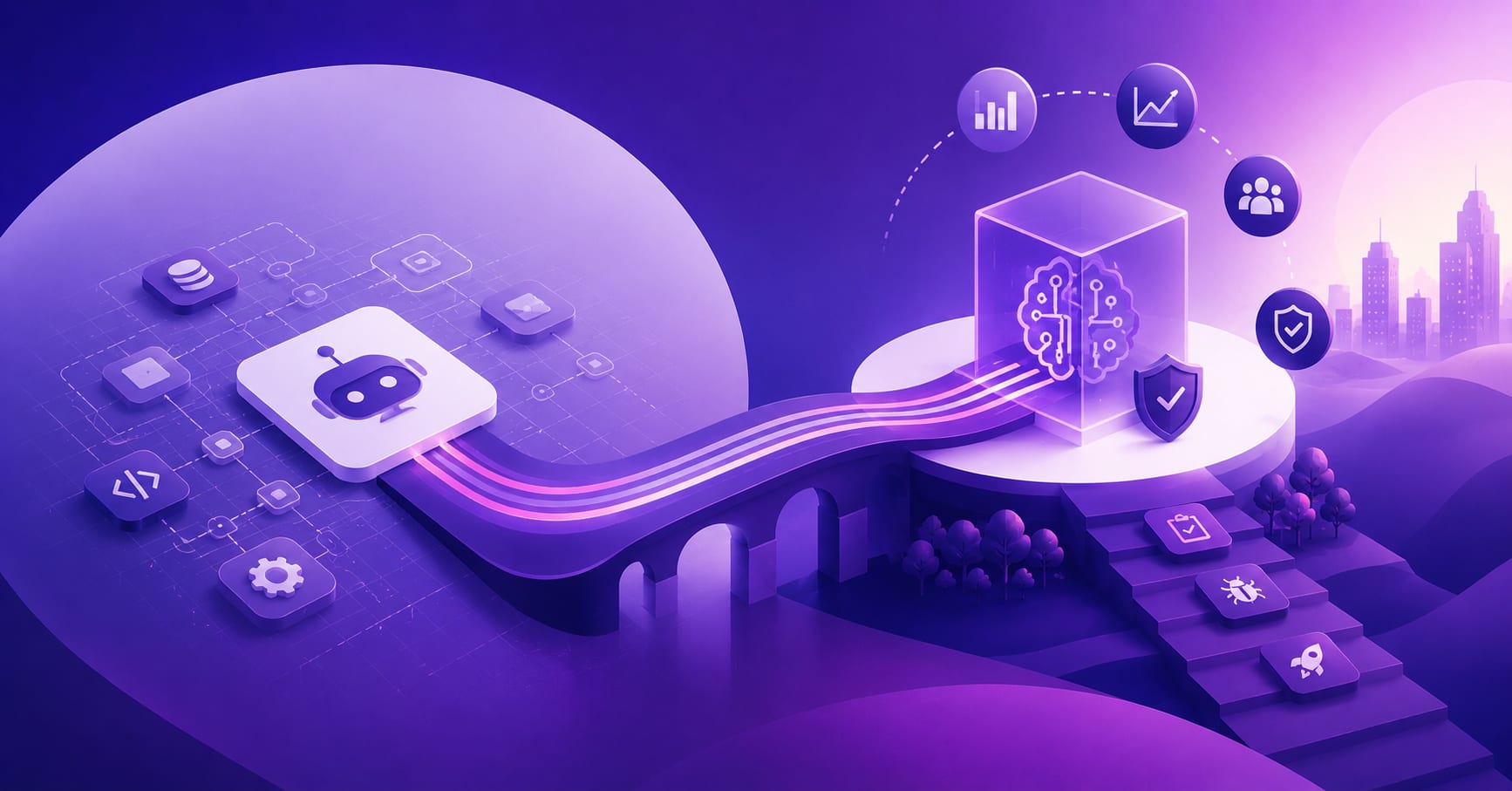
Building an AI agent that impresses a room is straightforward. Building one that survives contact with production is a different discipline entirely. AI agent development that actually reaches production requires four things most demos skip: a working evaluation loop, guardrails around autonomous behavior, real observability into what the agent is doing, and a cost model that holds up at scale.
That gap between “it worked in the demo” and “it’s running in production” is where most agent projects quietly die. According to MIT Media Lab’s State of AI in Business 2025 report, 95% of corporate generative AI initiatives show zero measurable return, and only about 5% of pilots make it into production with any measurable value attached. The pattern isn’t unique to generative AI broadly. It’s especially pronounced for agents, because agents don’t just generate text, they take actions, call tools, and make decisions with consequences. That’s a much higher bar than a chatbot that answers questions.
We’ve built and shipped agent-based automation ourselves, and one thing stood out from that work: the model wasn’t the reason the project was hard to get right. The engineering around the model was.
Why Most AI Agent Pilots Never Leave the Demo Stage
A demo has to do one thing: work, once, for an audience that already wants to be convinced. A production agent has to work repeatedly, for users who didn’t opt into forgiving it, against inputs nobody anticipated, on a budget somebody is watching.
Gartner predicts that over 40% of agentic AI projects will be canceled by the end of 2027, and the firm is specific about why: escalating costs, unclear business value, and inadequate risk controls, not model capability. As Gartner analyst Anushree Verma put it, most agentic AI projects today “are early stage experiments or proof of concepts that are mostly driven by hype and are often misapplied.” That’s a governance and engineering problem, not a model quality problem.
At the same time, agents are proliferating fast. Gartner separately projects that 40% of enterprise applications will feature task-specific AI agents by 2026, up from less than 5% in 2025. Adoption is outpacing the operational maturity needed to run these systems safely, which is exactly how you end up with a wave of impressive pilots and a much smaller number of durable production systems behind them.
McKinsey’s 2025 State of AI survey, published in November 2025, captures the same gap from a different angle: 88% of organizations now use AI in at least one business function, up from 78% the year before, yet only around 39% of respondents attribute any measurable enterprise-level EBIT impact to it, and about a third have begun scaling AI across the enterprise at all. Adoption is nearly universal. Value at scale is still rare. Agents, being the most operationally demanding form of applied AI, feel that gap first.
The Demo-to-Production Gap Isn’t a Model Problem
None of this is because today’s models are too weak to power useful agents. It’s because a demo doesn’t have to answer questions a production system can’t avoid: What happens when the agent is wrong? Who notices? What does it cost per run at real volume? What’s the blast radius if it takes the wrong action against a live system instead of a sandbox? Skip those questions during the demo phase and they don’t disappear, they just show up later, usually after the budget and the credibility for the project have already been spent.
What “Production-Ready” Actually Means for an AI Agent
Production-ready doesn’t mean the agent never makes mistakes. It means the organization can see the mistakes, contain them, and keep the system economically viable while it improves. In practice, that comes down to four pillars, and a demo that’s missing any one of them isn’t actually a prototype of a production system. It’s a different thing that happens to look similar on a screen share.
The four pillars are evaluation, guardrails, observability, and cost control. They’re not sequential phases you complete once. They’re ongoing disciplines that get built into the architecture from the start, because retrofitting any of them after an agent is already live and handling real workflows is considerably harder than designing for them up front.
Evaluation: How Do You Know Your Agent Actually Works?
A demo succeeds if it works on the three examples you tried before the meeting. A production agent has to work on inputs nobody tried, including ones nobody anticipated. The only way to have confidence in that is a real evaluation practice, not a vibe check.
Microsoft’s guidance on running agents in production lays out a two-phase pattern worth borrowing: offline evaluation against a curated dataset with known correct answers, which is repeatable and gives you clear accuracy metrics because you have ground truth, paired with online evaluation that monitors real production usage and catches drift and edge cases no test set anticipated. The loop is continuous: evaluate offline, deploy, monitor online, collect the failures that show up in the real world, add them back into the offline dataset, refine the agent, and repeat.
Building the Offline-Online Eval Loop
The mistake most teams make is treating evaluation as a one-time gate before launch instead of a running system. An agent’s behavior shifts as the underlying model gets updated, as the tools it calls change their APIs, and as the population of real user requests drifts away from whatever set of examples the team originally tested against. A production evaluation setup needs a golden dataset that grows every time something breaks in the wild, automated scoring that runs on every change to the agent’s prompts or tool definitions, and a clear, specific definition of “correct” for the task at hand. Vague success criteria produce vague evaluation, and vague evaluation is how a regression ships without anyone noticing until a customer complains.
Guardrails: Keeping an Autonomous Agent Inside the Lines
An agent that can call tools, write to databases, or take action on a user’s behalf needs boundaries that don’t depend on the model behaving well every single time, because it won’t. Guardrails are the mechanism that catches the cases where it doesn’t.
That starts with input and output filtering: detecting prompt injection attempts, screening for PII before it leaves the system, and blocking outputs that violate policy before they reach a user or a downstream system. It extends to action-level controls: which tools an agent is allowed to call unsupervised, which actions require a human to confirm before execution, and what the fallback behavior is when the agent isn’t confident in its own next step. And it requires an audit trail, both for compliance and for the more immediate practical reason that when something goes wrong, you need to be able to reconstruct exactly what the agent saw and why it acted the way it did.
Where Guardrails Belong in the Architecture
Guardrails work best layered at multiple points rather than bolted on as a single filter at the end. A pre-execution check on tool calls, a real-time policy check on outputs before they’re returned, and a post-hoc audit log catch different failure modes, and none of the three substitutes for the others. Treating guardrails as an afterthought, something to add once the agent is “basically working,” is one of the more common reasons pilots that looked fine in testing start producing incidents once they’re exposed to real, adversarial, or simply unexpected input.
Observability: Turning Agents From Black Boxes Into Glass Boxes
You can’t fix what you can’t see, and agents are unusually easy to lose visibility into, because a single user request can trigger a chain of model calls, tool invocations, and decision points before anything comes back as a response. Observability is what turns that chain from a black box into something a team can actually debug.
The practical approach centers on tracing every run end to end: capturing the full trace of a task along with the individual spans, meaning each step within it, so a specific failure can be traced back to the exact call that caused it. On top of that, production agents need consistent tracking of latency and cost per run, error and failure rates, user feedback where it’s available, and automated evaluation scores over time, all treated as first-class metrics rather than something you only look at after an incident. OpenTelemetry has become the practical standard for this kind of instrumentation, since it lets teams get structured tracing without building a custom logging system from scratch for every agent they ship.
What to Log (and What Not To)
More logging isn’t automatically better. Logging every token of every conversation creates a compliance and storage burden without necessarily making debugging easier. What matters is capturing the decision points: which tool the agent chose to call and why, what input it received at each step, what confidence or evaluation signal it had, and what the final outcome was. That’s enough to reconstruct almost any failure after the fact, without turning the observability layer into its own unmanageable dataset.
Cost Control: The Math That Quietly Kills Agent Projects
A demo runs a handful of times in front of a handful of people. A production agent might run thousands or millions of times a month, and every one of those runs costs real money in model inference. This is where a lot of agent projects that survive the technical hurdles still get shut down: not because they don’t work, but because nobody modeled what they’d cost at real volume until the invoice arrived.
The fix isn’t avoiding capable models. It’s architecting so the expensive model only gets used where it’s actually needed. That means routing simpler subtasks to smaller, cheaper models and reserving the most capable model for the steps that genuinely require it, caching responses for repeated or near-identical requests instead of paying for inference every time, and monitoring cost per run as a first-class metric alongside accuracy, the same way you’d track latency or error rate. Prompt caching in particular has shown real impact in production agent workloads, with some analyses of real-world usage showing total cost reductions in the 50 to 70% range when caching is applied well compared to running everything uncached.
Cost control has to be visible from day one of production, not discovered after a month of unmonitored inference bills, because by the time the bill is the thing that kills the project, the engineering work to fix it is competing with a much harder conversation about whether the project should exist at all.
What This Looks Like in Practice
The four pillars aren’t theoretical, they show up in the details of real builds. We ran into a version of all four while building an internal AI agent for one of our own operational workflows: automating time-tracking compliance so administrative staff didn’t have to manually chase down employees with delinquent time logs.
The agent, built in Python on AWS Bedrock with LangChain orchestrating the multi-step workflow, had to interpret input, navigate an internal project management system to identify who was behind on logging time, and send notifications through Google Chat to both the employee and their manager. None of that is exotic on paper. In practice, it meant dealing with multi-factor authentication in an automated browser flow, handling Google Chat’s own security protocols, and, notably, working around the instability of relying on fragile UI selectors for browser automation, a stability risk in any agent that has to interact with interfaces built for humans rather than APIs. Getting consistent behavior out of the agent also came down to meticulous prompt engineering, since the model’s behavior in edge cases wasn’t something you could just assume would work correctly on the first pass.
The result was a 30% improvement in timely time-log compliance across teams, but the more relevant point for this article is what it took to get there: iterating on prompt behavior until it was reliable, building around the parts of the workflow that weren’t reliable (like UI automation) rather than assuming they’d stay stable, and treating the whole thing as an engineering problem with a model in the middle of it, not a model problem with some engineering around the edges.
A Practical Path From Demo to Production
If a demo is working and the next question is whether it can become a production system, the honest way to answer it is to check it against the same four pillars, in roughly this order. Start with evaluation: build a golden dataset from real or realistic examples, including edge cases, before scaling traffic to the agent. Add guardrails next, specifically around any action the agent can take that would be expensive or hard to undo if it acted incorrectly, before those actions ever touch a live system. Instrument observability from the first production deployment, not after the first incident, since retrofitting tracing into a system already in production is significantly harder than building it in from day one. And model the cost at expected production volume before committing to an architecture, not after the first invoice makes the number impossible to ignore.
None of this needs to happen in a single monolithic phase before anything ships. It can and often should happen incrementally, with a narrow, well-guarded version of the agent handling a limited slice of production traffic while the surrounding evaluation, observability, and cost discipline catch up. What doesn’t work is treating a demo as effectively finished and layering these concerns on afterward, because the gap between “the demo worked” and “the production system is trustworthy” is exactly the work described above, and it’s rarely small.
Key Takeaways
Getting an AI agent from an impressive demo to a durable production system isn’t primarily a model problem. It’s an engineering and governance problem, and the data backs that up: MIT Media Lab found 95% of corporate GenAI initiatives show no measurable return, and Gartner projects over 40% of agentic AI projects will be canceled by 2027 for reasons that have nothing to do with model capability. The agents that make it are the ones built with evaluation, guardrails, observability, and cost control treated as core architecture from the outset, not features added after the first incident or the first surprising invoice.
If you’re weighing whether an agent concept is ready to move past the pilot stage, that’s a conversation worth having before more budget goes into it. Our AI/ML development and AI integration teams work through exactly this kind of production-readiness assessment with clients, and our Chief AI Officer as a Service offering exists specifically for organizations that need governance and risk oversight built in alongside the engineering.
Frequently asked questions
It means the organization can see what the agent is doing (observability), catch and contain its mistakes (guardrails), verify it’s actually working as intended on an ongoing basis (evaluation), and run it at real volume without the cost becoming unsustainable (cost control). A working demo satisfies none of these by default.
Most stall on engineering and governance gaps rather than model limitations. Gartner attributes over 40% of expected agentic AI project cancellations through 2027 to escalating costs, unclear business value, and inadequate risk controls, not weak model performance.
It depends heavily on task complexity, model choice, and volume, but cost scales directly with usage in a way a demo never reveals. Techniques like routing tasks to smaller models where appropriate and caching repeated requests can meaningfully reduce spend, with some production analyses showing total cost reductions in the 50 to 70% range from caching alone.
A demo has to work once, on inputs the team already tested, in front of an audience that wants it to succeed. A production agent has to work repeatedly, on inputs nobody anticipated, at a cost and reliability level the business can sustain, with a way to catch and correct it when it’s wrong.
Yes. Model-level safety training doesn’t account for the specific tools, data, and actions available to a particular agent in a particular system. Guardrails at the application layer, covering input filtering, action-level permissions, and audit trails, catch failure modes that are specific to what the agent can actually do, not just what it might say.