

Proptech and Technologies

Prop tech is a group of digital technologies and economic trends that gradually transforms the current real estate market. In particular, end-to-end automation, as well as advanced data processing and object demonstration capabilities, give the real estate industry a new form, allowing it to cover larger target audience scales. Let’s discuss the major prospects of such transformation.


[NAVIGATION LIST]


Which issues real estate experts must face most often?

  • Decent service for a growing TA. The significant growth of clients is both a gift and a curse for any company working in this niche. On one hand, it’s a definite mark of success, but on the other, there appears a question of providing service of the same, decent level of quality. The thing is, the usual size and capabilities of the existing staff can become insufficient and one can start losing clients because of that. Moreover, the competition strives restlessly, so one must be ready to work in harsh market conditions without slowing the service down.
  • High cost of company scaling. As an option, the previous issue can be solved by expanding the staff of employees. But what does this decision bring in this aspect? First of all, a necessity to organize new working places, rent more office space and pay more regular taxes appears. As a result, one risks to witness a real gash in the budget (according to practice, the speed of new working force paying off in terms of business profits is quite relative: sales experts are, usually, the faster to compensate your expenses while the managing stuff won’t be paying off for some time initially). 
  • Difficulties with demonstrating objects on the stage of planning. When an object isn’t really ready yet to be exploited, it’s difficult to attract potential investors and buyers. Regular 2D models, perhaps, work, however, advanced software based on the augmented reality tech concept will be much more efficient in this aspect.
  • High expenses power delivery systems demand. As you may know, right now, many countries direct lots of effort towards fighting global warming. Rational distribution of energetic resources, particularly, when it comes to domestic heating, plays quite a big role here. If a building company doesn’t timely employ energy-saving tech while designing an object, it will automatically decrease its competitive force on the market.
  • Difficulties with building design. The preciseness of design is the key to avoiding additional, unexpected expenses for building companies. Nowadays, it becomes practically impossible to do so in the 2D format, using out-of-date techniques that most great architects used to practice years ago.
  • Financial accounting difficulties. When there are lots of clients at hand, financial accounting and monitoring can become a real challenge for your accounting department. Even the smallest error made during composing reports can affect a company in the most negative way. It’s important to find a fitting tool or method of organizing financial processes efficiently, which would minimize human factor-caused mistakes.
  • Data synchronization challenges. If a real estate establishment has several departments, synchronization of data between them may become a real issue. It is as difficult to synch data between several applications as well. In the end, there are either drastic errors or delayed data update or, in the worst case scenario, data leaks, which result in the significant loss of money and clients.

On top of that, there start appearing clients that are well aware of the major smart home possibilities and are interested in purchasing properties with the high level of automation implied during the basic construction. For now, many countries lack highly-qualified experts able to integrate the IoT with numerous protocols and devices available on the market. During the following years, building companies are sure to focus the search for such experts.

In the nearest future, every room of high-end properties is expected to have its own microclimate that fully managed by smart devices based on the IoT proptech technology. In Western Europe and the USA, companies are already integrating such systems, allowing the niche to acquire new, more advanced solutions every year.

  • 3D modeling. A special method of measuring building based on the advanced 3D modeling property technology allows getting a high-precision 3D cloud of engineering points, architects and designers can efficiently use for project planning and building further on. It helps to achieve this high precision in building while avoiding additional costs and time (which won’t be wasted on numerous corrections during building). Interior designers can also employ this method in their work, as room dimensions are also best processed in 3D.
  • Smart home systems. A smart home is not only a trendy technological ‘innovation’ based on the Internet of Things concept. It is a solution to provide high rates of energy efficiency in your property. Thus, there are proptech companies that integrate thermostat management systems which allow reducing the level of heating in the domestic space (even in separate rooms) during warm days. There are also window climate control systems that provide comfortable temperature and humidity conditions in spaces based on smart sensors (these sensors monitor room temperature, humidity and CO2 levels). With the help of such data and remote control capacities, windows, highlights, sunblinds, and shutters can open and close automatically, providing an optimal microclimate for certain rooms. In such a way, building and developing healthy properties with the help of innovational solutions based on the IoT proptech technology, companies can boost brand awareness and competitive abilities.  
  • Augmented and virtual reality apps. A proptech technology approach that involves augmented/virtual reality solutions is, pretty much, a current mainstream in the niche. That’s why many companies out there selling real estate right now strive to deliver every other property as descriptively as possible. In particular, the most creative ones go to developers and build authentic AR- or VR-powered software. As a result, one can demonstrate properties in their full glory even while they’re on the planning or design stage.  
  • CRM solutions. For utterly efficient interaction between company employees and clients, CRM tools are involved in experts’ workflows. These are, basically, solutions that can come in handy in any niche related to commerce. It isn’t new and can vary only in terms of the overall technology and integration capacities. In particular, cloud CRMs are of especially high value on the current market – they are easy to scale, conveniently grant access to the in-house data and provide its immediate updates.
  • Blockchain. As we have already mentioned, blockchain as a property technology can become a pioneering tech concept powering the new deal-making scheme. A blockchain-protected approach to the interaction between parties can provide thorough transparency and reliability of all financial operations involved.


The main opportunity to modernize the current market of real estate on the level of your company is to start timely cooperating with software developers who would work with at least one or two technologies described above.

This will help you position your business as progressive, meet the highest client expectations, and even significantly lower the in-house workflow processes’ implementation expenses.

In the nearest future, the field of IT promises to radically reshape the real estate industry as it is. So if you wish to stay competitive during the next 3-5 years, you should implement at least one trendy property technology we described in the article. Go to Unicrew if you need an authentic software solution created for your business fast, at a reasonable price, and with a high-quality end product.

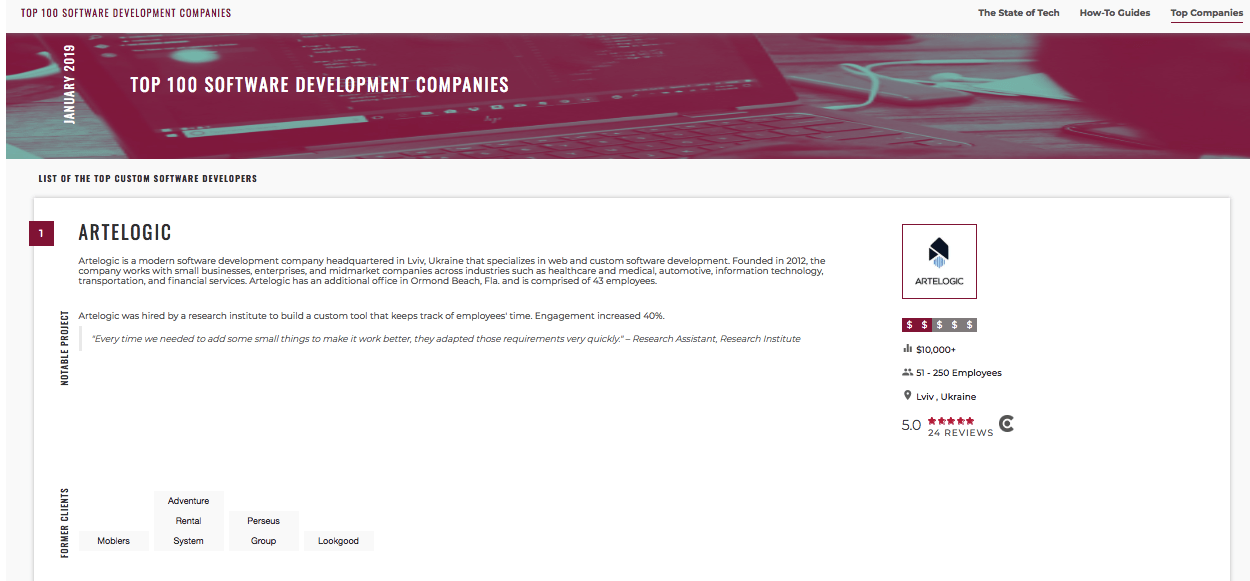
unicrew Tops The Manifest’s Software Developer List 2019

unicrew’s commitment to the quality at every stage of our work guides the company to the leading positions on independent rating resources. This time, the team is proud to lead the The Manifest’s “Top 100 Custom Software Developers”list published in January 2019.

Unicrew appreciates this recognition as well as the great feedback our clients give us that recognize us among other service providers. Exceptional customer satisfaction is the main navigator that helps us to grow as well as to achieve new great results.

The Manifest is the business guide, which helps to gather and verify the hard data, expert insights, opinion and actionable advice that helps businesses around the world to their brands and maintain sustainable growth over time. The mission of the platform is also to provide the practical business wisdom that manifests in success.

In line with this philosophy, The Manifest publishes the list of top service providers in different industries to help businesses to find the right service providers to accomplish and deliver complex projects.

Unicrew Named Top Global B2B Service Provider

Businesses need a software developer they can depend on. Here at Unicrew, we prioritize deadlines, working within the outlined budget, and delivering quality results.

We are committed to our customers and strive to meet and exceed their expectations. To do this, we use Clutch to gather feedback and reviews from clients. The B2B ratings and reviews platform collects third-party verified reviews from clients, which are combined with its analysts’ market research to determine leading service providers in a variety of market segments.

It is our attention to detail and commitment to customer service that has allowed us a perfect, 5-star rating on Clutch’s platform.

We are proud to announce that we have recently been named one of the top software development firms in the world in Clutch’s recent report. Earlier this year, we were named one of the top software developers in Ukraine by Clutch and one of the top 100 web development companies in the world by The Manifest (Clutch’s content-driven sister site); we are proud to be featured in this broader report.

The most exciting part of Clutch’s report, though? The inaugural roll-out of the Clutch 100, an elite selection of the top global service providers! We’re excited to be featured at 419 for our consistently proven ability to deliver.

This has been an exciting year for us and our clients – We want to thank all the clients we’ve partnered with and all of those who took the time to give feedback!

Want to learn more? Looking for a new partner? Start by checking out our featured work!

Why Your Service Business Needs a CRM

A CRM for service business does more than store contacts. It centralizes every client interaction, automates follow-ups, and gives your team the visibility needed to close deals and deliver consistently excellent service. According to Salesforce, companies using CRM software see an average return of $8.70 for every dollar spent.

Most service businesses hit a wall somewhere between 10 and 30 active clients. Communication breaks down, leads slip through the cracks, and it becomes unclear what was promised to which customer. Customer Relationship Management (CRM) software is the operational backbone that fixes this. It centralizes, simplifies, and scales how you manage customer relationships, from the first inquiry through to renewal and repeat business.

[NAVIGATION LIST]

There are a number of concrete advantages a CRM brings to a service business. Here is a look at each one.

  1. CRM stores and organizes your client data. All your emails, call logs, social media analytics, and customer history are stored in one place. Instead of hunting through inboxes or spreadsheets to recall what was discussed with a client three months ago, your team has everything at their fingertips. CRM software makes it dramatically easier to manage relationships at scale, especially once you move past ten or fifteen active clients.
  2. CRM keeps your team connected. Every employee can log new client interactions and instantly see what their colleagues have entered. This is particularly valuable for service businesses with remote teams or multiple departments. No more chasing down colleagues for updates or relying on someone’s memory. Company-wide reminders, shared notes, and a single source of truth mean that everyone stays aligned without the overhead of constant status meetings.
  3. CRM helps boost sales. The core purpose of a CRM for service business is growth. It tracks the complete sales cycle so you can see every deal at every stage. Your team spends less time on administrative tasks and more time actually selling. Research from Nucleus Research found that CRM adoption can increase sales productivity by up to 15%, and companies using CRM are 86% more likely to exceed their sales targets.
  4. CRM segments your contacts into meaningful groups. Not every client engages with your business the same way. Some buy once during a promotion; others are long-term retainer clients. A CRM lets you group customers by purchase history, industry, engagement level, or any other criteria relevant to your business. Targeted outreach based on those segments consistently outperforms mass messaging in both open rates and conversion.
  5. CRM brings consistency to how you work. When accurate data is accessible to everyone, your team stops wasting time double-checking information or verifying details across departments. New employees onboard faster because everything they need is already in the system. Clients notice the consistency too: they are not repeating themselves to every person they speak with, which builds trust and confidence in your service.
  6. CRM gives you full visibility into your sales pipeline. Beyond basic contact data, a CRM captures buying preferences, purchase history, and recurring topics of interest for each client. This lets your team make timely, relevant recommendations rather than generic follow-ups. You can also identify the exact stages where prospects are dropping off, pointing directly to where your sales process or service delivery needs attention.
  7. CRM comes with built-in analytics tools. The reporting capabilities inside a good CRM surface patterns that would otherwise stay invisible: lead conversion rates by channel, regional performance gaps, opportunity close rates by sales rep. Instead of running reports manually or relying on gut instinct, your team can make decisions based on what the data actually shows. Sales forecasting accuracy improves by an average of 32% with CRM adoption, according to Salesmate’s 2026 CRM statistics report.
  8. CRM helps you deliver a better customer experience. Service businesses run on repeat business and referrals. A CRM makes it possible to treat every client as though they are your only client, even when you are managing dozens of accounts simultaneously. Personalized communication, timely check-ins, and a full record of every past interaction all contribute to the kind of experience that keeps clients coming back. Research consistently shows that improving customer retention by just 5% can increase profits by 25% to 85%.
  9. CRM eliminates routine tasks and optimizes your workflow. Automated follow-up emails, task reminders, invoice triggers, and data entry: a CRM for service business handles the repetitive work that drains your team’s time and focus. When your team is freed from administrative overhead, they can direct their skills toward the work that actually moves the business forward. According to McKinsey research, sales teams that automate routine tasks reclaim roughly 20% of their working hours for higher-value activities.
CRM for service business dashboard showing client data and sales pipeline

There are CRM tools available for every type of service business and every budget. Here are three well-established platforms to evaluate. The right choice depends on your team size, workflow complexity, and how much customization you need.

HubSpot CRM

HubSpot CRM is one of the most widely adopted platforms for small and mid-sized service businesses. It offers a genuinely capable free tier that covers contact management, deal tracking, email integration, and basic reporting. As your business scales, HubSpot’s paid tiers add marketing automation, sequences, and service tools. It is cloud-based, easy to set up, and integrates with most common business tools.

  • Tracks the full sales process and deal stages with a visual pipeline.
  • Logs emails, calls, and meetings automatically against each contact record.
  • Includes a free meeting scheduler, live chat, and email templates.

Bitrix24

Bitrix24 is a solid option for service teams that want CRM and internal collaboration in a single platform. Beyond contact and deal management, it includes project management, team messaging, HR tools, and invoicing. All client communications are logged automatically and tied to the relevant deal or contact record.

  • CRM dashboards give each team member visibility into their deal activity and performance.
  • Built-in invoicing lets you generate and send invoices directly from client records.
  • Custom web forms can be built with templates and embedded on your site to capture leads automatically.

Salesforce

Salesforce is the market leader in CRM software and suits service companies that need a highly configurable, enterprise-grade platform. It covers sales management, marketing automation, customer service, and analytics in depth. While the learning curve and cost are higher than alternatives, Salesforce scales effectively from mid-market to enterprise and has one of the broadest ecosystems of third-party integrations available.

  • Marketing automation, customer service management, and sales pipeline tracking in one platform.
  • Salesforce for Outlook synchronizes contacts, emails, calendar entries, and tasks across your team.
  • Extensive AppExchange marketplace for industry-specific integrations and add-ons.

What does a CRM do for a service business?

A CRM for service business centralizes all client data, tracks interactions across every touchpoint, and automates routine tasks like follow-up emails and reminders. The result is faster response times, fewer things falling through the cracks, and more consistent service delivery across your entire team.

Is CRM worth it for small service businesses?

Yes. Most small service businesses outgrow spreadsheets and email inboxes sooner than they expect. Once you are managing more than ten or twelve active client relationships, the cost of missed follow-ups, duplicate effort, and inconsistent communication adds up quickly. CRM tools like HubSpot offer a capable free tier, so the barrier to starting is low.

How is CRM different from project management software?

CRM software focuses on managing the relationship with the client: tracking leads, deals, communication history, and customer data. Project management software focuses on the work itself: tasks, timelines, and deliverables. Many service businesses use both. Some platforms, like Bitrix24, combine elements of both in a single tool, which can simplify your stack if deep specialization in either area is not required.

How long does CRM implementation take for a service business?

For a small service business adopting a cloud-based CRM like HubSpot or Bitrix24, the basic setup (importing contacts, connecting email, configuring your pipeline) typically takes one to two days. Getting your team fully comfortable with the system and building out automation workflows usually takes two to four weeks. Larger implementations with custom integrations take longer and may benefit from external support.

If you are managing client relationships through a combination of inboxes, spreadsheets, and memory, a CRM for service business is a worthwhile investment. Your team will spend less time on administration and more time delivering the work clients actually pay for. Your clients will experience more consistent, attentive service. And you will have the data you need to make better decisions about where to focus your growth efforts.

If you are evaluating options, start with a free trial. HubSpot’s free tier, Bitrix24’s free plan, and Salesforce’s trial period are all practical starting points to test fit before committing.

Sources

Why .NET should be a great choice for your FinTech application

In today’s fast-paced business world, FinTech has played a substantial role in financial regulations. And it has now become extremely crucial for any business owner to establish the correct application to optimize cost planning, enhance security, augment user engagement and ameliorate financial services in general.

If you decide to launch a fintech product that is going to conquer the market niche, there are lots of prerequisites that you should pay attention to.

[NAVIGATION LIST]

First of all, you need to make your product stand out. Сonduct large-scale market analyses, determine what your competitors have and what they need. Therefore, think in what way your users might benefit from your product, and why people would want to tend to your product rather than using the ones your competitors provide. Remember that if you want to launch a successful FinTech app, users should always come first. In other words, you need to deliver a product that makes a difference for your target audience and that creates value for them.

Second, your product should offer advanced security. As a matter of fact, security is a point of emphasis for any modern application, especially the fintech one.

Third, as a fintech business owner, you need to pick up the proper languages and frameworks that stand behind your core product as they will have a solid effect on your product lifespan. But choosing the right stack for your fintech application is not as simple as ABC. Despite the fact that your application should come with a set of unique capabilities maintaining at the same time the top-notch security, it should offer a great user experience and interfaces that allow users to do everything you want them to do, easily and quickly.  Plus, it’s paramount to take into account the current and future availability of all talents needed who will be in charge of working on the chosen technologies. Furthermore, you have to pick up the technology that can assure smooth solution growth in the long run. Paying attention to the tools that offer high-performance and intelligent automation is also highly desirable right from the start.

The question is pretty rhetoric as there is no exact answer. In fact, everything depends on several facts, such as your product functionality, requirements, budget and the available pool of talents your company has. It’s predetermined already that you have to choose such a programming language that is rather easy to handle and, scale. Plus, the chosen technology should be already mature and packed with ready-made libraries. But today, there is a huge myriad of languages and frameworks that developers might want to use, right? And which one should you choose? Based on our expertise, Unicrew suggests that you regard .NET as the source for your FinTech product. Wondering why? Consider the following.


  • It’s rather easy to create apps that run on multiple platforms because it reduces a lot of lines of code that needed to build a big and secure application.
  • The .NET framework is multi-language compatible. In other words, it is not limited to scripting languages, but it creates a unified environment that lets developers build programs in C#, F#, C++ or Visual Basic.
  • It has a massive development community and keeps all data in one place. That means that it offers a versatile and dynamic library, ensuring security and rapid development. You may count on direct support for security plus multiple support programs, compilers, code libraries, APIs. And thus, it is easier to create, develop, compile, and deploy apps or tailored products. It’s also important to mention that .NET will be surely supported in the future.
  • It offers great code management.
  • You can develop specific business functions, for instance, finance, CRM, and supply management.
  • It guarantees enhanced security between remote services. Its code is processed on the windows server before it is displayed in the web browser, making the apps execute faster than interpreted scripts.
  • A code execution environment which helps programmers minimize conflicts as they develop and deploy the app.
  • It’s extremely scalable.
  • It allows development of really complex applications and still have them easy to maintain.
  • It offers a powerful caching system.
  • It saves a lot of time and thus reduces the product development cost.

Needless to add, despite being a smart option for FinTech applications software development, .NET comes with some disadvantages, including the following ones.

Final Thought

To remain competitive in the FinTech market, you have to choose the proper stack of technologies for your product. While there are several completely different opinions regarding which tech stack to choose, Unicrew experts believe that the .NET Framework is a decent choice. So, you can use .NET Framework, which will deliver language interoperability, so that you can use the code written in another language for creating additional functionality. Plus, it offers patching and friendly ecosystem for apps and provides solid time and money savings in terms of application development. But don’t forget about the .NET’s famous cons – it does take solid system resources and requires a Windows-based framework.

By the way, if you are not still ready to make an informed decision regarding which tech stack to choose for your product, Unicrew can help you. We are a full cycle software application development company that knows how to deliver the top-notch services the FinTech niche requires. We can assist you in any step of your product application development, from idea to ready product, and beyond. In short, Unicrew is there to satisfy even the most sophisticated of your fintech-driven needs.

P.S. Have something to add about the pros and cons the .NET offers in terms of fintech app development? We value your opinion, please share it with us.

How To Design And Develop A Healthcare App

The digital age brings innovations to every single industry. Information technologies integrate with every branch of human activity and change it completely. These days, we cannot separate IT from the other aspects of our lives: it is literally everywhere. And it is not only about  entertainment. Web and mobile applications are upgraded with such cutting-edge technologies like the Internet of Things, Artificial Intelligence, Blockchain, etc.

A special role belongs to the healthcare application development. Some old-school specialists are still wondering how high-quality software may impact such vital processes. No doubt, the human factor is more important here than in any other industry. But at the same time, healthcare application can provide relevant up-to-date information, save both patients and doctors’ time, allow online consultations, etc. A survey provided by a healthcare company showed that people prefer an online meeting to a visit to a doctor. Of course, it depends on the particular situation and personal health but the point is that a health application makes a huge difference. Let us discover how to design and build health apps to make this world a bit better.

[NAVIGATION LIST]

The statistics on the healthcare industry provide us with tons of graphic data. The most impressive numbers are the following:

Thus, we can say that every second inhabitant of the Earth has a health app installed on their smartphone. It opens wide horizons for the application development companies. At the same time, it causes a demand for high-quality solutions.

Healthcare institutions worldwide build partnership with IT companies in order to provide better services and win the attention of people. With the help of a simple mobile app, a healthcare provider can easily contact patients of staff. A smart device like a phone or a watch serves as the assistant in this process. The users can access their personal information within seconds; they feel more engaged and thus more confident and protected.

The app development for the healthcare industry is up and running. To join this rush and gain your own profit you need to build a solution that resonates with the users. The application’s one and only aim is to satisfy both the healthcare provider and the patient. No doubt, it is rather challenging. But having a clear vision of how things look like on the healthcare market right now, along with the comprehensive guide we provide, will help you succeed.


First of all, let us define the types of healthcare apps available on the modern market.

  • Apps for personal health records

These applications help with diagnosis, allow checking symptoms, provide the patients with the results of laboratory tests, etc.

  • Healthy lifestyle apps

These tools help to monitor your pregnancy or diet, allow tracking physical activity, etc.

  • Apps for remote control

Lifescans, remote monitoring and viewing, and telehealth are the key purposes these apps can be used for.

  • Apps for medical referencing

These are the software reference guides.

  • Reminder apps

These are the simple tools for scheduling prescriptions or appointments.

Actually, the number of ways to implement software solutions into healthcare is almost unlimited. However, lots of medical apps do not cater to users’ needs and expectations, provide poor user experience and a limited number of features. So, what are the key mistakes one might make in a health app?

  • Unclear interface and structure;
  • Lack of useful data;
  • Problems with data security.

In order to build a successful solution that is both compliant with the law and appeals to users, pay special attention to the above-mentioned factors. And take a look at the most important functionality users would like to experience when using your app:

  • Fast and seamless access to medical records and test results as well as the possibility to download them;
  • The access to doctor’s profile and schedule;
  • Appointment scheduler and reminder;
  • Prescription reminder;
  • Weight, glucose, cholesterol tracker;
  • Emergency call feature;
  • Integration with Google Maps to find a way to the hospital;
  • Notifications about news and events. etc.

Those are the basic features your potential users may need. Of course, it all depends on your app’s specifics and purpose but keep this list in mind to provide the best experience to your customers.

After the brief introduction let us proceed with the development process itself.

Define the Problem

This is the very first task you need to solve before coding. Define the app’s essence and understand how and why the users will use it. The more clearly you see the answers to those questions, the better the result of the efforts will be.

Make sure that the software solution is the best way to solve the problem. Do research of competitors’ applications, analyze their strengths and weaknesses. It is also crucial to answer another simple question: will my app actually help?  Many entrepreneurs worldwide want to jump on the trend train and invest in software development just because it is popular. A lot of software developers contribute to the industry just because it is a way to earn money and not because it brings obvious useful results for other people. The point is to make sure that you are going to start the development of an effective and powerful one-of-a-kind solution that solves problems, not emphasizes them. Start with something simple but useful and grow your idea like a small flower on your windowsill.

Get Acquainted with Your Audience

Consumer-driven development is the only way to profit. Let us clarify a very important thing here: your great app is just a bunch of lines of code if no one is using it. Many hospitals and healthcare institutions in the USA or Western European countries offer their patients custom mobile apps to improve the interaction and the processes. But as the experience shows, not every patient uses the suggested app. The application’s designers create an app they think is great. Unfortunately, in many cases, their opinion differs completely from the way things actually look like. The creators simply do not know their audience and thus fail to offer the best services.

The significant thing is to ask the patients and healthcare providers questions about what they actually need. If you have some doubts as to whether your app will meet the expectations, create a quick poll to make sure you do it right. Analyze the age and gender of the potential users and build a picture of their needs. Be attentive to their interests and preferences, include some gamification for the younger audience, and regularly check if your app is still relevant.

Design the App Carefully

Healthcare app design deserves to be highlighted in a separate chapter.

First of all, pay attention to the structure. If you are working on a large scalable solution, design it in modules. This approach provides 2 considerable advantages:

  1. If the need appears, it is easier for the developers to fix one single module;
  2. The user should not have to install the whole heavy app, but a single needed module. In case of need, the functionality can be upgraded with other extensions as well.

Now let us dive into user interface peculiarities. Always keep in mind that you deal with a sensitive target audience. Some of the users may be seniors, some may have disabilities. You should think ahead about all the people who will be using your app in the future and build a lovely user-friendly design along with the above-mentioned suitable functionality.

1. The Tricky Choice of the Color Scheme

Avoid vibrant, “crazy” colors: your app should not shock the user. Pick delicate and calming colors to make the users feel comforted when they open the app. Make them feel like they are visiting a reliable and competent doctor they have built a trustworthy relationship with. Colors play a great role when creating this type of atmosphere.

Most successful health apps are designed in cool tones. It allows the users to concentrate on the specific problem and the state of their health.

  • White

White color implies purity and innocence; it calms the patient and positively influences the human brain. Different shades of white are suitable, pick one that you like.

  • Blue

Peace and harmony are associated with the color blue. It may bring up the feeling of safety and healing. Medical staff worldwide tend to wear blue uniforms, which also proves the advantages of this color for your app.

  • Green

Green is a color of youth and good luck. It is a color of nature and life, so it would be great to use shades of green (except neon of course) for your software solution.

Warm tones are less widely used for medical purposes. However, there are some applications that warm colors would be suitable for.

  • Pink

This is the color of romance and childhood. It is often used for the design of web apps devoted to women’s or children’s health. But take note that if you are building a gender-neutral app this color will not be appropriate.

  • Yellow

Yellow is the color of the stars and the sun; it is joyful and hopeful. However, bright shades of yellow may be a bit distracting, so it is recommended to only use elements of this color and combine it with more neutral colors. Since we are talking about personal sensitive information, the interface should not be too eye-catching.

The target audience means a lot as well. Children and youth tend to like bright and warm colors while older people prefer softer shades. You should also create conditions for the colorblind users. Add the color inversion option in order to make them feel comfortable.

2. Picking the Right Font

There are 2 key features you need to consider when choosing the font for your health app. They are minimalism and simplicity. The topic of healthcare is quite serious, so it is not appropriate to implement some super creative design skills to fonts and make them hard to recognize and read. Avoid small details and letters that look alike. Take into account the fact that your app will be used on different devices with different screen sizes. So use simple and easy-to-read fonts like Arial, Calibri or Sans Serif.

Take a look at some other recommendations for fonts:

  • According to the best practices, it is good to use up to three fonts per platform;
  • Android and iOS typography may differ, so make sure the chosen fonts look the same on both platforms;
  • Use more recognizable fonts for the Call-to-Action button;
  • Make the font size meet the users’ needs;
  • Font color should contrast with the background.

A nice tip is to allow the users to customize the fonts according to their needs. In fact, it is not difficult to add such a panel to the pages of your app, but it improves user experience considerably.

3. Buttons, Icons, Images: Things to Be Aware of

Your application’s users may have specific needs, so try to make the buttons a bit bigger than usual. Set the active elements size to 48 pixels and more. Feature buttons with sound effects and simplify the usage for people with limited visual perception.

If we are talking about the healthcare industry, the icons and their meaning should be intuitive. Use only the most understandable and common icons and avoid the more complicated ones so as not to confuse the user.

When choosing the images for the healthcare app, give preference to the ones with better resolution. Add relevant pictures only, and avoid double entendres.

After your app is ready, test it carefully or hire a team that has expertise in QA and QC. It is crucial to provide the users with an impeccable, high-quality and bug-free solution. And testing is the only way to reveal imperfections before launching the app.

In modern society, the topic of data security is extremely important. Creating an app of such a great importance, you need to comply with the privacy laws in your country, limit the access to personal data and protect the users’ information. It is necessary to use special software plugins and extensions to improve data protection, and to cooperate with a qualified IT security specialist to avoid potential data breaches in the future.

Final Thoughts

Healthcare software development is a complicated task that consists of many important stages. It requires time, money and great focus to get a profitable and useful result. With the help of a competent team, this goal becomes achievable. Experienced software developers are able to get your idea to life. So let’s discuss your idea and make the world better together!

How to Set Up the Accounting Software for a Small Business

The accounting process is an integral part of keeping the business up and running. Having the detailed information on your money flow helps to understand the nature of both internal and external transactions.

Fortunately, as modern technologies develop, we receive more and more opportunities to automate the accounting process with computers. A lot of software suppliers provide a broad range of products for businesses of any scale.

Small business accounting has its specifics and requires following some successive steps to build an efficient system. Let’s find out how to set up the accounting software for a small business in these 6 steps:

[NAVIGATION LIST]

You should choose the software provider depending on your business structure, scale, platform, and accounting system budget. Let’s discover the most substantial point to bear in mind.

Business Platform Integration

If you run an eCommerce business and use a web platform for it, it’s essential to integrate your accounting program with the platform. This will significantly reduce the time and effort you spend on the bookkeeping.

Business Scale

Small business is an extensive concept, and different entrepreneurs operate with different business net worth. Moreover, competing service suppliers offer different software features, such as regular backups, summary reports and other options you may find necessary to satisfy your business needs.

Accounting Software Budget

Considering the scale of your enterprise, the cost of automated bookkeeping can be an issue as well. Decide how much your company is ready to invest in accounting. However, we believe that most accounting and invoicing software for small business has an affordable price tag and pays off really fast.

After all, there are several decent free-of-charge solutions to start from. And don’t forget about free trials offered by the majority of paid-for programs to verify the efficiency of their functionality.

For example, if your small company includes 10 or fewer employees, you may find the Wave Accounting the best solution with unlimited invoicing, as this software supplier offers a free-of-charge application.

On the other hand, if you need to add up to 50 contacts and not mind spending a couple of bucks per month, you can choose Zoho Books. It’s a truly budget-friendly and powerful bookkeeping software.

There are, however, other accounting software programs for small business. Your choice should always be a comprehensive and reasonable decision based on the aforementioned aspects.

Now that you have chosen the suitable small business accounting software, it’s time to configure it!

At the very beginning, it’s always required to fill in the additional information about the company (name, address, other contacts). After you have completed this formal step, you can start setting up your program. We believe that spending some time exploring the functionality and options your software provides is totally worth it.

It’s vital to add financial information about your enterprise, set tax rates, and templates for invoices. The cutting-edge accounting software allows small businesses to add a payment gateway to let the businesses accept payments for invoices online.

What is more important, every bookkeeping program has a feature for adding new users and setting up the payrolls for employees in the “Settings” section. As you can see, digging into the settings from the start is not an option but a strict requirement. It will lead to tremendous losses later if you don’t customize the software the way you should.

You may need to link a banking account to your accounting software. It’s a convenient way to track and record all the transaction via your bank. This is where this feature can be hidden in your interface:

  • Settings section;
  • Expense tracking;
  • Banking.

If you are still unable to find the information about the linking process, feel free to contact your software provider to figure this out.


As we’ve previously discussed, it’s essential to check the accounting software for the needed integration possibility. Modern UI/UX approaches of software suppliers make an integration a piece of cake, even for the beginner.

All you have to do is to find an integrating feature on the dashboard or, once again, in the “Settings” section. That’s it! Connecting the external applications sounds more complicated than it actually is!


You have saved the necessary settings and connected the application you use, it’s time to impart the data you have in your previous accounting software (if you are migrating to a new platform) or another source.

The most significant aspect to keep in mind is the guidelines for the data import that the software supplier has published. This is a set of strict rules and formats the program accepts. You won’t be able to import a random file with your transaction records.

Depending on your business specifics, the information you need to import includes but is not limited to the following:

  • Items;
  • Contacts;
  • Chart of Accounts (a list in the accounting system for every single account in it).

If you don’t have structured data to import into your bookkeeping program, the majority of software providers offer a formatted template for data so you can fill it with yours. In spite of the common opinion that it’s a long and tiring process, the initial data import saves you hours because you don’t have to manually add every single record later.


Every decent small business accounting program offers a range of “additional functionality” – unnecessary yet useful features for managing your bookkeeping even more convenient.

These are the options that are often deactivated or lowered by default but can be launched manually from settings:

  • Project time tracking;
  • Backup frequency;
  • Project management;
  • Additional automation features.

Make sure to implement the full power of the product you use. No genius software developer can compensate for the user’s lack of attention and zero desire to know the program better.

The Bottom Line

The modern accounting software is a convenient and beneficial solution for small businesses to keep track of their income and expenses. Cutting-edge interface approaches make it a no-brainer to set up these products and use them with maximum efficiency.

The greatest thing about this software type is that it doesn’t require involving any accountants: you can configure and maintain these pieces of modern technology by yourself.

One more thing to remember is that you should feel free to contact the software supplier support about any issues you encounter with the program. These people guarantee you stable access to the data and flawless performance, and they have to keep their promises.

Double-check the software you are going to use, read the user guidelines and manuals for the program. Be confident and passionate. Bear in mind that a thriving business of yours is the only motivation you need!

Cloud accounting software features your business needs

If you are a business owner, be it small or big one, you definitely need the right business accounting software to control and manage all of your finances. Of course, you can be still using the Excel forms as your main accounting program, but that is so old-school. Plus, using Excel-like accounting options is dramatically inefficient. Moreover, today, even when you have an installed business accounting software, it is becoming outdated as well.

So these are a few questions we will overview in our article:


[NAVIGATION LIST]


In fact, if you want to run your business successfully and efficiently, you have to be up to date, and thus, you have to be tech-savvy.  Meanwhile, all tech-savvy business owners choose cloud accounting software programs. Are you now wondering why you should invest into a cloud accounting software solution? Here’s why: traditional accounting software has many problems. Just to name a few of them:

  • Neither data nor software is up to date
  • The software is installed on the computer and works only on it. If you travel, you need to take that computer to be able to access the software
  • The program is not secure and reliable enough
  • Only one person has access to the software
  • It is rather expensive and hard to keep backups
  • It’s expensive and rather time-consuming to perform software upgrades.
  • The support is expensive and slow.

Sounds familiar for you? If yes, you have to stop this and get a robust cloud accounting program.

Typically, a good cloud accounting software helps you keep your business a little more organized by letting you track your business’s financial health and monitor the money moving in and out of your accounts from any location. If you invest in a good cloud accounting software application, you may definitely count on better decisions, higher efficiency and a solid cut on costs, in particular, in human resources and travel expenses. But to be more specific, the key points why cloud accounting software is a wise investment will be described below. So, let’s take a closer look.  

Therefore, working in the cloud-based accounting systems:

  • Makes both you and every member of your team mobile: your team can access your business cloud software from any device with the internet connection from any location. Needless to add, with any cloud accounting software solution, there’s no need to install and run applications over a desktop because both you and all members involved in your team with the given access can enter your application online. (Note the access is secure! Only those who granted access can work in the cloud software program)
  • Gives you a better overview of your finances: you have all your data gathered into one system in real time; the data is always updated. Once somebody of your team members changes/edits something, the rest of your team sees it in real time.
  • Offers you an ability to seriously improve collaboration with your team: your team can be updated with everything happening within the business and every member of your team can do their job within one platform at the same time.
  • Saves time and money in the long run: you don’t need to spend time and money on business trips, tickets, hotels and other travel expenses- every member of your team can work in real time from any location, be it day or night.
  • Helps you achieve more accurate demand planning: you know what your customers want and when, you can easily check the real place/price of all your products. Simply put, you have what customers want the moment they want it.
  • Safeguards you from lost data, lost sales and left customers: your data is securely maintained in real time, and thus, you may sleep well knowing that it won’t be lost or misused. By default, cloud-based accounting systems use bank-level security to protect against all possible data losses. Plus, you know what items you have and what should be ordered in advance and a result, you can deliver the products  any time your customers want them.
  • Eliminates the need of program support department: You don’t need to hire an IT department just to support your software.

These days, you may find numerous cloud accounting options on the market depending on your niche, functionality, team, and, of course, budget. Noteworthy is the fact that with dozens of cloud accounting software programs out there (both small business accounting and enterprise-level accounting programs), it is of vital importance to find the one that suits your business needs. For example, if you are planning to grow, your software solution should be scalable and flexible enough.


By default, there are two types of cloud-based accounting software solutions:

  1. Ready-made products that can be customized according to your needs
  2. Custom-made products that are developed especially for you.

That means that if you are looking for a robust cloud accounting software solution, you can get the ready-made cloud accounting software and pay for using it on a subscription basis. Typically, such a cloud service comes with a standard set of features. That won’t cost you an arm and a leg.

However, the best way to go here is to address a custom software application development company to get tailored and configurable products. By the way, the small business accounting software and the enterprise level accounting software can greatly vary in terms of cost, features, and time needed to be developed and implemented. By the way, Unicrew is a reliable custom software development vendor who has an arsenal of cloud-based tools and the right human resources to help you with your accounting software solution. Evidentially, we can develop a program that can satisfy even the most sophisticated business-driven needs.

Key Takeaways

In a nutshell, cloud accounting systems are revolutionary for small business owners and the owners of huge corporations alike, whether we like it or not. The benefits of cloud accounting are numerous. First of all, cloud accounting software helps business owners always stay connected to their data and their accountants. Moreover, good online business accounting software securely keeps all valuable business data protected from malware, viruses and data loss. Needless to add, it the cloud accounting software is custom-made by Unicrew, it can bring numerous other benefits to your business, be it small, medium or a big one as in that case your ultimate business needs, specularities and challenges will be taken into account.

Anyway, in the span of the next few years any business owners should move to cloud accounting software to stay on top in their business niche. Why not invest into your custom-made cloud-based technology solution today then?

Unicrew Bridges. Communicates. Delivers. SEO

The team at Unicrew prides itself on our exceptional service: From web and software development to our unfailing commitment to quality, Unicrew has the expertise, drive, and passion to ensure that our clients receive the solutions and products that they deserve – exemplified by our extensive portfolio.

We are happy to announce that in line with our consistent success, Clutch recently named Unicrew as a market leader within the entire software development industry in all of Ukraine! This accolade as a top software developer in the Ukraine and a top web developer in the Ukraine speaks volumes about our capabilities and client satisfaction, and Unicrew greatly appreciates this recognition.

Clutch bases its reviews and rankings of firms on an extensive methodology that considers qualitative and quantitative aspects of how small and mid-market businesses like Unicrew perform. From market presence and prior experience to digital development and client satisfaction, Clutch compiles and analyzes data to produce rankings of companies, as well as national and industry-wide comparisons of the top firms within a certain field.

In addition to the professional evaluation and recognition of Unicrew from Clutch, we also want to highlight some of the feedback that our clients have had regarding their experiences partnering with us and their satisfaction during and after our collaborations. Unicrew attributes much of our growth and success to clients, and we thank our customers for their support!

“We’ve seen a 15-20% increase in revenue, which is through the efficiency gains and the ability to accurately track time on a permanent basis rather than just by a quarter hour or an hour,” shared one client on the improvements that resulted from our work. “It’s been really good working with them. They’re very responsive. In the initial stages, they were proactive at finding solutions to issues I wasn’t aware of that would come up in the development process. It was good to know that we’d be crossing those issues off before we had the system fully built. Communication was always really good.”

“Even though Unicrew didn’t have a background in this area, they learned quickly and repurposed technologies they’d used before in order to solve the business problem. I was very impressed with this ability, as most of the people we contacted before implied that they’d need to spend a lot of time trying to understand our business logic. I have a lot of roles in terms of this project, and I was happy to be able to rely on Unicrew’s skills and expertise to do what needed to be done,” mentioned another client, outlining our flexibility and resourcefulness. “I can’t point to anything that Unicrew could do better.”

More than a dozen full-length reviews can be found on our Clutch profile, and we again thank our clients for their time, support, and positive remarks on our collaborations. We appreciate the recognition from Clutch as a premier industry presence in all of Ukraine, and Unicrew looks forward to connecting if you have a partnership in mind for the future!

HIPAA compliance implemented right

Does your app handle protected health information (PHI)?  Should it be HIPAA compliant? If these issues are familiar for you and if you have heard about PHI and HIPAA, we’ve got you covered. Below, we will tell you what you need to know about HIPAA and everything related to it to maximize your chances of gaining both HIPAA and FDA approval in this regard.

What’s the post about?

Due to gigantic demand in digital health over the last few years, more and more health apps software development vendors and people working in the digital personal health information businesses have to become HIPAA-compliant. This post reveals some useful information regarding the basics of HIPAA compliance, including the following:

[NAVIGATION LIST]

So, let’s get started.

HIPAA stands for Health Insurance Portability and Accountability Act. It is a set of standards for the protection of certain health information, especially personal health data. Not to incur the high costs of non-compliance, all medicine and healthcare application development companies need to strictly follow this special act upon building any kind of eHealth and mHealth and or wearable software solutions. In other words, it is a must-have act to keep in mind if you are in the  medical and healthcare software development business.

All businesses and organizations that work with PHI (Protected Health Information) must be HIPAA-compliant, not to mention the ones that work in the following industries:

  • Hospitals and Clinics
  • Health insurance agencies
  • Pharmacies
  • Dentists
  • Psychologists
  • Nursing Homes
  • Chiropractors
  • Health Plans
  • Clearinghouses.

Needless to add, the HIPAA rules apply to both doctors and other people involved (called “Covered Entities”) and to the developers, hosting provider and others (called “Business Associates”). To put it simpler, every party involved in the medicine and healthcare industry, be it a patient surveys & feedback gathering app, EMR/EHR system, trials & research collecting solution or a training & certification platform, it should be HIPAA-compliant.

First things first: find out whether or not the data you collect would be subject to HIPAA rules.

Second, check the main meaning of the HIPAA-compliant and ensure your product satisfied four major 4 rules:

  1. HIPAA Privacy Rule
  2. HIPAA Security Rule
  3. HIPAA Enforcement Rule
  4. HIPAA Breach Notification Rule.

To put it simpler, below, is the extensive checklist to develop a good HIPAA-compliant app.

  1. Ensure your health care app features the following:
  • Its back-end system is made according to HIPAA safeguards.
  • Before downloading your app, your users must see a link to the app’s privacy policy.
  • It tells users how their data is protected and how it will be used.
  • It comes with a secure-only login option.
  • It encrypts data during transit.
  • All if its data is stored on a HIPAA compliant server (and encrypted at rest). By the way, when it comes to the best HIPAA compliant hosting servers, Amazon AWS and Microsoft Azure are definitely well worth mentioning.
  • All of its HIPAA compliant data is shared within the organization, across a network, or within an app.
  • It comes with a system performing regular security updates.
  • It offers the ability to wipe user information remotely if a device is lost or stolen.
  1. Implement a system to audit medical information and other data so that you can easily ensure that your healthcare app hasn’t been accessed or modified any time such necessity might occur.
  2. Perform dynamic and static application security testing on a regular basis.
  3. Implement the possibility of regular updates and bug fixing.
  4. Request Unicrew for a professional HIPAA compliance audit to forecast risks or detect errors related to the HIPAA compliance.
  5. And one more important thing to mention: don’t use push notification to update the PHI because that implies violation of the privacy regulation as outlined in HIPAA. So, remember to never inculcate any PHI information in your app’s push notification (both in mobile and desktop applications).
  6. Don’t violate in your messages. Do you know that text messaging can prove to be extremely useful in boosting doctor and patient engagement? But don’t send PHI texts as regular email applications; do it through the HIPAA approved organization’s app instead. Therefore, if sending PHI messages is necessary, it’s of paramount importance to integrate a HIPAA compliant email service provider into your healthcare app.
Hot Tip: sending PHI featuring texts through non-medical communication apps can result in a HIPAA violation as well. The best way here is to choose a medical digital communication vendor.

Anyway, HIPAA provides no safe harbor for businesses. That means that the main idea for all businesses involved in medicine and healthcare application development is to design a highly secure healthcare app from its first stages and to always maintain this highly secure level.

Key Takeaways

Health Insurance Portability and Accountability Act (HIPAA) protects the privacy and security of health data and it is really crucial to develop apps in an HIPAA compliant way. Use this guide to ensure that your health care software remains in compliance with the HIPAA standards. By the way, in case you need any help with the HIPAA compliance implementation, Unicrew is always at your disposal. We have senior-level specialist in our expert team. We’ve created some great HIPAA compliant apps and can help you with yours.

In a nutshell, Unicrew has the required understanding, infrastructure and diligence to provide you with the 100% HIPAA compliant application. So, get ready to capitalize on new opportunities for growth in the space!