How to Develop an Internal AI Change Management Culture
AI change management decides whether AI investments translate into productivity and revenue. A 2026 guide to leadership, training, governance, and resistance.

Volodymyr KhitsiakSenior Marketing Manager
Published · Updated
Share

Quick answer: An internal AI change management culture is the operating system that decides whether your AI investments translate into productivity and revenue, or stall. In 2026, the gap between AI leaders and laggards is no longer about access to models. It is about leadership clarity, distributed ownership, training, governance, and how the company treats employees who are anxious about change.
Updated April 2026 with current data on enterprise AI adoption, employee resistance and AI sabotage, the EU AI Act, and the 2026 leadership playbook for AI culture. The original post is from 2025.
Table of contents
- Why AI change management culture matters in 2026
- The 2026 reality: adoption is up, resistance is up too
- The role of leadership in AI change management
- Embracing learning and innovation
- Building and managing knowledge resources
- Ensuring data security in an AI-driven world
- Breaking organizational silos for AI success
- Fostering AI change management with knowledge sharing
- Enabling customer-centric AI development
- FAQ
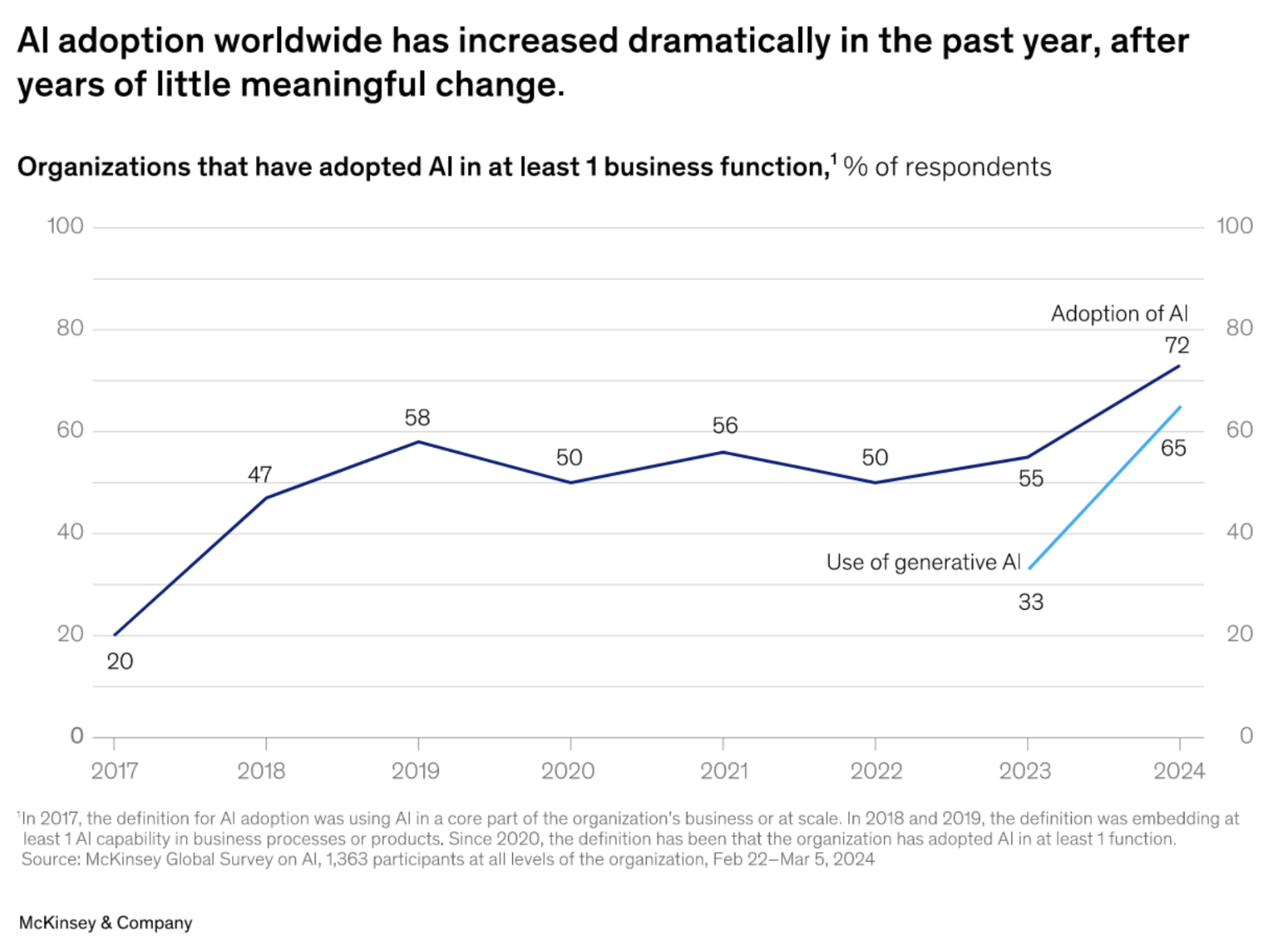
AI adoption keeps climbing. According to McKinsey's State of AI, 72% of organizations were already using AI in 2024, up from 55% in 2023, and the curve has continued to steepen across 2025 and 2026. Gallup reports that 70% of employees and 94% of the C-suite now use AI tools for at least 30 minutes a day, and 58% of employees use AI at work regularly (Gallup, 2026).
Adopting AI, however, does not guarantee harnessing its full potential. So, what separates top performers from laggards? The key lies in a wide range of best practices, many of which constitute AI change management. Fostering an AI culture has to be an integral component of AI implementation and a continuous process that continues long after the tools are up and running. This article is a guide to building and maintaining that culture, refreshed for the realities of 2026.
Why AI change management culture matters in 2026
What is AI culture, exactly? We define it as a company culture that supports AI deployments and allows the business to mitigate risks and extract value from AI tools. On the ground level, being an AI-first company means that your employees:
- Have the right skills to use AI efficiently
- Are mindful of the associated risks
- Show willingness to develop their AI skills further and experiment with tools
- Embrace iterative changes in processes and tools
4 benefits of becoming an AI-first company
Leveraging AI in a company can pay off in a variety of ways:
- Enhanced productivity. AI tools can boost employee productivity by 66%, according to Nielsen Norman Group. A Stanford University study showed that GenAI assistants can boost call center agents' productivity by 13.8%.
- Improved customer experience. 61% of customers are willing to spend more if companies personalize their approach. AI is the driving force behind meaningful personalization at scale.
- Cost reduction. 39% of GenAI adopters already report cost savings across business functions, with the highest cost savings observed in HR, risk, legal, and compliance.
- Revenue increases. 58% of analytical AI adopters report revenue increases. GenAI tools have boosted revenue for 44% of adopters, and companies that add AI to their data capabilities see a 30% revenue increase on average.
Why developing AI culture is crucial
Organizations do not benefit from AI adoption equally. An organization's AI maturity and AI culture play a key role in the outcomes of the AI transformation. The total shareholder return CAGR of leaders in digital and AI capabilities can be 2.3x to 6.1x times higher than that of laggards.
Following best AI change management practices also correlates with higher returns on investment in technology. Just take a look at McKinsey's survey of GenAI adopters. It revealed that organizations that receive the highest returns are more likely to follow these practices than other respondents:
- Senior leadership understanding how GenAI can generate value for the business (64% vs 39%)
- Having curated learning journeys tailored to every role to build GenAI skills for technical talent (43% vs 18%)
- Nontechnical personnel understanding the potential value and risks of using GenAI in their daily work (52% vs 21%)
Oleksandr Trofimov, CTO at unicrew, agrees that company culture is a key ingredient in successful AI adoption. "AI transformation is essential for success, but it cannot happen without the right company culture. We learned this firsthand when introducing new AI initiatives in our engineering team. The key lesson is to address the operational challenges of acquiring new skills and knowledge."
The 2026 reality: adoption is up, resistance is up too
Two trends define enterprise AI in 2026, and they pull in opposite directions. Adoption keeps rising, and so does friction with the workforce.
Adoption is everywhere. 97% of executives say their company deployed AI agents in the past year, and 52% of employees are already using them. Regular AI usage among workers has jumped 13 percentage points to reach 45%, while confidence in using the technology fell sharply by 18 points (Writer Enterprise AI Report 2026). Adoption is outpacing training and support.
Resistance has gone from passive to active. Writer's 2026 enterprise data found that 29% of employees, and 44% of Gen Z workers, admit to actively sabotaging their company's AI strategy. 76% of executives say employee sabotage now poses a serious threat to their AI initiatives, and 79% of organizations report meaningful challenges in adopting AI, a double-digit increase from 2025.
Manager support is the missing ingredient. Only 35% of employees say their direct manager is an AI champion. Without manager-level conviction, every other piece of the change management framework loses leverage. The Center for Creative Leadership's 2026 work on AI and culture reaches the same conclusion: real cultural shifts come from understanding how beliefs and behaviors reinforce each other, not from one-off announcements (CCL, 2026).
Workforce stratification is a quiet risk. 92% of executives are now actively cultivating an "AI elite" tier of employees, and 60% plan to lay off employees who cannot or will not adopt AI. AI super-users were 3x more likely to be promoted in the past year and 5x more productive than slow adopters. The cultural risk is obvious: a two-tier workforce is fragile, and people sense the framing long before any layoff is announced.
The pattern across all of this data is the same. Tools are easier to deploy than ever. People are harder. AI change management in 2026 is mostly people work. We have written more about the people side of this in our piece on building AI-native development teams, and about the trust angle in ethical AI in IT services.
The role of leadership in AI change management
It is the leadership's responsibility to:
- Establish the vision for AI initiatives
- Set clear guidelines on how to use AI for business purposes
- Create a robust AI governance strategy to mitigate risks
- Ensure enterprise-wide alignment
- Select the right use cases for AI adoption based on business impact and feasibility
As Oleksandr Trofimov puts it, "In software development companies, engineers are often overwhelmed with tasks. However, it's the leader's responsibility to provide a clear vision and demonstrate the benefits of venturing into new territory."
A clear AI framework does more than bring your teams on board and protect your business against risks. It also has a positive impact on how employees interact with AI tools. Employees at companies with clear AI guidelines are six times more likely to have experimented with AI tools.
7 pillars of championing AI adoption
To ensure a successful AI adoption, senior leaders should focus on:
- Vision. Identify the strategic opportunities for AI-driven transformations, such as revenue increases, improved customer engagement, reduced costs, or improved efficiency and productivity. Ensure the company's strategic alignment with the AI vision.
- Metrics. Decide how to measure the success of your AI initiatives. Focus on business metrics rather than financial ones, use benchmarks, and monitor metrics consistently and continuously.
- Gap and barrier analysis. Pinpoint resources needed for AI transformation and potential barriers to AI adoption. Those barriers can include lacking skills, subpar data quality, outdated data security protocols, and similar.
- Risk management. Consider potential regulatory and reputational losses stemming from AI use and how to prevent them. Take into account the inherent risks of AI: false, biased, or inaccurate outputs, data privacy and security, and lack of transparency and explainability. We covered the bias question in detail in AI for businesses: common biases and their refutations.
- Enterprise-wide framework. Establish guardrails to ensure ethical, safe, and secure AI use. Be clear about what is allowed and prohibited when it comes to AI use. The EU AI Act, in force since August 2024, makes this an explicit regulatory expectation for any organization touching the European market.
- Governance. Conduct impact assessments of AI systems before deployment, establish an independent review board, and include responsible AI use in policies. Conduct regular audits of AI systems and enable continuous improvement.
- Stakeholder support. Foster the culture of cross-functional collaboration. Seek out and act on feedback from workers from the ground level to senior management.
Case study
Snaplore is a knowledge management tool that leverages cutting-edge AI capabilities to turn video calls into structured briefs without human involvement. It also comes with a Snaplore Bot, a custom AI assistant powered by GenAI, and intelligent content analysis.
unicrew's CEO, Tural Mamedov, was behind the push to implement these AI capabilities in Snaplore. Thanks to his initiative, Snaplore became a powerful tool for aggregating, sharing, and developing the team's knowledge. As a result, the team could implement AI in commercial projects and deliver value to clients faster.
Embracing learning and innovation
Fostering a culture of innovation and continuous learning is the most important AI initiative success factor, according to a Bain & Company survey. 68% of respondents cited it as crucial, ahead of even strategic vision and strong leadership (49%).
Enabling this culture means embracing learning from failures and experimenting with AI to power continuous innovation. What separates AI leaders from laggards is not how well they map out the AI transformation. It is how they recognize failures and learn from them.
Instead of trying to get everything right from the start, embrace an iterative approach to your AI initiatives. The agile methodology is a suitable way to manage and improve upon them. In practice, it means:
- Quickly testing hypotheses as you experiment with technology
- Learning from both successes and failures
- Conducting regular reviews
- Improving the solution in iterations
Following agile principles is a solid foundation for continuous research and development around AI, which should be a priority for your organization. Our overview of the key principles of agile project management walks through how to set this up if it is not already part of how your teams work.
Building and managing knowledge resources
IBM's Global AI Adoption Index puts limited AI skills and expertise in the number one spot among barriers to AI adoption. Only 34% of organizations are actively reskilling employees to update their skills for new AI tools.
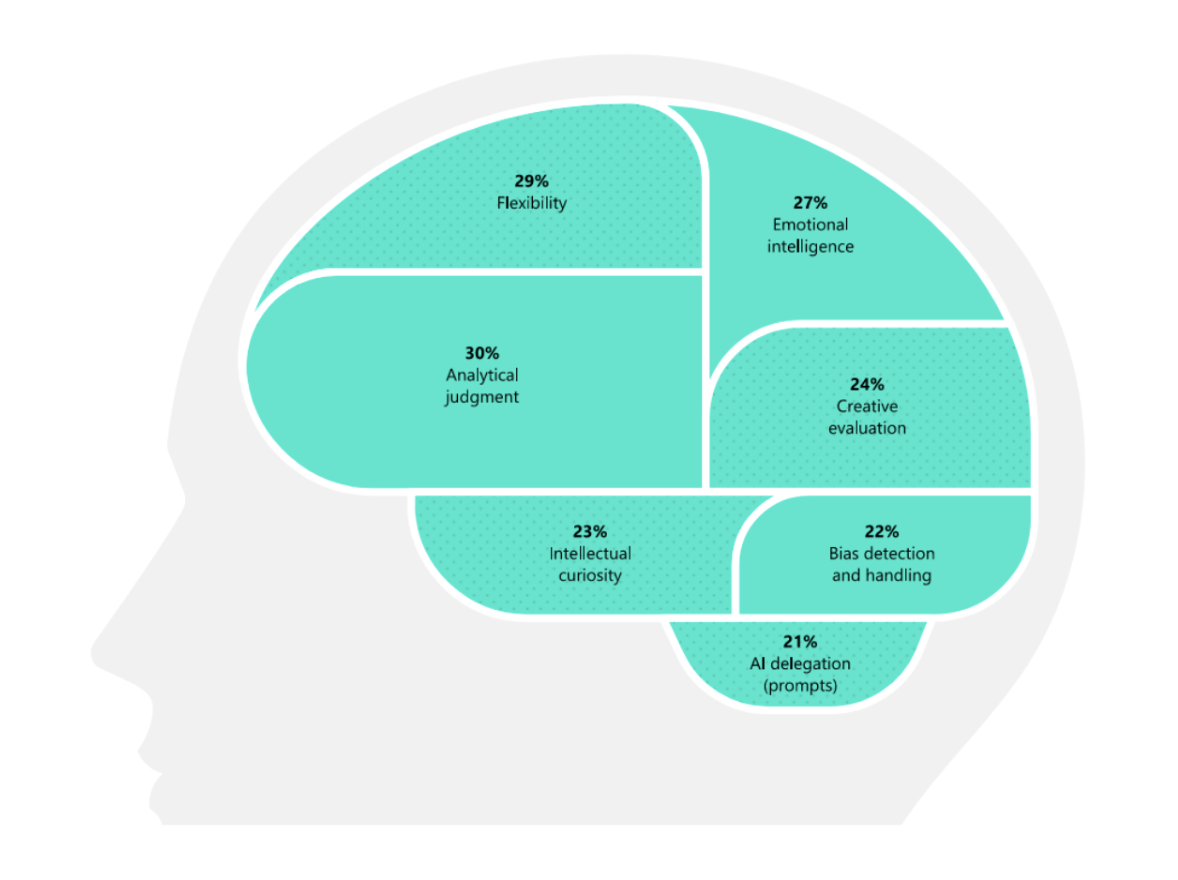
As for the skills in question, Microsoft's Work Trend Index surveyed business leaders on the AI skills they are looking for in their employees. The results were:
- Analytical judgment (30%)
- Flexibility (29%)
- Emotional intelligence (27%)
- Creative evaluation (24%)
- Intellectual curiosity (23%)
- Bias detection and handling (22%)
- AI delegation (prompts) (21%)
While these soft skills are integral to making the most out of the technology, AI users also have to be well aware of the potential and risks of their tools. Developing a centralized knowledge base enables the transfer of this information, serving as a single source of truth available anytime, anywhere.
However, knowledge sharing is only the first step in leveraging AI for businesses striving to become leaders. As Oleksandr Trofimov, CTO at unicrew, puts it: "Another important lesson is to put the acquired knowledge into practice. Whether it's for an internal product or R&D, theoretical knowledge alone is not enough. Becoming an AI-driven company requires not only certifications but also the practical application of what we've learned."
6 tips for developing an effective knowledge base
An internal knowledge base is a centralized library of FAQs, standards, guidelines, video tutorials, how-to guides, documentation, and other resources. It allows employees to find answers to their questions without seeking IT support. Here is how to make it effective:
- Keep it structured and organized
- Enable comprehensive search and seamless navigation
- Ensure all common questions are covered in the base
- Make the content easy to scan and understand
- Keep the content up-to-date by regularly auditing the base
- Make the knowledge base a single source of truth across the organization
3 best practices for knowledge management
Knowledge management does not end with creating a centralized knowledge base. Here is what else you can do to enable knowledge sharing:
- Develop AI mentorship. Tacit, implicit knowledge gained with experience can be difficult to put into writing. Introduce a mentoring program to enable its transfer between more and less AI-savvy employees.
- Capture unstructured knowledge. With the help of GenAI, you can transform unstructured knowledge (emails, forum threads, meeting transcripts) into knowledge-base articles.
- Ensure organization-wide adoption. A knowledge management system can be effective only when people use it. Provide adequate training to enable adoption and proactively maintain it.
Ensuring data security in an AI-driven world
73% of GenAI-using employees believe it introduces new security risks. Data security and privacy are also on customers' minds:
- 57% of consumers worldwide agree that AI threatens their privacy.
- 63% of U.S. consumers are concerned about the cybersecurity risks of AI solutions.
In addition to employee and consumer concerns, regulators are also worried about data protection. In the EU, ensuring data security and privacy is part of the AI Act, and personal data protections are already in place under GDPR. The UK Online Safety Act and a wave of U.S. state-level privacy laws extend the same expectations across most major markets.
10 policy changes to consider
To ensure compliance and avoid reputational losses, consider:
- Preventing shadow AI, where employees use AI tools without the IT team's knowledge, with clear guidelines and access controls
- Outlining what information can and cannot be shared with AI tools, especially third-party solutions
- Setting up appropriate data controls to prevent unauthorized access, switching to a "need-to-know" approach to data access
- Anonymizing personal data and obtaining consent if you are using it for training or fine-tuning custom AI tools
- Using synthetic data instead of real personal data for training AI models when possible
- Following encryption and data masking best practices, including encryption at rest and in transit
- Setting up data backup, loss prevention, and disaster recovery procedures and ensuring they are followed enterprise-wide
- Securing access with phishing-resistant multi-factor authentication and authorization
- Regularly testing AI tools (adversarial, penetration testing) and conducting security audits
- Conducting impact assessments on data protection for AI initiatives
Do not overlook the training
Apart from putting these principles into a documented framework, you need to bring your employees up to speed on how to use AI for business tasks securely. Invest in appropriate training on data literacy, cybersecurity, and access controls.
Make sure any changes in policies are communicated well to avoid a transparency gap. While 31% of executives say they have AI guidelines in place, only 18% of workers say the same about their workplace.
Breaking organizational silos for AI success
AI projects cannot be the prerogative of the IT team if you want them to deliver a meaningful impact across business functions. As unicrew CEO Tural Mamedov explains: "It's crucial to involve the entire company in AI transformation, not just the engineering department. This way, we can see how AI impacts all aspects of the business."
Collaborating across functions enables:
- A holistic approach to AI initiatives that takes into account feedback across the organization
- Fresh perspectives and ideas that drive innovation
- Continuous learning among participants
- A deeper understanding of AI's impact across functions
- Greater engagement and commitment to the AI initiative across departments
An AI culture that encourages cross-departmental collaboration also leads to improved job satisfaction and employee retention.
10 steps to fostering cross-functional collaboration
- Bring everyone on board from the very beginning. Do not wait to connect members from other departments with AI experts. Otherwise, you risk losing time on bringing newcomers up to speed and missing out on their valuable input.
- Take the lead. Identify activities that can benefit from cross-functional collaboration and help team members build connections.
- Use the right tools. Make sure you use the same project management and communication toolkit across functions.
- Keep apps to a minimum. Juggling 16+ apps makes knowledge workers three times more likely to miss messages and actions compared to using 1-5 apps.
- Break data silos to improve transparency. Ensure data flows seamlessly between departments while enforcing data controls.
- Encourage feedback. Establish a feedback system for team members to share their opinions anonymously or confidentially. Keep an open mind and act on the provided feedback.
- Recognize collaboration. Adapt the way you track employee and team performance to incentivize cross-functional cooperation. Consider a reward system; celebrate both small and big accomplishments.
- Communicate on the vision, strategy, and expectations. Be clear about what is expected of every team member and how their work fits in with the enterprise-wide AI vision and strategy.
- Keep meetings meaningful. Inefficient meetings are the number one obstacle to productivity. Meet when necessary, stick to an agenda, and replace meetings with asynchronous tools when possible.
- Provide regular updates on your AI initiatives. Communicate where the company is headed, what its AI roadmap is, and what future investments are coming. Consider hosting AI forums to help employees learn about AI initiatives.
Fostering AI change management with knowledge sharing
How do you encourage knowledge hoarders to share their resources with others? One word: recognition. They have to feel that their contributions are valued.
To achieve this effect:
- Start a formal recognition program for contributors
- Encourage peer-to-peer acknowledgements
- Offer small incentives and rewards for sharing knowledge
Knowledge sharing can happen in many forms, from workshops and AMAs to mentorship programs. You can also extend knowledge sharing with a digital version of your organization's town hall, a knowledge-sharing platform.
Do not confuse this platform with a knowledge base. A knowledge base exists as a somewhat static central repository of information with one-way communication. A knowledge-sharing platform is closer to an internal social network and project management tool. It allows just about anyone to:
- Ask questions and start discussions
- Share insights and helpful resources
- Celebrate accomplishments
- Provide updates on the company's policies, milestones, or activities
- Centralize the company's files, such as templates, documents, and presentations
Popular off-the-shelf knowledge-sharing platforms include Snaplore, Notion, Confluence, Microsoft SharePoint, and Google Workspace.
Enabling customer-centric AI development
Mature AI organizations are almost twice as likely to use customer success metrics in measuring AI initiatives' impact than others. At the same time, they are less likely to focus on metrics related purely to business growth, financial requirements, and estimated value.
Customers want to feel personally catered to. 82% admit personalized experience impacts their brand choice at least half the time. Better customer experience translates into increased loyalty and lifetime value, and reduced churn.
Customer-centric AI strategies typically involve leveraging AI to:
- Provide hyper-personalized customer experiences
- Improve operational efficiency with AI-powered automation to reduce waiting times
- Gain a real-time 360-degree customer view
- Offer self-service customer support options for common queries
- Enhance customer support agents' productivity with GenAI assistants
- Streamline the customer journey with automation
How to nail customer-centric AI adoption
To adopt a customer-centric approach to AI initiatives:
- Identify key sources of friction in customer experiences to map out potential AI solutions (long ticket resolution times can be addressed with intelligent triaging, for example)
- Set clear objectives and customer-centric KPIs (retention rates, satisfaction scores, share of customer wallet)
- Build trust by identifying potential concerns around AI use and addressing them head-on (data privacy, biases, inaccurate responses)
- Test AI initiatives and improve them in iterations based on measured metrics and qualitative feedback
A data-driven understanding of your customers is key to finding the right AI use cases. If your customer data still resides in silos, you will first need to centralize it and turn it into insights. Our overview of the broader trend in enterprise application development for 2026 covers how AI integration, low-code platforms, and zero-trust security fit together at the architecture level.
Ready to build a sustainable AI culture?
Let us recap the key strategies for building an internal AI change management culture that supports your transformation:
- Ensure founders and managers lead by example and set the enterprise-wide framework and vision for AI use
- Foster a culture of continuous learning and innovation, and encourage learning from mistakes
- Build and manage internal knowledge resources to ramp up AI skills across the organization
- Keep your data secure by following cybersecurity best practices, preventing shadow AI use, and training your team members
- Break organizational silos and foster a culture of cross-functional collaboration
- Recognize and incentivize internal knowledge sharing
- Keep customer needs in mind when designing and rolling out AI initiatives
- Treat employee resistance as a signal, not a problem to be punished
The right AI culture equals improved AI skills across the organization, higher innovation capacity, and more effective risk mitigation. In the long run, this is what separates AI leaders from laggards.
If you need a hand identifying gaps in your company's culture to make it AI-ready, our AI expertise is at your service. We can help you identify the AI potential for your company, ensure alignment with business goals, introduce robust change management, and provide ethical AI guidance.
Discover our AI consulting services, or get in touch with unicrew to discuss how we can help you ramp up your AI maturity with a cultural shift.
Frequently asked questions
AI change management is the discipline of helping an organization absorb AI tools, workflows, and policies without losing productivity, trust, or talent along the way. It covers leadership communication, training, governance, security policy, cross-functional collaboration, and the day-to-day cultural work of moving people from skepticism to confident, responsible use.
Most are not failing on the technology. They are failing on the people side. 79% of organizations now report meaningful challenges in adopting AI, 29% of employees admit to actively sabotaging their company's AI strategy, and only 35% of employees say their direct manager is an AI champion. Without manager-level buy-in and a credible training plan, AI rollouts stall regardless of how good the underlying tools are.
Be specific about what is changing and what is not, invest in role-based training rather than generic AI literacy, give employees a way to flag concerns without penalty, and avoid framing AI adoption as a loyalty test. Resistance is rarely about the tool itself. It is usually about job security, autonomy, and trust in management. Address those directly.
An AI strategy is a set of decisions about where AI will be applied, what it will optimize for, and how success will be measured. An AI culture is the everyday behavior that makes that strategy actually happen: how employees use the tools, how teams handle failures, how leaders model adoption, and how the organization governs risk. Strategy without culture stays on a slide deck.
Sponsorship sits with senior leadership (CEO, CTO, CHRO), but execution is distributed. The most effective programs name a cross-functional steering group, identify AI champions in each department, give the IT and security functions a clear governance mandate, and treat people leaders (managers, team leads) as the primary delivery mechanism for adoption.
The first 90 days can establish vision, governance, and pilot use cases. Real cultural change (the point at which AI use is normal across departments and feedback loops are running cleanly) typically takes 12 to 24 months. The work does not end there. AI tools, regulations, and risks all keep evolving, so AI change management becomes a permanent capability, not a project.