What AI Agents for Business Actually Do, and Where People Still Decide
AI agents for business are reshaping operations by automating workflows across finance, HR, and supply chain, without the headcount cuts most executives fear.

Andrii BurdaSenior Engineering Manager
Published
Share
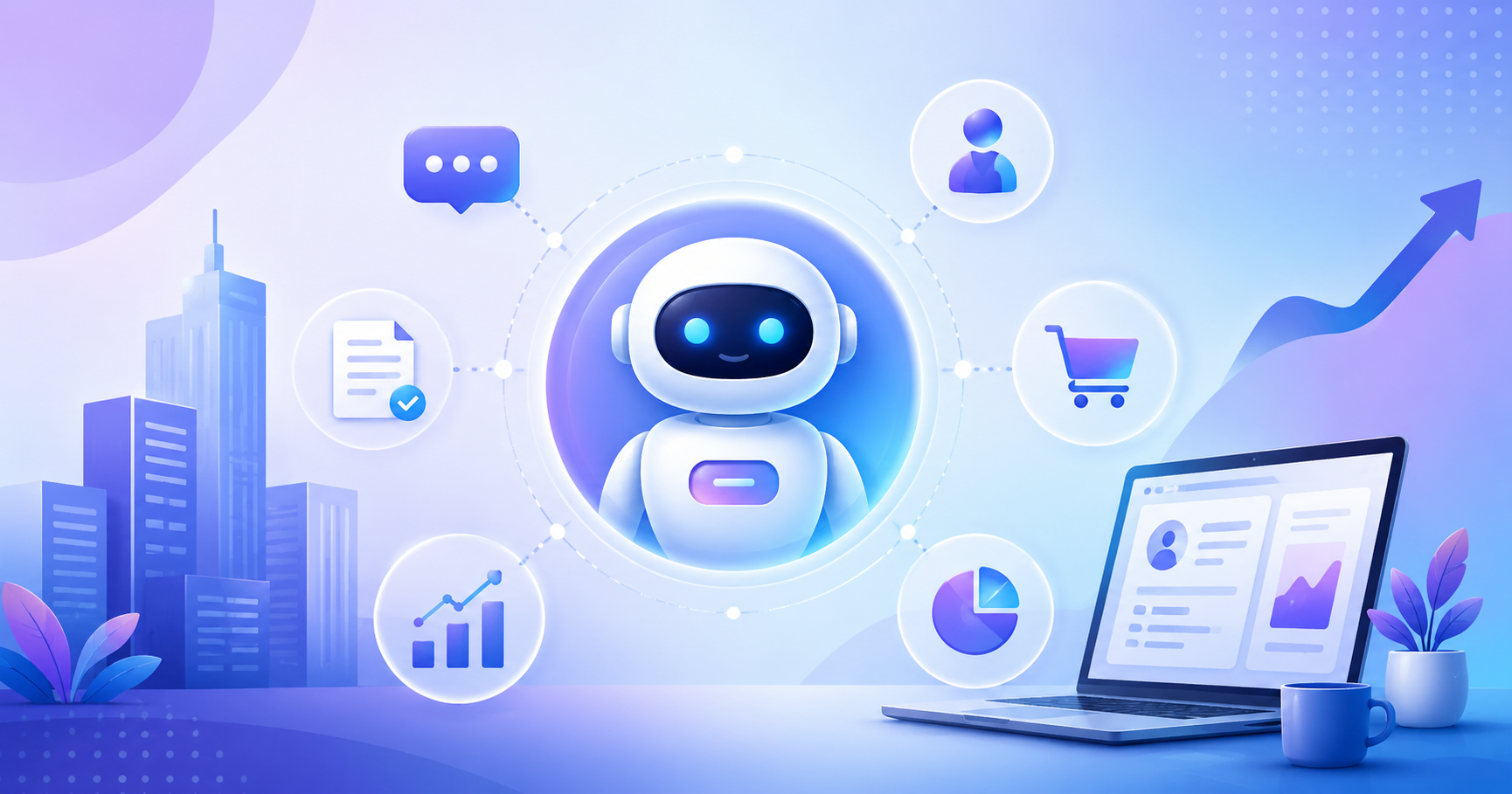
AI agents for business are software systems that can reason through multi-step problems, use tools, make decisions, and execute workflows autonomously without requiring a human to approve each action. They're already handling real work across finance, HR, supply chain, and customer operations. And contrary to the dominant narrative, the data shows they're expanding what teams can do, not shrinking how many people do it.
That distinction matters because most organizations evaluating AI agents in 2026 are asking the wrong first question. Instead of "will this replace someone?", the more useful question is: "what work is currently slow, expensive, and bottlenecked by manual steps that shouldn't require human judgment?" That's where AI agents for business deliver the clearest return, and understanding what they actually are makes all the difference.
What Are AI Agents, and How Do They Differ from Traditional Automation?
The term "AI agent" gets used loosely, so it's worth being precise. An AI agent is a system that perceives its environment, reasons about what to do next, takes actions using connected tools or APIs, and adjusts based on feedback, all without explicit step-by-step instructions for every situation.
That's meaningfully different from the automation most businesses already have.
From Rule-Based Bots to Reasoning Agents
Traditional robotic process automation (RPA) follows deterministic scripts. It clicks button A, reads field B, writes to spreadsheet C. It works well when a process is perfectly consistent and never deviates. When it hits something unexpected (a field that moved, a document in a different format, a missing value) it stops or fails silently.
AI agents handle ambiguity. They can read an invoice in an unfamiliar layout, recognize that a vendor name doesn't match the expected format, look it up in a connected system, reconcile the discrepancy, and flag the one remaining case that actually needs human review. The difference is not intelligence for its own sake. It's the ability to complete variable, judgment-adjacent work without constant human supervision.
According to Gartner, 40% of enterprise applications will include task-specific AI agents by the end of 2026, up from less than 5% in 2025. That's not a slow adoption curve. It reflects organizations discovering that agent capabilities have crossed a practical threshold: they're reliable enough to hand real work to.
The Key Capabilities That Make Agentic AI Different
Three capabilities separate AI agents from earlier automation:
Multi-step reasoning. An AI agent can break a complex goal into a sequence of sub-tasks, execute them in order, and revise the plan when an intermediate step returns an unexpected result. A cash reconciliation agent, for instance, doesn't just match records. It investigates discrepancies, checks transaction histories, cross-references vendor databases, and generates a resolution summary.
Tool use. AI agents can interact with external systems: databases, APIs, email, calendars, ERPs, CRMs. They're not confined to a single application. A well-integrated agent can pull data from five systems, make a decision, write a result to a sixth, and send a notification in one uninterrupted workflow.
Self-correction. When an action fails or produces an unexpected output, agents can diagnose what went wrong and try an alternative approach. This is what makes them suitable for processes that occasionally break in unpredictable ways.
These capabilities don't require replacing existing systems. Most organizations deploy AI agents as a layer on top of the infrastructure they already have, connecting them to the same ERPs, CRMs, and databases their teams already use. For a deeper look at how this integration works in practice, our AI integration services page covers the architecture patterns we see most commonly.
Where AI Agents for Business Are Delivering Real Results
Across industries, four operational areas are generating the clearest ROI from AI agent deployments in 2026. What follows isn't theoretical; each has documented examples and measurable outcomes.
Finance and Accounting
Finance operations are built on repetitive, rule-adjacent work: reconciliations, approvals, exception handling, reporting. These are exactly the conditions where AI agents perform well.
A cash management agent can analyze daily bank statements, match transactions against internal records, identify discrepancies, apply resolution logic for common exception types, and escalate the ones that need human review, all before the finance team starts their day. Industry data from enterprise deployments shows up to 70% reduction in the time finance teams spend on manual cash positioning tasks.
At the more complex end, JPMorgan's agentic systems now generate investment banking presentations in roughly 30 seconds, work that previously occupied junior analysts for several hours. The analysts haven't been replaced; they've moved to reviewing, refining, and advising on the output rather than producing it.
HR and People Operations
High-volume, structured tasks in HR (screening resumes against job criteria, scheduling initial interviews, sending status updates to candidates, triggering onboarding workflows) map cleanly onto what AI agents can do autonomously.
A recruitment agent can screen an inbound pipeline of 300 applications, score candidates against defined criteria, schedule qualifying calls for the top tier, send personalized status responses to others, and surface a prioritized shortlist to the hiring manager. What used to be two to three days of coordinator work happens before anyone opens their inbox.
The same logic applies to onboarding. An agent can trigger the right provisioning workflows, assign training modules based on role, and follow up on incomplete steps, without the People Operations team manually tracking each new hire through a checklist.
Supply Chain and Logistics
Supply chain disruption is expensive and often preventable. The problem is that the signals (a supplier delay, a weather event, a port backlog) arrive faster than human planners can process and act on them.
Microsoft's research on agentic AI in supply chains describes orchestrator agents that continuously monitor supply chain signals, identify disruptions autonomously, find alternative suppliers, re-route shipments, adjust procurement orders, and execute contingency plans across interconnected systems in a single coordinated response.
Walmart's supply chain AI ingests real-time sales data from thousands of stores and fulfillment centers and makes autonomous replenishment decisions without human approval loops. The human role shifts to setting policy, reviewing outcomes, and handling edge cases the agent flags.
Customer Operations
Tier-1 customer support is high volume, repetitive, and follows decision trees that most support agents could navigate in their sleep. It's also the area where slow response times most directly damage customer experience.
AI agents handle the full resolution cycle for common request types: account queries, order status checks, returns initiation, password resets, billing questions. They escalate to a human only when the situation falls outside their resolution scope or when a customer requests it.
Sema4.ai's enterprise case data shows organizations achieving 60–80% reductions in routine task handling time after deploying customer-facing agents. The support team's time reallocates toward complex cases, escalations, and relationship-sensitive interactions, the work that actually requires human judgment.
The Workforce Reality: What the Data Actually Shows
The job-displacement narrative around AI agents is louder than the evidence warrants. Here's what the analyst data actually says.
McKinsey's November 2025 State of AI report found that 43% of executives expect no change in overall workforce size from AI adoption. Only 32% expect decreases, and of those, fewer than 20% report decreases of 3% or more in most functions. The plurality outcome, across most roles and industries, is no net headcount change.
Gartner's May 2026 analysis is more pointed: "Organizations that improve ROI are not those that eliminate the need for people, but those that amplify them by aggressively investing in skills, roles, and operating models that allow humans to guide and scale autonomous systems." They go further: "Long term, autonomous business will create more work for humans, not less."
PwC's AI Agent Survey found that 48% of executives expect to increase headcount because of the changes AI agents bring. The roles being created are different: agent architects, performance engineers, AI governance leads, and oversight specialists are appearing across organizations that have moved past pilot deployments.
What Actually Changes in How Work Gets Done
The more accurate framing isn't "jobs disappear"; it's "what counts as a job changes." A finance analyst who used to spend 40% of their week on reconciliation work now spends that time on analysis, forecasting, and advising the business. The output expectation increases. The nature of the contribution shifts.
This is disruptive for individuals who don't adapt. But at the team level, organizations that understand this are not running leaner. They're running more capable teams at the same or slightly higher headcount, with meaningfully higher output per person.
For a broader look at how this mirrors what's happening in software development partnerships, our post on whether AI is replacing outsourcing covers the same dynamic from a delivery team perspective.
What a Successful AI Agent Deployment Looks Like
Most AI agent deployments that struggle do so for reasons that are visible before the first line of code gets written. Getting the foundation right matters more than the technology choice.
Starting with the Right Process
The processes where AI agents consistently deliver are high-volume, rule-adjacent, and low on genuine ambiguity. The test: can you describe the process in a decision tree? Could a well-trained junior employee follow it reliably on day two? If yes, it's a candidate.
If the process requires institutional judgment, relationship context, or decisions that depend on organizational politics, it's not a good first target. Not because agents can't participate (they can surface data and draft options), but because the value of automation comes from removing the human from the loop on routine steps, and that only works when the routine steps are actually well-defined.
High-value starting points across most organizations: invoice processing, candidate screening, customer request triage, report generation, data reconciliation, and internal IT ticketing.
Integration with Existing Systems vs. Greenfield Builds
Most AI agent deployments connect to systems that already exist. The agent doesn't replace the ERP; it reads from and writes to it. This is both an advantage and a constraint: the quality of the agent's output is partly a function of the quality and accessibility of the data it can reach.
Organizations with clean, well-structured data in accessible APIs deploy agents faster and get better results. Organizations with fragmented data across legacy systems often find that the data engineering work is the longer phase of the project. Our business process automation service includes a process mapping and data readiness assessment specifically because this step is where most projects either accelerate or stall.
The enterprise application development trends post on this blog covers the underlying infrastructure choices (cloud-native architecture, API design, data pipelines) that make agent integration faster and more reliable.
Governance and Human-in-the-Loop Checkpoints
An AI agent operating without oversight in a consequential process is not a best practice, regardless of how well it performs in testing. Governance means knowing what the agent can decide autonomously, what requires a human sign-off, how decisions get logged, and what happens when the agent hits a case it wasn't designed for.
According to PwC, 60% of businesses do not fully trust AI agents to perform tasks autonomously, and 28% rank lack of trust as a top-three challenge. That's not irrational caution; it reflects appropriate skepticism about systems that are still being calibrated to specific organizational contexts.
The practical implication: build human-in-the-loop checkpoints into the workflow design from the start. Define the exception types that always route to a human. Build audit logs. Create a review cadence for edge cases the agent flagged. Treat governance as part of the deployment, not an afterthought to be added when something goes wrong.
Where to Start if You're Evaluating AI Agents for Business Operations
The difference between organizations that get real returns from AI agents and those that spend budget on pilots that never scale usually comes down to one thing: how well they defined the problem before choosing a solution.
The right starting point is identifying the processes in your operations that meet three criteria: they're high-volume, they consume skilled time on work that shouldn't require skill, and there's a clear definition of a correct output. Those three conditions predict agent performance better than any technology feature comparison.
If you're at the stage of evaluating which processes fit that profile, how your current data infrastructure affects deployment timelines, or what governance looks like for an agentic system in your specific context, that's exactly the kind of assessment our AI consulting services team works through with clients. We also build and deploy the agents themselves through our AI/ML development services and business process automation practice.
The question isn't whether AI agents have a place in your operations. The question is which problem you want to solve first.
Frequently asked questions
AI agents for business are software systems that can plan, reason, and execute multi-step workflows autonomously by connecting to tools, APIs, and data systems. Unlike rule-based automation, they handle variable inputs and adjust their approach based on intermediate results. In practice, they're deployed to handle high-volume operational work (reconciliation, candidate screening, customer triage, supply chain replanning) and escalate to humans only for exceptions.
The data from Gartner, McKinsey, and PwC consistently points toward augmentation rather than replacement as the dominant outcome. McKinsey's 2025 State of AI report found 43% of executives expect no headcount change, and Gartner's 2026 analysis explicitly states that organizations achieving the best ROI are those that amplify human workers rather than eliminate them. New roles (agent architects, AI governance leads, oversight specialists) are appearing alongside agent deployments.
Processes that are high-volume, rule-adjacent, and have clear criteria for what constitutes a correct outcome are the strongest fits. Invoice reconciliation, candidate screening, customer request triage, internal report generation, IT ticketing, and supply chain exception handling all meet this profile. Processes that require institutional judgment, relationship context, or political awareness are less suited for full autonomy; agents can assist, but shouldn't run the whole workflow unsupervised.
Traditional RPA follows deterministic scripts and breaks when it encounters anything outside its predefined rules. AI agents reason about what to do next, handle variable inputs, use multiple connected tools in sequence, and self-correct when a step fails. The practical difference: RPA handles the same task the same way every time; an AI agent handles the task even when the inputs vary, the format changes, or a system returns an unexpected result.
Timeline depends heavily on data readiness and process complexity. A well-scoped, single-process deployment (say, invoice processing in a finance team with clean ERP data) can reach production in 6–10 weeks. More complex multi-system deployments with significant data preparation work typically run 3–6 months. The longest phase is usually not the AI development itself; it's the process mapping and data integration work that precedes it.