
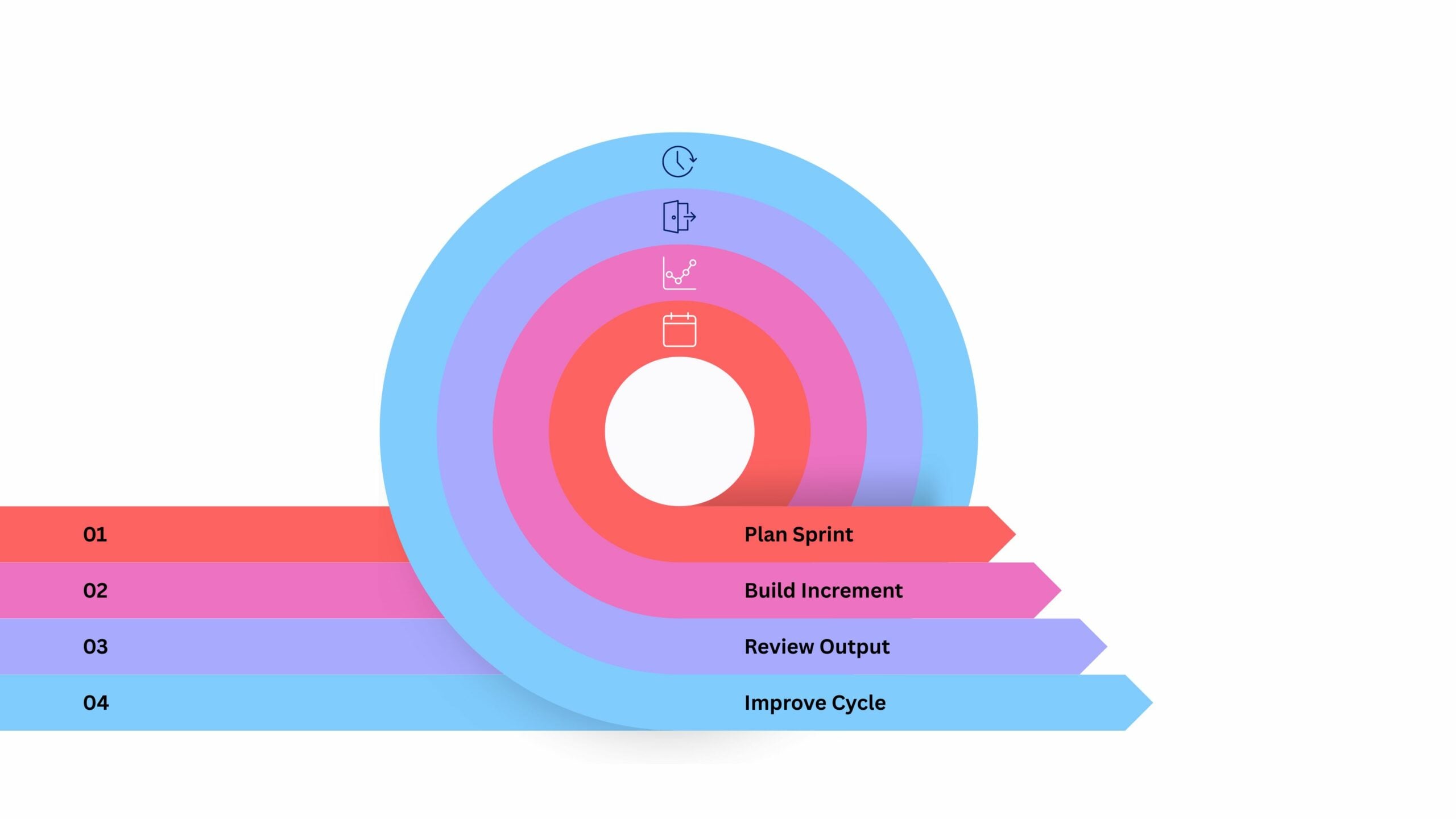
Key Principles of Agile Project Management
Have you ever been part of a project that felt doomed from the start? You spend months creating a perfect plan, but the moment work begins, a deadline shifts, the client wants a new feature, and the final result is delivered late and isn’t even what people wanted anymore. This common frustration highlights a key flaw: trying to plan for everything upfront often fails. But what if there was a way to work that embraces change instead of fighting it?
That’s the core promise of an Agile philosophy. Imagine building a Lego castle: instead of a 500-page blueprint, you build one small tower, show it to friends, and use their feedback to decide what to build next. This adaptive approach is the essence of what Agile means in business. It isn’t a complex system but a common-sense mindset that allows teams to respond to change, reduce wasted effort, and consistently deliver what truly matters.
The ‘One-Piece-at-a-Time’ Rule: Building Value Incrementally
The traditional way to run a project is like planning a huge road trip down to the last turn—you create the entire map before starting the car. If you hit an unexpected traffic jam or a better route appears, you’re stuck with the original, outdated plan. It’s an all-or-nothing gamble.
Agile flips this with a method called iterative development. Instead of one long journey, you plan your trip in a series of short drives from one city to the next. At each stop, you can check the map, get local advice, and confirm you’re still headed in the right direction. This approach drastically reduces risk.
By delivering a small, finished piece of the project early, you get real feedback immediately. This prevents a team from spending months building something only to discover it wasn’t what anyone actually wanted. The ‘one-piece-at-a-time’ rule ensures you are creating real value constantly, not just hoping for it at the finish line.
What is a ‘Sprint’?: Your Project’s Two-Week Mini-Mission
The ‘one-piece-at-a-time’ approach gets organized into short, focused work cycles called “Sprints.” A Sprint is a mini-project with a hard deadline, usually one to four weeks long, where the team concentrates on completing one specific goal. The point isn’t just to be busy; it’s to get something tangible finished.
This strict time limit is a crucial feature called time-boxing. The deadline doesn’t move, which creates a predictable rhythm and forces the team to be realistic about what it can achieve. Instead of a project dragging on indefinitely, Sprints ensure there is a clear finish line every couple of weeks.
Critically, a Sprint is defined by a goal, not a random to-do list. The aim is to create a small, usable outcome, shifting the team’s focus from “working on” something to “delivering” it.
- Sprint Goal: “Create a functioning login page.”
- vs. Traditional Task: “Work on user authentication.”
- Sprint Goal: “Launch one marketing email and measure results.”
- vs. Traditional Task: “Develop Q3 email strategy.”
At the end of each Sprint, the team has a finished piece of work to show for its efforts. But with a whole project’s worth of things to do, how does a team decide what to tackle next?
The Prioritized To-Do List: How Agile Teams Decide ‘What’s Next’
Agile teams know what to work on in each Sprint by pulling from a master plan called the Product Backlog. Think of it as the ultimate, evolving to-do list for the entire project. Instead of being a chaotic jumble of ideas, the Backlog is a single, organized list where the most important items are always kept at the very top.
Keeping that list in the right order is a vital job that falls to one person in a role called the Product Owner. This individual acts as the voice of the customer and the business. Their focus is to make sure the team’s time is spent on features that matter most, providing clear direction and shielding the team from conflicting requests. This ensures every Sprint delivers genuine value.
The simple rhythm—the Product Owner prioritizing the Backlog and the team delivering the top items each Sprint—is the engine of an Agile project. This process is powerful because the Backlog isn’t set in stone; it’s a living document that changes as the team learns more.
The Power of the Daily Check-In and Constant Feedback
Staying on track requires a constant rhythm of communication. This isn’t about more meetings for the sake of meetings; it’s about making every conversation count.
Internally, this starts with a quick, 15-minute huddle each morning called the Daily Stand-up. The goal isn’t to report progress to a boss but for team members to sync up by answering three questions for each other: What did I do yesterday? What will I do today? Is anything blocking my progress? This keeps the team aligned and helps them solve problems fast.
Then, at the end of every Sprint, the team holds a Sprint Review. This is the most crucial feedback moment. It’s not a presentation about plans; it’s a live demonstration of the actual work they just finished. They show the new feature or finished draft to customers and stakeholders to get immediate, real-world reactions.
This rhythm of daily check-ins and end-of-sprint demos creates a powerful cycle of continuous feedback. Instead of waiting months to find out if you’re on the right track, you’re making small course corrections every day and major ones every couple of weeks.
Start Thinking Agile Today: Your First Small Step
Agile is a practical approach that turns uncertainty into an advantage. It trades a fixed, fragile plan for a flexible path forward built on incremental value, constant feedback, and short Sprints guided by a prioritized backlog.
Putting this into practice is simpler than you think. The next time you start any task, from a work assignment to a personal goal, ask yourself one question: “What is the smallest possible version of this I can complete to get feedback?”
That single question is the key to transforming big risks into small, manageable wins and building a true agile culture, one success at a time.