
Forget Horsepower, It’s About Processing Power
What our team saw at IAA Mobility 2025 in Munich, and what the shift to software-defined vehicles means for engineers building OTA, AI and MaaS systems.

Volodymyr KhitsiakSenior Marketing Manager
Published · Updated
Share
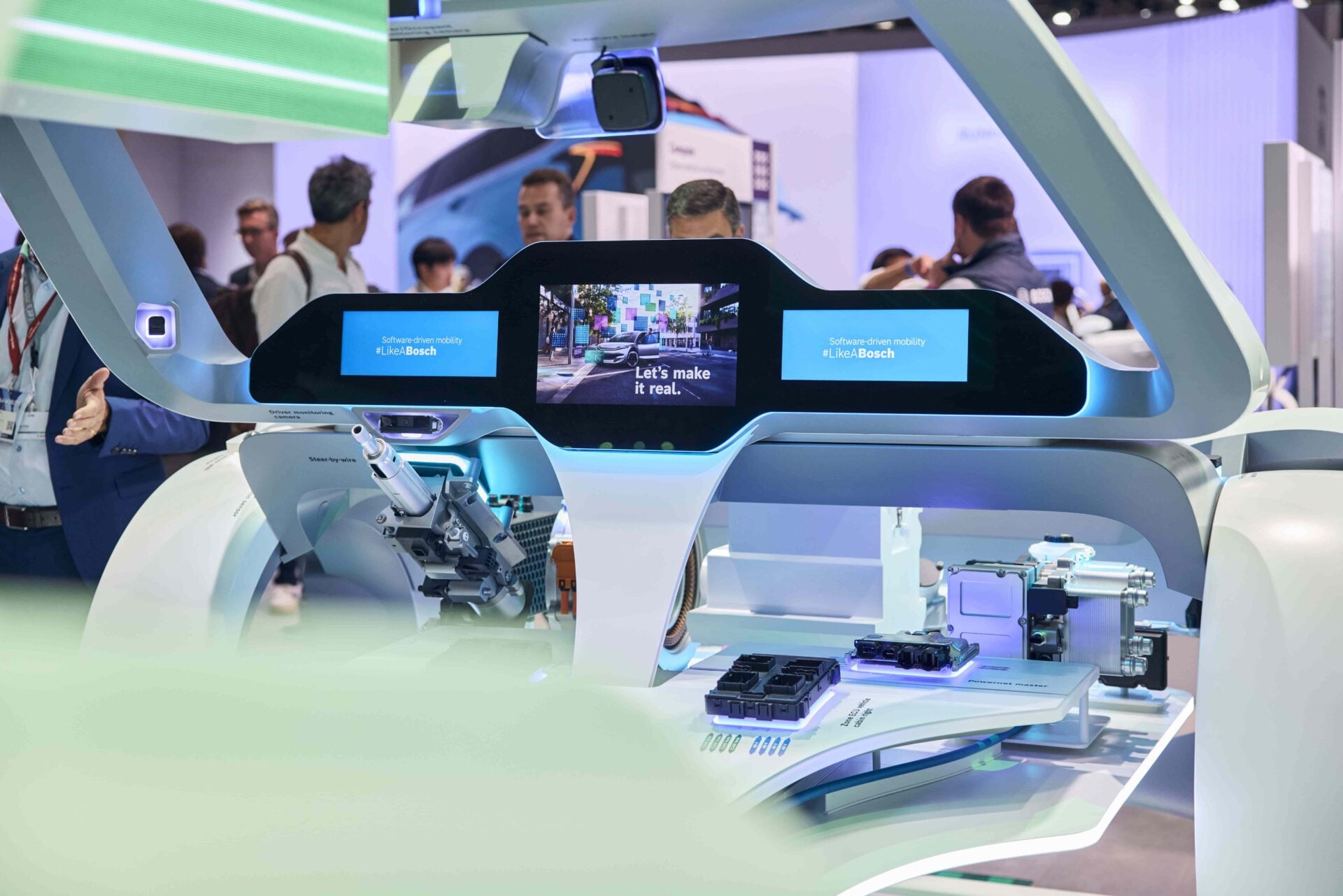
The soul of a modern car is its software. That was the single clearest takeaway when our Senior Marketing Manager Volodymyr Khitsiak attended IAA Mobility 2025 in Munich, getting hands-on with the future across several days on the show floor. Cars are no longer static hardware products; they are connected, updatable platforms that improve through software long after leaving the factory, and that shift is opening significant opportunities for software teams across the industry.
Table of Contents
- A New Kind of Show Floor
- Germany Is All In on Electric
- The Real Star of the Show: Software
- What Is a Software-Defined Vehicle?
- The Market Is Already Moving
- The Road Ahead for Software Engineers
- Frequently Asked Questions
A New Kind of Show Floor
The first thing that struck our team about IAA Mobility 2025 was the format itself. The most successful and crowded spaces, including the "Open Space" concept spread across Munich's city center, weren't the ones with cars roped off behind barriers. They were the ones where people could get their hands on things: test-drive vehicles, interact with interfaces, try the technology directly. People don't just want to look at the future of mobility anymore; they want to experience it. That appetite for interaction is itself a signal about where the industry is heading.
The atmosphere confirmed what product teams building automotive software have known for years: user experience is now a primary differentiator in vehicles, not an afterthought. The quality of the interface, the responsiveness of the system, the intuitiveness of the controls, these things are shaping purchase decisions as much as any mechanical specification.
Germany Is All In on Electric
There was a strong sense of national purpose throughout the event. Listening to German Chancellor Friedrich Merz speak, the message was unambiguous: Germany's goal isn't to participate in the electric revolution but to lead it. He pointed to IAA as proof of the industry's "innovative strength" and emphasized that the country must not lag behind Asia in the transition to electric mobility.
The infrastructure commitment backs that ambition. Aggressive plans were on display for fast-charging points on motorways, alongside innovative pilots for residential and bidirectional charging. The foundation for a connected, electric future is being built at the national level, not just the product level.
That urgency reflects a real global shift. By the end of 2025, electric vehicles accounted for 25% of all new car sales globally, according to the International Council on Clean Transportation. In Europe's top five markets (France, Germany, Italy, Spain, and the UK), the new-energy vehicle share reached 23% in Q2 2025 alone. The electric transition is happening faster than most industry forecasts predicted five years ago.
The Real Star of the Show: Software
Beyond the EVs and the charging infrastructure, the most profound shift at IAA was in the conversation itself. The automotive industry has moved past debating whether to go electric. The question now is how to build holistic Mobility as a Service (MaaS) ecosystems, where software is the core product and the vehicle is the delivery mechanism.
A speaker from Bosch captured the moment precisely. Future vehicles, he said, will "constantly learn by means of artificial intelligence," and software updates will never stop. That observation deserves some unpacking, because it describes something genuinely new in the history of the automobile.
The car you buy today is not a finished product. It's a platform. Over-the-air (OTA) updates will add features, patch vulnerabilities, and improve performance long after the vehicle leaves the assembly line. In that sense, it's closer to a smartphone or a cloud service than anything the automotive industry has built before. The software team becomes, in effect, permanently responsible for the product's quality and capability, even after the sale.
What Is a Software-Defined Vehicle?
A software-defined vehicle (SDV) is one where most core functions are controlled, updated, and improved through software rather than being fixed in hardware at the point of manufacture. This includes driver assistance systems, infotainment, battery management, safety features, powertrain behavior, and increasingly, vehicle dynamics.
The practical implication is a complete change to the product lifecycle. Traditional vehicles depreciated in capability over time because hardware was fixed. An SDV can gain new capabilities years after production. A firmware update can improve range efficiency. A software patch can add a new safety feature. A subscription unlock can enable hardware capabilities that were always present in the vehicle but held in reserve.
This model is already established in the EV space, but the SDV concept extends to all vehicle types. Automakers increasingly see post-sale software revenue as a major component of long-term profitability, with feature subscriptions, fleet management tools, and AI-driven personalization all becoming standard parts of the business model alongside the hardware sale.
The Market Is Already Moving
The market data confirms that the software-defined vehicle era is well underway. The global SDV market was valued at approximately $61.7 billion in 2025, according to Future Market Insights, with strong growth projected through the end of the decade driven by centralized computing architectures, OTA capabilities, and subscription-based features becoming standard across vehicle segments.
The automotive OTA updates segment alone was valued at $5.2 billion in 2025 and is forecast to reach $25 billion by 2035, a compound annual growth rate of 17%, per Future Market Insights analysis. The broader automotive software market reached $19.28 billion in 2025 and is projected to grow to $30.28 billion by 2030 at a 9.45% CAGR, according to Mordor Intelligence.
These figures represent investment already flowing into automotive software development, not future projections. Every major automaker has either launched or accelerated a dedicated software division. Volkswagen created Cariad. BMW has its own software engineering organization. Stellantis and GM are making similar structural moves. The race to build the software layer of the next vehicle generation is actively underway.
The Road Ahead for Software Engineers
What IAA Mobility 2025 made clear is that the automotive industry needs software talent at a scale it has never needed before. The Bosch speaker's prediction about AI-driven continuous learning isn't aspirational; it's already being built into production vehicles. For software engineering teams, the opportunities span several areas.
AI and machine learning systems. Vehicles need onboard inference for driver assistance, anomaly detection, and adaptive behavior. The AI layer needs to work reliably across diverse environments, hardware configurations, and edge cases, with strict latency and safety requirements that differ significantly from typical enterprise AI deployments.
OTA infrastructure. Secure, reliable update delivery for vehicles in the field is a complex distributed systems problem. A botched OTA update to a moving vehicle is not a minor UX issue; it's a safety event. Building update pipelines that are atomic, verifiable, and rollback-capable requires serious systems engineering.
Digital twins and simulation. Automakers use digital replicas of vehicles and entire fleets to test software changes before pushing them live. Building and maintaining accurate digital twin systems requires real-time data pipelines, physics modeling, and close collaboration with hardware teams.
MaaS platforms. Mobility as a Service backends require the kind of cloud architecture, API design, real-time routing, and payment integration that custom software teams are well-positioned to build. These platforms connect vehicles, users, operators, and infrastructure into a single coherent system.
The shift from hardware engineering to software engineering as the primary automotive value driver is one of the more consequential industry transitions underway. For software teams with the right capabilities, it represents a meaningful expansion of the addressable market. You can explore unicrew's automotive software development practice to see where our team focuses within this space, or look at our AI/ML development services for the intelligent systems layer specifically.
If you're thinking through the broader technology transformation happening across industries, our pieces on technology platforms reshaping proptech and navigating software compliance in regulated industries cover adjacent territory worth reading alongside this one.
The Bottom Line
The future of mobility is not just electric or autonomous. It's software-defined. What our team saw at IAA Mobility 2025 confirmed that the competitive advantage in the automotive industry no longer lives under the hood; it lives in the codebase.
For engineering teams building the next generation of automotive experiences, the window to develop relevant capability is now. The investments automakers are making in software infrastructure today will determine who powers the vehicles of the next decade. If you're thinking about how your software practice fits into that picture, our automotive solutions page is a good place to start the conversation.
Sources
Frequently asked questions
A software-defined vehicle is one where core functions, including safety systems, infotainment, drivetrain management, and driver assistance, are controlled primarily through software rather than fixed hardware. This allows manufacturers and fleet operators to update, improve, and add capabilities to vehicles over the air throughout their operational life, rather than only at the point of manufacture.
The global SDV market was valued at approximately $61.7 billion in 2025, per Future Market Insights. The automotive OTA updates segment alone is forecast to grow from $5.2 billion in 2025 to $25 billion by 2035, at a 17% compound annual growth rate. The broader automotive software market is projected to reach $30.28 billion by 2030.
Mobility as a Service refers to integrated platforms that combine multiple transportation modes, including ride-sharing, public transit, rental, and micro-mobility, into a single on-demand service. Rather than owning a vehicle, users access transportation through subscription or per-trip models, with software coordinating availability, routing, and payment across providers.
The highest demand areas include secure OTA update infrastructure, onboard AI and machine learning for driver assistance and personalization, digital twin platforms for pre-deployment testing, and MaaS backend systems. Cybersecurity for connected vehicles is also a growing requirement, as remote update capabilities create new attack surfaces that need rigorous protection.