Why Eastern Europe for Tech Talent? Ukraine and Poland Explained
Eastern Europe tech talent offers 40–60% cost savings with no quality trade-off. Here's the case for Ukraine and Poland as a combined engineering strategy.
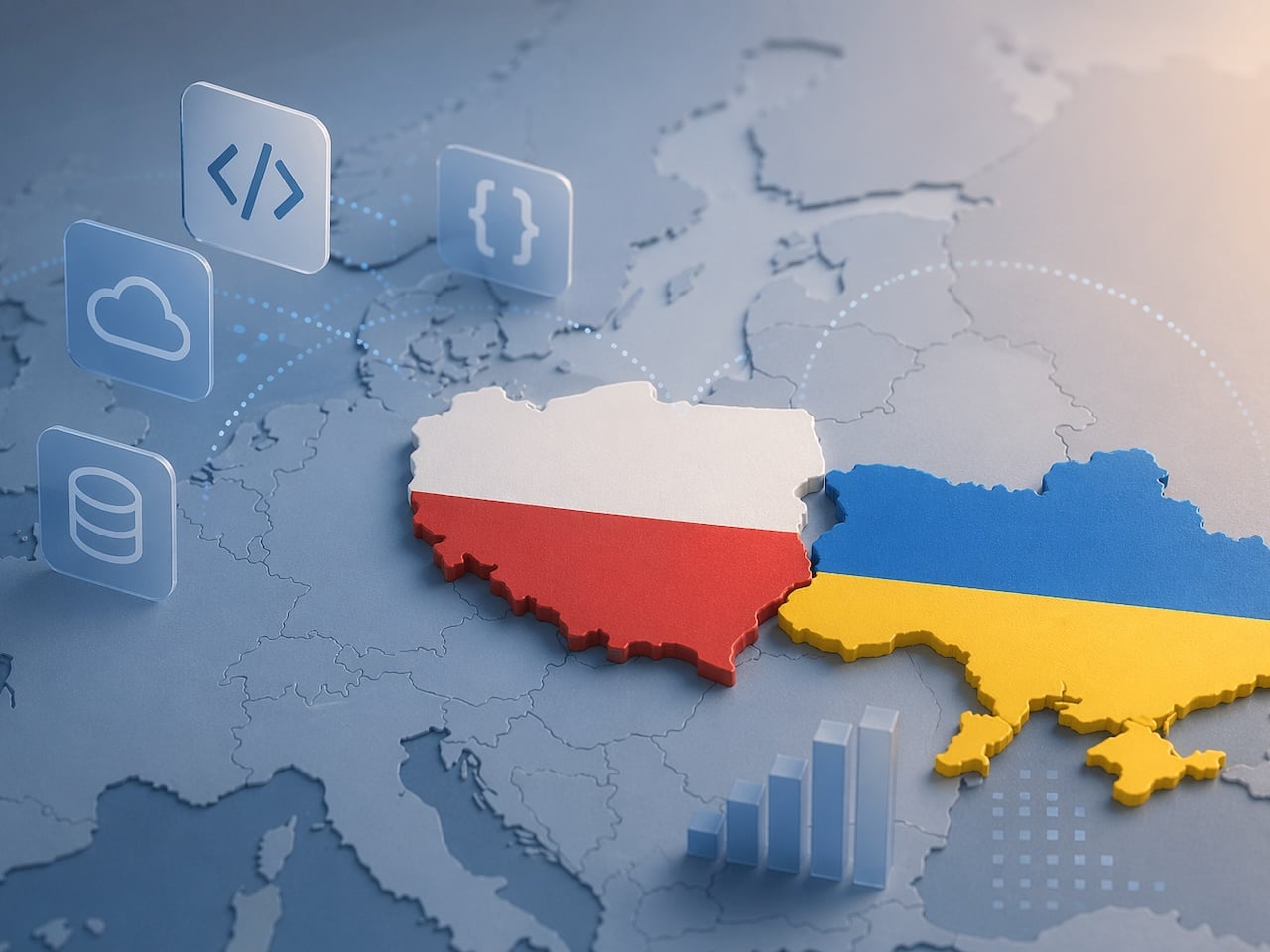
Eastern Europe tech talent offers 40–60% cost savings over Western markets without the quality trade-off. Ukraine and Poland are the region's two strongest markets: Ukraine for engineering depth and technical specialisation; Poland for EU-native compliance, senior-level scale, and operational stability. The companies getting the most from the region treat the two as complementary, not competing.
The conversation has been running for two decades, which means it carries outdated assumptions alongside legitimate ones. This post cuts through both and makes the specific case for why Ukraine and Poland together consistently outperform picking one or the other.
Why Eastern Europe Still Earns the Conversation
Eastern Europe's IT recruitment market grew from $9.93 billion in 2020 to $14.39 billion in 2024, with projections reaching $23.69 billion by 2028, according to Index.dev's 2025 market analysis. That is not a niche industry growing on hype. It is a region that has spent thirty years building technical education systems, growing engineering communities, and proving itself to clients across North America and Western Europe.
The cost advantage remains real, but it is no longer the primary story. Mid-to-senior engineers in Ukraine and Poland typically bill at $30–$70 per hour, compared to $100–$200 in the US and UK (Devico, 2026). For a ten-person engineering team, that gap compounds into a meaningful budget difference, fast. But rate arbitrage is table stakes at this point.
What distinguishes the region is what those rates buy. Ukrainian developers rank 11th globally by HackerRank's technical assessments. Polish developers rank first globally in Java on the same platform. 77.4% of tech companies hire remote talent in Eastern Europe, and 82.9% cite cost efficiency as the reason they started, according to Technology.org. What keeps them there is quality. These are not marketing claims; they are measurable outputs from technical assessments across hundreds of thousands of developers worldwide.
The more relevant question for engineering leaders in 2026 is not whether Eastern Europe delivers. It does. The question is how to structure the engagement to get the most out of it.
Ukraine's Engineering Depth
Ukraine's IT sector exported $6.45 billion in services in 2024 (National Bank of Ukraine) and grew a further 2.4% through the first eleven months of 2025, maintained through significant geopolitical disruption. That track record reflects a workforce built on practical depth, not cheap labour. Here is what the numbers show:
| Criteria | Detail |
|---|---|
| Talent pool | ~340,000 tech specialists; 20,000 STEM graduates entering the workforce annually (N-iX, 2025) |
| Self-training pipeline | 821,300 non-formal IT completions (2019–2024) vs 180,400 university graduates: industry self-trains at 4x the formal rate |
| IT export revenue | $6.45B in 2024; US accounts for 37.2% of total export volume (National Bank of Ukraine) |
| Global technical ranking | 11th worldwide on HackerRank developer assessments |
| English proficiency | 85% at intermediate level or above |
| Gender diversity | 28.3% women (vs European average of 16%) |
| Developer rates | $25–$80/hr mid-to-senior, depending on stack and seniority |
| Operational resilience | IT exports grew 2.4% YoY through first 11 months of 2025 despite ongoing conflict |
| Leading technical domains | AI/ML, cybersecurity, cloud architecture, fintech |
A market that has maintained and grown its export base under these conditions has proven something a smooth-market competitor cannot: it adapts. For clients who need specialists in AI, security, or fintech rather than generalists, Ukraine's depth in those domains is a genuine differentiator built over years of demanding client work.
Poland's Stability and Scale
Poland is not the cheapest option in Eastern Europe. It is the most mature, which is a different value proposition, and a more sustainable one for clients with complex or long-running product requirements. With the largest talent pool in the CEE region and the most established enterprise delivery culture, here is what Poland brings to the table:
| Criteria | Detail |
|---|---|
| Talent pool | 850,000+ tech professionals; 45,000+ IT graduates annually (Alcor BPO, 2025) |
| Global technical ranking | #1 in Java worldwide on HackerRank |
| Legal and regulatory framework | EU member (GDPR-native, EU contract law, IP protections); NATO member |
| Developer rates | $30–$70/hr mid-to-senior |
| Market size | $9.75B (2024); projected $13.14B by 2029 at 6.14% CAGR |
| Fastest-growing roles | Security +39% YoY, Data and BI +34%, AI and product management double-digit growth (ITCompare.pl, 2025/2026) |
| Senior concentration | Ongoing migration of senior developers from regional markets has deepened principal-level talent |
| Leading technical domains | Enterprise Java, security engineering, data, AI |
| Market maturity | Longest-established IT outsourcing market in CEE; major global tech firms have significant engineering presence |
For companies serving European markets or operating in regulated industries, Poland's EU-native compliance removes a compliance layer that other Eastern European markets cannot fully address. For clients assessing multi-year commitments to an engineering location, its NATO membership and Western-aligned legal framework change the risk profile of that decision.
Why Combining Both Beats Choosing One
The standard framing across the outsourcing market is Ukraine or Poland. That is the wrong question.
The two countries have genuinely complementary profiles. Ukraine provides engineering depth, strong specialisation in AI, cybersecurity, and fintech, and competitive rates that make scaling teams cost-efficient. Poland provides EU-native compliance, senior-level concentration, and operational reliability backed by stable political and legal frameworks. Together, they deliver what neither country fully provides on its own.
Risk distribution across markets. Concentrating an engineering team entirely in one country, any country, is an operational risk. Distributing that team across two markets with different stability profiles and talent concentrations creates natural continuity. If one market faces disruption, the other absorbs without full exposure. This is not a theoretical hedge; it is an operational architecture that clients in regulated and high-availability industries take seriously.
Surge capacity and specialisation within one model. Some engineering challenges need volume quickly; others need narrow, deep expertise. Ukraine's talent pool handles volume and specialisation in emerging domains. Poland's senior concentration handles depth and enterprise-grade delivery standards. A partner operating in both can calibrate the model to the actual requirement rather than forcing the requirement into whatever geography they happen to staff.
A single delivery layer across two markets. The real operational challenge of multi-country engineering is not talent acquisition; it is coordination, cultural alignment, and accountability. Running two separate vendor relationships across two countries introduces management overhead, inconsistent quality standards, and split accountability when problems arise. A partner who operates natively across both countries, with unified engineering practices and a single point of accountability, eliminates that friction while preserving the geographic advantage.
What to Look for in a Partner Operating Across Both Countries
Not every IT services firm with a presence in Eastern Europe operates there in a meaningful way. "Office in Warsaw" and "an integrated engineering team across Ukraine and Poland" are different things. When evaluating partners for a dual-country model, press on these four criteria:
- Single delivery framework across both markets. Partners who treat Ukraine and Poland as genuinely integrated environments, with unified practices, shared quality standards, and one point of accountability, reduce coordination overhead significantly. Partners who staff each country independently and leave the client to manage alignment are adding complexity, not removing it.
- Genuine engineering depth in each market. Not "do you have developers in Ukraine and Poland?" but: at what seniority levels, in what specialisations, across what domains? A partner with real depth in both markets matches talent to requirement. A partner with a thin presence in one country routes most work to wherever their real capability sits.
- Auditable quality governance. ISO 27001 (information security) and ISO 9001 (quality management) certifications indicate structured processes and consistent standards across geographies, not country by country. They do not guarantee delivery quality, but they signal the process discipline that makes quality repeatable.
- Client continuity over time. Longevity of relationships is one of the clearest signals that a delivery model works. Ask how long typical client engagements run and whether they tend to grow in scope.
unicrew operates with engineering and consulting teams across both Ukraine and Poland, alongside offices in the US, UK, and Azerbaijan. With 100+ senior engineers and consultants delivering for clients across 12 countries, the dual-country model is not a positioning statement for us: it is the delivery architecture we have built and refined in practice. Our ISO 27001:2022 and ISO 9001:2015 certifications apply across the full operation regardless of geography. For companies looking to build or scale engineering teams in Eastern Europe through a single, accountable partner, our team extension and staffing model covers how we structure that engagement. Our guide to hiring developers in Ukraine goes deeper on that specific market for those at an earlier stage of evaluation.
Conclusion
Eastern Europe's talent advantage is well-documented. What is less discussed is that the strongest way to access it is not choosing between Ukraine and Poland, but treating both as a single delivery ecosystem. Each covers gaps the other cannot fill, and a partner who operates natively across both removes the coordination overhead without sacrificing the geographic advantage.
Start with our guide to hiring developers in Ukraine to build your picture of the market, or go directly to our team extension page if you are closer to a decision.
Sources
- Index.dev: IT Recruitment in Eastern Europe, 2025 Market Insights
- National Bank of Ukraine / GTInvest: Ukraine IT service exports 2024–2025
- N-iX: Ukraine Tech Market 2025 Report
- Technology.org: Is Eastern Europe Still a Cost-Effective Talent Market in 2026?
- Alcor BPO: Poland Technology Sector
- ITCompare.pl: Most In-Demand IT Technologies in Poland 2025/2026
- HackerRank developer rankings, via DistantJob
- Scroll.media: Ukrainian Tech in the Fourth Year of War, IT Research Ukraine 2025
Frequently asked questions
Yes, substantially. Mid-to-senior engineers in Ukraine and Poland typically bill at $30–$70 per hour, compared to $100–$200 in the US and UK. That translates to 40–60% savings on comparable team composition (Devico, 2026). The cost advantage has narrowed slightly at the senior end as demand has increased, but remains significant across every seniority level.
Ukraine's IT sector has operated through significant disruption since 2022 and continued growing: IT service exports reached $6.45 billion in 2024 and grew a further 2.4% through the first eleven months of 2025. Most Ukrainian IT firms have invested heavily in distributed structures, backup infrastructure, and remote-first practices. Risk is real and should be factored in, which is exactly why pairing Ukraine with a more stable market like Poland within the same delivery model is a sound operational structure rather than a workaround.
Ukrainian developers show particular depth in AI and ML, cybersecurity, fintech, and cloud engineering. Polish developers lead in Java (ranked first globally on HackerRank) and show the strongest growth in security, data engineering, and AI roles. The profiles are genuinely complementary: Poland's enterprise-grade engineering culture alongside Ukraine's specialisation in emerging technical domains means a combined team covers more ground than either market alone.
A single partner with integrated operations in both countries typically delivers better outcomes than managing two separate vendor relationships. The coordination overhead of aligning two agencies on delivery standards, quality expectations, and security practices adds up quickly and creates split accountability when problems arise. A partner who operates natively across both markets provides the geographic advantage of diversification without the management complexity of multi-vendor coordination.